



- Apr 16, 2026
- 8
- 10
- Awards
- 2
- First Name
- Emily
Hey all — Emily from Widewail here. Wanted to share something from this week's REV, our weekly briefing on what the auto industry can learn about customer experience from millions of Google reviews. Every Thursday we Rank, Explore & Visualize automotive reputation & sentiment data, and this week's edition felt like one worth bringing here to get your take.
We will be publishing Reputation Healthscore rankings for Q1 next month, but today I wanted to give you a little teaser.
One brand, potentially surprising, made a big move: Mitsubishi.
It moved up eight spots, from #21 to #13. The score climbed primarily on response rate, which contributes to 30% of Widewail’s Healthscore calculation.
The mechanics behind the climb tie to what's been happening to the brand's ongoing dealer network restructuring: 35 store terminations in the past 18 months alone.
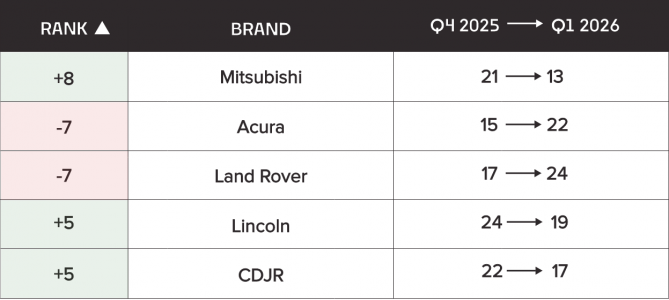
Q1's biggest rank movers, positive and negative, Q4 2025 → Q1 2026:
The Healthscore weighs monthly review volume (25%), lifetime review volume (15%), star rating (30%), and response rate (30%). What customers actually write in the reviews (topic-level content) is tracked separately.
Mitsubishi's response rate jumped from 86% to 92.1%. Monthly review volume rose. Star rating held strong at 4.6.
The other movers in the table were simpler. Lincoln and CDJR also climbed on response rate. Acura and Land Rover lost ground on both response rate and topic-level review data at once, the kind of stack that pulls a rank down hard.
By the score, Q1 was a strong quarter for Mitsubishi. But there's more to it than that, which we will cover next.
Two things happened at Mitsubishi while the reputation score was climbing.
First, the dealer network shrank, on purpose.
Mitsubishi has been actively restructuring its U.S. footprint, with 35 dealer terminations in the past 18 months under what CEO Mark Chaffin describes as a "quality over quantity" strategy: cutting lower performers and recruiting stronger, new-car-focused operators in their place.
Automotive News laid out the most recent details earlier this month.
When a brand restructures around stronger operators, the network's averages tend to rise, particularly on response rate, where the gap between higher and lower performing dealers is usually wide.
Mitsubishi's score climb is consistent with that math, though the data can't confirm the restructuring drove it. Healthscore captures that kind of structural movement. What's happening inside the stores that stayed is a separate question.
Second, underneath the climb, the topic-level review data tells a different story.
In Q1, industry-wide, the five subjects in reviews frustrating customers the most were the following:
Negative mentions of the Mitsubishi service department fell 23%, wait times fell 47.5%, car maintenance fell 11.8%.
Mitsubishi dealers are also operating under broader pressures: a sales mix heavily skewed toward fleet (about 60% of Q1 volume), a lineup anchored by a 15-year-old platform, and one-year residual values among the lowest in the industry. These aren't conditions that make selling easy.
Mitsubishi's Healthscore went up in the same window the dealer network got smaller. The two are consistent. The customer reviews show separate movement underneath. Both are true, but only one of them shows up in the Heathscore rankings.
The leaderboard tracks the restructuring. It doesn't track what's happening at the stores that stayed.
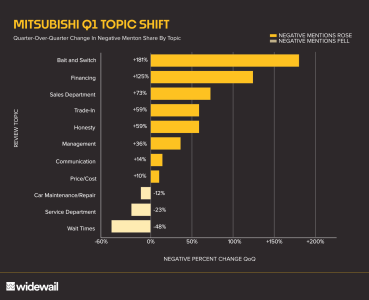
At Mitsubishi in Q1, complaints rose on the sales floor and fell in the service bay. The Healthscore composite doesn't track topic-level data, so the split doesn't show up in the rank.
Carvana's first seven franchise acquisitions tell a clear story in the data: response rates collapsed almost immediately after takeover, in some cases dropping straight to zero.
What works in a digital transaction doesn't automatically translate to managing the customer relationship after the car is over the curb.
See the full analysis.
See you next week - Emily, Marketing @Widewail
RANK
Mitsubishi Eight Spots Up, 35 Dealerships Gone
We will be publishing Reputation Healthscore rankings for Q1 next month, but today I wanted to give you a little teaser.
One brand, potentially surprising, made a big move: Mitsubishi.
It moved up eight spots, from #21 to #13. The score climbed primarily on response rate, which contributes to 30% of Widewail’s Healthscore calculation.
The mechanics behind the climb tie to what's been happening to the brand's ongoing dealer network restructuring: 35 store terminations in the past 18 months alone.
Q1's biggest rank movers, positive and negative, Q4 2025 → Q1 2026:
The Healthscore weighs monthly review volume (25%), lifetime review volume (15%), star rating (30%), and response rate (30%). What customers actually write in the reviews (topic-level content) is tracked separately.
Mitsubishi's response rate jumped from 86% to 92.1%. Monthly review volume rose. Star rating held strong at 4.6.
The other movers in the table were simpler. Lincoln and CDJR also climbed on response rate. Acura and Land Rover lost ground on both response rate and topic-level review data at once, the kind of stack that pulls a rank down hard.
By the score, Q1 was a strong quarter for Mitsubishi. But there's more to it than that, which we will cover next.
EXPLORE
How a Smaller Dealer Network Makes a Bigger Score
Two things happened at Mitsubishi while the reputation score was climbing.
First, the dealer network shrank, on purpose.
Mitsubishi has been actively restructuring its U.S. footprint, with 35 dealer terminations in the past 18 months under what CEO Mark Chaffin describes as a "quality over quantity" strategy: cutting lower performers and recruiting stronger, new-car-focused operators in their place.
Automotive News laid out the most recent details earlier this month.
When a brand restructures around stronger operators, the network's averages tend to rise, particularly on response rate, where the gap between higher and lower performing dealers is usually wide.
Mitsubishi's score climb is consistent with that math, though the data can't confirm the restructuring drove it. Healthscore captures that kind of structural movement. What's happening inside the stores that stayed is a separate question.
Second, underneath the climb, the topic-level review data tells a different story.
In Q1, industry-wide, the five subjects in reviews frustrating customers the most were the following:
- Communication
- Staff
- Management
- Car maintenance
- Price/cost
- Communication (+13.7%)
- Management (+35.9%)
- Price/cost (+10.3%)
- Bait-and-switch: negative mentions nearly tripled (now in 6.8% of reviews)
- Financing: negative mentions more than doubled (16%)
- Sales department: negative mentions up 73% (40%)
- Trade-in: negative mentions up 59% (5.8%)
- Honesty: negative mentions up 59% (9.2%)
Negative mentions of the Mitsubishi service department fell 23%, wait times fell 47.5%, car maintenance fell 11.8%.
Mitsubishi dealers are also operating under broader pressures: a sales mix heavily skewed toward fleet (about 60% of Q1 volume), a lineup anchored by a 15-year-old platform, and one-year residual values among the lowest in the industry. These aren't conditions that make selling easy.
Mitsubishi's Healthscore went up in the same window the dealer network got smaller. The two are consistent. The customer reviews show separate movement underneath. Both are true, but only one of them shows up in the Heathscore rankings.
The leaderboard tracks the restructuring. It doesn't track what's happening at the stores that stayed.
VISUALIZE
The Topic Split Beneath the Climb
At Mitsubishi in Q1, complaints rose on the sales floor and fell in the service bay. The Healthscore composite doesn't track topic-level data, so the split doesn't show up in the rank.
Carvana's first seven franchise acquisitions tell a clear story in the data: response rates collapsed almost immediately after takeover, in some cases dropping straight to zero.
What works in a digital transaction doesn't automatically translate to managing the customer relationship after the car is over the curb.
See the full analysis.
See you next week - Emily, Marketing @Widewail