• Stop being a LURKER - join our dealer community and get involved. Sign up and start a conversation.

Structured Data is Critical for Dealers To Get Into AI Search Results

actually, it has been definitively proven that AI models do not rely on schema markup
  • Google has explicitly integrated structured data into its AI search ecosystem. In its Search Central documentation and recent 2025-2026 updates, Google identifies schema as a primary factor for "AI-ready" content.
  • In OpenAI’s technical guidance for OAI-SearchBot, they recommend implementing Schema.org markup: Implementing schema.org markup helps SearchGPT [ChatGPT Search] precisely interpret content, improving its ability to serve your content directly to users.
  • Bing (OpenAI partner): "As a content publisher, you can contribute to – and stand out in – this experience by annotating your structured content using any of the following supported specifications. "
Those are just a few references I found. Our 380+ customers have all seen a substantial growth in AI visibility after migration, so I'm working with Ahrefs and our clients.

Can you rank without it? Sure. Can you appear in AI without it? Sure. But data validation is a critical element of today's AI platforms, given their prior quality issues.

I would love to see this definitive proof and understand "rely" which is somewhat subjective. Please share!
 
  • Google has explicitly integrated structured data into its AI search ecosystem. In its Search Central documentation and recent 2025-2026 updates, Google identifies schema as a primary factor for "AI-ready" content.
There is no Google document that says schema is a “primary factor” for AI Overview inclusion.

Google Search Central says:
  • Structured data helps understanding
  • Structured data enables rich results
  • Structured data can improve eligibility
That is not the same as:
  • Primary ranking factor
  • Primary AI inclusion factor
  • Required for AI readiness
“AI-ready” is not a defined Google metric.

Where does Google define “AI-ready content” as a measurable ranking or inclusion factor?

  • In OpenAI’s technical guidance for OAI-SearchBot, they recommend implementing Schema.org markup: Implementing schema.org markup helps SearchGPT [ChatGPT Search] precisely interpret content, improving its ability to serve your content directly to users.
Yes. They recommend it.

Recommended does not equal Required
Recommended does not equal Ranking factor
Recommended does not equal Inclusion trigger

Schema helps machine readability.

It does not override:
  • Authority
  • Retrieval ranking
  • Citation thresholds
  • Freshness signals
  • Trust signals
This is like saying:
“Google recommends HTTPS, therefore HTTPS makes you rank.”
  • Bing (OpenAI partner): "As a content publisher, you can contribute to – and stand out in – this experience by annotating your structured content using any of the following supported specifications. "

Again:
  • Helps
  • Stand out
  • Supported specifications
This is guidance language.

Not algorithmic weighting language.

There is a massive difference between:

“Supported”
“Recommended”
“Primary inclusion factor”

That’s Not proof of anything.

Those are just a few references I found. Our 380+ customers have all seen a substantial growth in AI visibility after migration, so I'm working with Ahrefs and our clients.
  1. How are you measuring “AI visibility”?
    • AI Overview citations?
    • Impressions in AIO?
    • LLM referral traffic?
    • Bing Chat citations?
    • ChatGPT Search referral logs?
    • Branded query lift?
  2. What tool measures that at scale for 380 dealers?
Ahrefs does NOT track:
  • AI Overview citation frequency
  • ChatGPT inclusion rate
  • Bing Copilot retrieval presence
Ahrefs tracks:
  • Keyword rankings
  • Backlinks
  • Organic visibility

If schema were truly a primary AI inclusion factor:

Then:
  • Small schema-perfect sites would outrank high-authority sites without it.
  • Cars.com would lose citations to small dealers with perfect JSON-LD.
  • Wikipedia pages without schema would not dominate AI answers.
That’s not happening.

Authority still dominates. If you want I'll buy a new domain name right now, get 100% on that tool in a couple minutes and we'll see if I outrank everyone.

Can you rank without it? Sure. Can you appear in AI without it? Sure.
You seem to be softening your claim while still implying it’s important?

But data validation is a critical element of today's AI platforms, given their prior quality issues.

AI systems validate against:
  • Multiple sources
  • Knowledge graphs
  • Trusted domains
  • Structured data (yes)
  • Internal consistency
  • Historical crawl data
Schema is ONE validation input.

Not the validation engine.

If schema were critical for validation, AI systems wouldn't work on the majority of the web, because most of the web has incomplete or incorrect schema.

But it doesn't...

Our 380+ customers have all seen a substantial growth in AI visibility after migration, so I'm working with Ahrefs and our clients.

Can you share how you isolated schema as variable for AI visibility growth across 380 accounts?

Because to prove that, you would need:
  • A control group (no schema change)
  • A test group (schema only change)
  • No other technical improvements
  • A defined AI visibility metric
  • A repeatable measurement framework
  • Before/after AI citation tracking logs
If you have that then please share it because this is a debate that has been going on SEO communities for a long time and it is not what their test have shown, but if you have the results we can hit those forums and show them the proof but keep in mind these guys are experts in SEO and testing so the results and proof need to be solid.

I'm on your side, my sites also get 100% on those tools so I would love to see the proof.

 
Last edited:
  • Like
Reactions: douglaskarr
There is no Google document that says schema is a “primary factor” for AI Overview inclusion.

Google Search Central says:
  • Structured data helps understanding
  • Structured data enables rich results
  • Structured data can improve eligibility
That is not the same as:
  • Primary ranking factor
  • Primary AI inclusion factor
  • Required for AI readiness
“AI-ready” is not a defined Google metric.

Where does Google define “AI-ready content” as a measurable ranking or inclusion factor?


Yes. They recommend it.

Recommended does not equal Required
Recommended does not equal Ranking factor
Recommended does not equal Inclusion trigger

Schema helps machine readability.

It does not override:
  • Authority
  • Retrieval ranking
  • Citation thresholds
  • Freshness signals
  • Trust signals
This is like saying:
“Google recommends HTTPS, therefore HTTPS makes you rank.”


Again:
  • Helps
  • Stand out
  • Supported specifications
This is guidance language.

Not algorithmic weighting language.

There is a massive difference between:

“Supported”
“Recommended”
“Primary inclusion factor”

That’s Not proof of anything.


  1. How are you measuring “AI visibility”?
    • AI Overview citations?
    • Impressions in AIO?
    • LLM referral traffic?
    • Bing Chat citations?
    • ChatGPT Search referral logs?
    • Branded query lift?
  2. What tool measures that at scale for 380 dealers?
Ahrefs does NOT track:
  • AI Overview citation frequency
  • ChatGPT inclusion rate
  • Bing Copilot retrieval presence
Ahrefs tracks:
  • Keyword rankings
  • Backlinks
  • Organic visibility

If schema were truly a primary AI inclusion factor:

Then:
  • Small schema-perfect sites would outrank high-authority sites without it.
  • Cars.com would lose citations to small dealers with perfect JSON-LD.
  • Wikipedia pages without schema would not dominate AI answers.
That’s not happening.

Authority still dominates. If you want I'll buy a new domain name right now, get 100% on that tool in a couple minutes and we'll see if I outrank everyone.


You seem to be softening your claim while still implying it’s important?


AI systems validate against:
  • Multiple sources
  • Knowledge graphs
  • Trusted domains
  • Structured data (yes)
  • Internal consistency
  • Historical crawl data
Schema is ONE validation input.

Not the validation engine.

If schema were critical for validation, AI systems wouldn't work on the majority of the web, because most of the web has incomplete or incorrect schema.

But it doesn't...


Can you share how you isolated schema as variable for AI visibility growth across 380 accounts?

Because to prove that, you would need:
  • A control group (no schema change)
  • A test group (schema only change)
  • No other technical improvements
  • A defined AI visibility metric
  • A repeatable measurement framework
  • Before/after AI citation tracking logs
If you have that then please share it because this is a debate that has been going on SEO communities for a long time and it is not what their test have shown, but if you have the results we can hit those forums and show them the proof but keep in mind these guys are experts in SEO and testing so the results and proof need to be solid.

I'm on your side, my sites also get 100% on those tools so I would love to see the proof.

I was told their was definitive proof that schema was not impacting AI visibility. I'll continue to wait on that. :)

SEO has always been about OPTIMIZATION, and if you're telling me that Schema doesn't help, then we'll just have to disagree. I have over 380 clients that have proved its value. Not to mention it's simply an infrastructure change and requires no effort on behalf of the client. Platforms that are not incorporating schema are doing their clients a disservice.
 
I was told their was definitive proof that schema was not impacting AI visibility. I'll continue to wait on that. :)

SEO has always been about OPTIMIZATION, and if you're telling me that Schema doesn't help, then we'll just have to disagree. I have over 380 clients that have proved its value. Not to mention it's simply an infrastructure change and requires no effort on behalf of the client. Platforms that are not incorporating schema are doing their clients a disservice.
I agree, every site should have it, it takes five minutes to stick it on a site however your selling it as a ranking factor and that is dishonest unless you can share how you isolated schema as variable for AI visibility growth across 380 accounts?

Just show:
  • A control group (no schema change)
  • A test group (schema only change)
  • No other technical improvements
  • A defined AI visibility metric
  • A repeatable measurement framework
  • Before/after AI citation tracking logs
You are the one making the claim so you are the one that needs to provide the data, it is not about disagreeing it is about making claims and trying to sell a platform with dishonest claims.
 
"44% of car shoppers have already used AI tools, and 97% say it will influence their decisions." according to Cars.com

Early AI search engines were a bit of a mess. They tried to guess context and often hallucinated or got the details wrong. But the tech has evolved. Today’s AI Overviews (AIO) and Generative Engine Optimization (GEO) rely on structured data and its validation. And the results are increasingly helpful and accurate. Schema markup has always been advantageous for SEO, but now it's a must-have as more customers are turning to AI. And they are!

When your homepage, inventory search, and VDPs are properly tagged, you aren't just indexing; you’re giving the AI a roadmap. Platforms that have leaned into this are seeing their inventory show up directly in AI-generated answers. And these aren't just random clicks; they are high-intent leads who are being served your specific vehicle because the AI actually understands your business, location, as well as your inventory.

There’s been a lot of buzz in the dealer industry lately about the Savvy Dealer AI Compatibility Tester. As with most "audits and analyzers", we were skeptical at first, so we took a deep dive. We reviewed the tool's results and saw how our CMS stacked up. If you haven't checked your site's "AI readiness" yet, it’s worth the two minutes to see where you stand. Check your score!

Full disclosure: We’re pretty proud that the Overfuel platform consistently hits a 100/100 on this analysis. It’s a testament to why our clients are seeing such strong performance right now—when you combine a fast UX with structured data, the search engines (and AI bots) love you.
I didn't realize how controversial this topic was, so I'm going to just keep providing additional evidence from third parties.

Semrush Study:
Our analysis of 5 million cited URLs reveals a clear pattern: AI platforms consistently cite pages that tend to have strong technical foundations, many of which are associated with traditional SEO success.

These correlations don't prove causation, but they do point to technical SEO as a foundation for AI visibility.

What correlates with AI visibility:
  1. Structured data implementation: Organization, Article, and BreadcrumbList schema appear most frequently on cited pages, with higher implementation rates on pages cited by Google AI Mode
  2. URL structure patterns: URLs with 17–40 character slugs receive the most citations, and cited URLs tend to use descriptive but concise paths
  3. Strong user engagement signals: Top-cited pages demonstrate higher visit duration, lower bounce rates, and better conversion metrics across all traffic sources.
 
"44% of car shoppers have already used AI tools, and 97% say it will influence their decisions." according to Cars.com

Early AI search engines were a bit of a mess. They tried to guess context and often hallucinated or got the details wrong. But the tech has evolved. Today’s AI Overviews (AIO) and Generative Engine Optimization (GEO) rely on structured data and its validation. And the results are increasingly helpful and accurate. Schema markup has always been advantageous for SEO, but now it's a must-have as more customers are turning to AI. And they are!

When your homepage, inventory search, and VDPs are properly tagged, you aren't just indexing; you’re giving the AI a roadmap. Platforms that have leaned into this are seeing their inventory show up directly in AI-generated answers. And these aren't just random clicks; they are high-intent leads who are being served your specific vehicle because the AI actually understands your business, location, as well as your inventory.

There’s been a lot of buzz in the dealer industry lately about the Savvy Dealer AI Compatibility Tester. As with most "audits and analyzers", we were skeptical at first, so we took a deep dive. We reviewed the tool's results and saw how our CMS stacked up. If you haven't checked your site's "AI readiness" yet, it’s worth the two minutes to see where you stand. Check your score!

Full disclosure: We’re pretty proud that the Overfuel platform consistently hits a 100/100 on this analysis. It’s a testament to why our clients are seeing such strong performance right now—when you combine a fast UX with structured data, the search engines (and AI bots) love you.
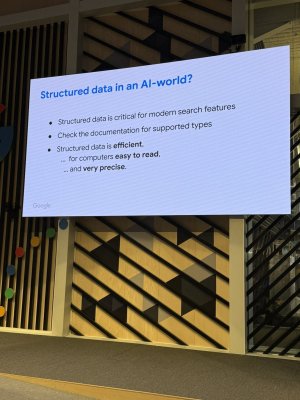
google-presentation-slide-titled-structured-data.jpg
During the Google Search Central Live conference Senior Search Analyst John Mueller explicitly stated that structured data is critical for AI search.
 
I didn't realize how controversial this topic was, so I'm going to just keep providing additional evidence from third parties.

Semrush Study:
First: The Study Actually Undermines You!

The Semrush study says this multiple times:
“These correlations don't prove causation.”
That line alone destroys the “schema is critical for AI visibility” narrative.

The study is basically saying:

Pages that are already technically strong tend to be cited more.

That is not controversial. That’s like saying: Pages that rank well in Google tend to get more organic traffic.
Yes. Because they rank well.

What percentage of the entire web has Organization schema?
What percentage of high-authority domains have Article schema?
What percentage of the top 1M sites use Open Graph?

High-authority sites almost universally have:

  • Open Graph
  • JSON-LD
  • Clean URLs
  • Strong engagement metrics
So if AI cites authoritative sites…And authoritative sites use schema…

That does NOT mean schema caused citation. It means high-quality sites tend to implement best practices.

The study says: Cited pages have higher engagement metrics. But they also admit: Engagement happens after the click and is unlikely to be a direct AI signal.

So what is actually happening?
High-ranking pages, Get more traffic, Have stronger engagement, Are trusted more, Are cited more.

They say:

Schema.org JSON-LD appears on:
  • 40% of AI Mode cited pages
  • 30% of ChatGPT cited pages
That means:

60–70% of cited pages DO NOT have JSON-LD schema.

That alone disproves the “critical element” framing.

If something is critical, it appears in the overwhelming majority.

Critical means required.
Required means near-universal among winners.

This is not that and it is not proof of what your saying.

Your original pitch implied:

Schema + AI readiness → competitive advantage.

The Semrush study does not prove that.

It proves:
Well-optimized sites get cited more.
That’s expected.

If schema were critical, why do 60–70% of cited pages lack JSON-LD?
Is schema the driver, or do authoritative sites simply tend to implement it?
Can we isolate schema as a causal variable independent of domain authority and ranking strength?
 
During the Google Search Central Live conference Senior Search Analyst John Mueller explicitly stated that structured data is critical for AI search.
Did Mueller say: “Structured data is critical for AI search inclusion and ranking”? or did he say “Structured data remains important and helps systems understand content”?

Those are NOT the same statement.

Google uses the word “critical” in the sense of: Important for clarity and machine readability. They do not use it in the sense of: Required for AI citation inclusion.

If structured data were critical for inclusion, then:
  • AI Overviews would largely exclude pages without schema.
  • 60–70% of cited pages wouldn’t lack JSON-LD (as the Semrush data shows).
  • Google would list it as a ranking requirement.
They don’t.

What determines retrieval?

Retrieval systems rank documents using:
  • Traditional ranking signals
  • Authority
  • Freshness
  • Relevance
  • Link graph
  • Engagement history
  • Entity graph signals
Schema is not the retrieval engine.

Schema may improve clarity once retrieved. It does not override retrieval ranking.

Google said: No extra tweaks are needed for AI features.

That means:
  1. No AI-specific markup.
  2. No AI-specific schema.
  3. No AI-specific hacks.
Stick to SEO fundamentals. Both those articles you posted prove my point they help my argument, not yours!
 
Just yesterday, Google Chrome released an early preview of WebMCP, which is a proposed web standard that would allow a website to expose structured tools directly to in-browser agents. So instead of an agent having to screen scrape and guess its way through a UI, it can call real functions with defined schemas.

Making your site MCP-compatible for AI agents is a little different than just wanting to show up in AI search results, but having structured data and clearly defined actions on your site certainly can’t hurt.