




• This thread is just the tip of the iceberg.The people ahead of the curve aren't Googling for answers — they're already in here, having the conversations you haven't found yet. DealerRefresh is free.Get the full picture →

I want more AI traffic! But what content is worth creating?

Eric Miltsch

Don't forget where you came from!
Apr 16, 2009
202
81
Awards
5
First Name
Eric
“I want more AI traffic.” “What are we doing to improve our GEO/AEO?” I hear these questions daily. But dealers should be asking another question first:
“What content is still worth creating when AI can answer the shopper's question without a click?”

Asking for more AI traffic without understanding shopper behavior is like asking for more showroom visitors who only come for the free hot dogs.

When a shopper searches: “What's the best midsize SUV for a family in Anytown, NY?”
AI can compare models, explain features, recommend vehicles, and estimate ownership costs. All without the shopper ever visiting a dealership website. That's useful information. It can influence a purchase decision. But it doesn't necessarily generate a lead.

Then the shopper gets more serious: “Which dealership should I buy it from near me?” AI results can highlight dealer reputations, customer reviews, locations, and business information.

Next come the questions that get closer to an actual sale:
- Do you have the vehicle in stock?
- What's the actual price of that specific vehicle?
- How much is my trade worth?

That's where your dealership website needs to connect the dots. And it's why we need to reset expectations around AI traffic.

If AI currently generates less than 0.5% of your website sessions, reaching 5% means increasing that share more than tenfold.

For a dealership website generating 100,000 monthly sessions, that's moving from fewer than 500 AI-driven visits to 5,000, assuming total traffic stays the same. That means a massive shift in shopper behavior, AI visibility, clicks, or a combination of all three.

Expect paid opportunities to remain a major part of the search experience as AI evolves. Google generated approximately $82 billion in advertising revenue in Q3 2026, including $63.35 billion from Search and other advertising. (And Google just announced its new Multiturn ads on AI Mode solution this month)

So what should dealers actually focus on to drive traffic?

Create content that helps buyers move from researching vehicles to taking action. That includes having accurate and compliant inventory pricing.

And measure the things that matter:
→ Traffic from your primary traffic channels for website visits.
→ Calls, chats, forms, and appointments for actual business results.

The goal isn't to generate more AI traffic. It's still to make sure your dealership gets discovered and chosen, regardless of where the car buyer begins. The majority of your traffic still comes from direct, organic, and paid search.

AI results are a shopping adviser. Your website is where car shoppers check for affordability, selection, and to take the next step.
 
  • Like
Reactions: Jeff Kershner
“I want more AI traffic.” “What are we doing to improve our GEO/AEO?” I hear these questions daily. But dealers should be asking another question first:
“What content is still worth creating when AI can answer the shopper's question without a click?”

Asking for more AI traffic without understanding shopper behavior is like asking for more showroom visitors who only come for the free hot dogs.

When a shopper searches: “What's the best midsize SUV for a family in Anytown, NY?”
AI can compare models, explain features, recommend vehicles, and estimate ownership costs. All without the shopper ever visiting a dealership website. That's useful information. It can influence a purchase decision. But it doesn't necessarily generate a lead.

Then the shopper gets more serious: “Which dealership should I buy it from near me?” AI results can highlight dealer reputations, customer reviews, locations, and business information.

Next come the questions that get closer to an actual sale:
- Do you have the vehicle in stock?
- What's the actual price of that specific vehicle?
- How much is my trade worth?

That's where your dealership website needs to connect the dots. And it's why we need to reset expectations around AI traffic.

If AI currently generates less than 0.5% of your website sessions, reaching 5% means increasing that share more than tenfold.

For a dealership website generating 100,000 monthly sessions, that's moving from fewer than 500 AI-driven visits to 5,000, assuming total traffic stays the same. That means a massive shift in shopper behavior, AI visibility, clicks, or a combination of all three.

Expect paid opportunities to remain a major part of the search experience as AI evolves. Google generated approximately $82 billion in advertising revenue in Q3 2026, including $63.35 billion from Search and other advertising. (And Google just announced its new Multiturn ads on AI Mode solution this month)

So what should dealers actually focus on to drive traffic?

Create content that helps buyers move from researching vehicles to taking action. That includes having accurate and compliant inventory pricing.

And measure the things that matter:
→ Traffic from your primary traffic channels for website visits.
→ Calls, chats, forms, and appointments for actual business results.

The goal isn't to generate more AI traffic. It's still to make sure your dealership gets discovered and chosen, regardless of where the car buyer begins. The majority of your traffic still comes from direct, organic, and paid search.

AI results are a shopping adviser. Your website is where car shoppers check for affordability, selection, and to take the next step.
There is a simple set of rules here. Follow these and you'll be visible for AI:

  1. Grant /allow access to the AI bots in your robots.txt file (The best providers give this access and have better results)
    1. Remove the crawl delay that your provider put on it.
  2. Have an llms.txt file installed.
    1. Most sites today do this
  3. If a window pops up when you go to the site stating that it is a verification of some type, change providers. This is killing you.
  4. Ensure you have proper schema setups - 4 layers deep on VDP. If it shows an error, you have a problem.
  5. Ensure you have unique and current meta data.
  6. Be positive that your SEO provider has listing management in your package and that you're getting the top listings management setup for maximum citations
  7. Be sure that you have similar review ratings or higher to your competitors. Use a review generation/repman service. If you're 4.4 stars and your competitor is 4.7 stars, you're in trouble.
  8. Visit your pricing. A much as many of us like "unlock price", AI views this is lack of transparency. This does hurt your results
  9. Visit you value ads and make sure your "Why Buy" messages are on every VDP.
If you do all of this, THEN AI can read and is more likely to use your content to fill answers. Most AEO/GEO programs are only trying to make up for what proper SEO should already be doing. Don't get caught by fear mongering.
 
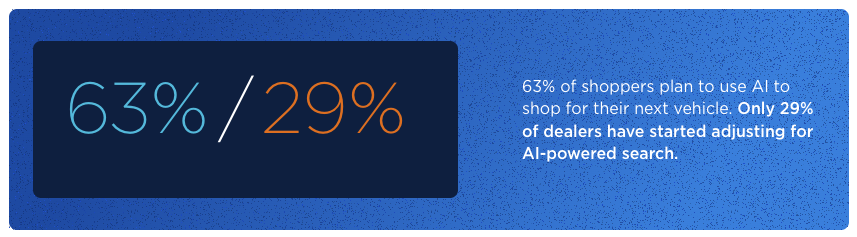
@AdamRafael highlighted this in his latest post - 63% of buyers will shop with AI, only 29% of dealers are ready for AI search -from the Cox Automotive's AI in Auto Retail Tracker.

Are dealers keeping up with consumers?​

1794612733663.png
Cox Automotive's AI in Auto Retail Tracker (Q2 2026, 483 dealers and 1,502 in-market shoppers) puts it plainly: 63% of shoppers say they will definitely or probably use AI to shop for their next vehicle.

Only 29% of dealers have started adjusting for AI-powered search.
And 26% of dealers say they're not sure what AI search means for them.


again - 63% of buyers will shop with AI, only 29% of dealers are ready for it

All these stats and studies sure take me back to the late 90's, early 2000's when dealers were wondering if the Internet was here to stay.
 
Eric, the line I'd underline is "accurate and compliant inventory pricing." That's the one piece of content AI can't write for you.

Full disclosure, I build software that posts dealer inventory to Facebook Marketplace, so weigh accordingly. In our data, 22.6% of dealer listings changed price after they went live (2,443 of 10,798). Every one of those is a moment where the website, the Marketplace post and whatever the model read last week can disagree.

The car-search demos from the big sites all lead with a budget: "third row under $25,000," "used truck under $30k." 45.4% of the dealer units we track ask $30,000 or more. Cut one to $29,500 on the website, leave $31,900 on a rep's Marketplace post, and the copy the model saw last decides whether you're in the answer.

So my vote for content worth creating is the boring kind. One price, everywhere, the same hour it changes. Then the VDP is the page AI has to send people to.

A test anyone can run before lunch: open three reps' Marketplace profiles and compare five prices to the website. That gap is your AI visibility problem too.
 
Eric, I’d put the next content dollar into helping a shopper choose an actual vehicle, not another generic “best SUVs” article.

Pick 10 live VINs and look at them like a customer. Take two same-year Grand Cherokees with the same trim badge. Can you tell which one has the package you want without calling? Does the VDP match the window sticker or build information where available? Is the advertised price clear about conditional rebates? Is the unit actually on the ground or inbound?

That’s content worth building. Real equipment differences, useful VIN-to-VIN comparisons, and answers to the questions that determine whether somebody is ready to buy. Not the same generic description pasted across every VDP.

Then there’s the handoff. If the VDP, BDC, and desk aren’t giving the same answer on availability and advertised pricing, more traffic isn’t fixing that. And when a customer submits an inquiry, the VIN and whatever shopping information they agreed to share should follow into the CRM.

I’d be more interested in whether those shoppers turn into shown appointments and sold deals than whether an AI referral number went up.

Anybody actually auditing that from VDP to showroom?
 
Good question, and I agree with Eric and Shean — the content that earns AI citations is the content that answers a real buyer's question with a real, current fact.

From an independent dealer's side, the pages I would prioritize are the ones an AI (and a shopper) can actually act on: one page per VIN, in stock, with real photos, the actual price including fees, and what's different about that specific car — trim, miles, history, why it's priced where it is. Generic "best SUV for families" posts don't move a sale. A page that says "this 2021 RAV4 XLE, 42,300 miles, one owner, $24,900 out the door, in stock today" does.

Two things I'd add: first, audit the basics before you write anything new. If your VDP price, your SRP price, and what your desk would quote don't match, AI will surface the mismatch and the shopper will trust none of it. Second, measure it like a lead source, not a traffic source — appointments and sold units from AI-assisted visits, not just AI sessions. If a page brings in shoppers who show up and buy, make more of that page. If it only brings in clicks, stop.
 

✨ AI Highlights

Dealers are chasing AI traffic and GEO/AEO metrics without first asking whether that traffic can actually convert, since AI can now answer general shopping questions without sending users to a dealership site. Eric Miltsch frames the real strategic question as identifying what content is worth creating when AI handles the informational phase, with replies pointing to reviews, structured inventory data, and accurate real-time pricing as the content AI cannot fabricate but will cite. A Cox Automotive stat that 63% of shoppers plan to use AI while only 29% of dealers are adapting underscores the urgency, and one contributor's inventory data showing frequent post-live price changes highlights how pricing inconsistency can silently exclude a dealer from AI-generated results.

Replies Views 7 534 Started Last Reply