






• This thread is just the tip of the iceberg.The people ahead of the curve aren't Googling for answers — they're already in here, having the conversations you haven't found yet. DealerRefresh is free.Get the full picture →

Is this broken? (Roadster Digital Retail)

Mitch Gallant

Refresh Team
Apr 6, 2009
479
146
Awards
7
First Name
Mitch
Hey All,

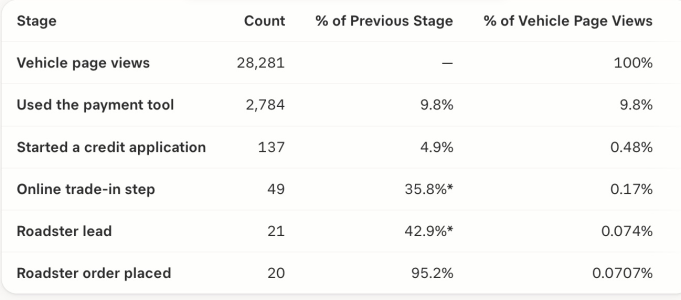
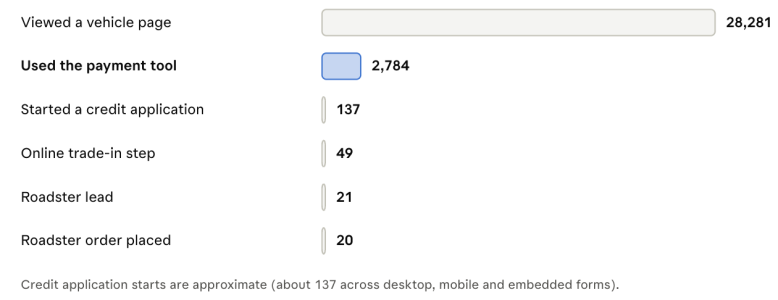
I want to get your take and opinions on the data below. It has a swan dive, bounce, skid profile to it that makes me feel like it could be better...

I don't know what to do about it though. It's Roadsters fault, the tool has too much friction. It's our fault, our settings are the problem. It's a blend of both or maybe neither or something else.

Heck, maybe these results are outstanding for a Hyundai dealership in Canada running roadster.

If it matters we do not have the lead gate turned on in order to use the tool...

Does this make you shit your pants or does it make you say... yeah, that's normal?
1794876418622.png
 
  • Like
Reactions: Jeff Kershner
Does this make you shit your pants or does it make you say... yeah, that's normal?

Yo Mitch, wazzz up! Here we go :unclejoe:

Generally speaking, most dealerships close less than one percent of the people who visited the VDP (easy math in GA4). It looks like about a tenth of one percent placed a Roadster order.

Many forces are at play.

First, from first principles, for a shopper to go from a VDP view to placing a Roadster order requires super-high conviction and the tenacity to complete all the forms. This makes for an ultra rare shopper profile (like about a tenth of one percent lol!) .

My instinct is that the Roadster orders are B‑backs, people who have been to the store, sat in the car, made a decision, and bought the car in their pajamas via Roadster.

Looking at your chart, all I see is a lot of keystroke time. What is Roadster’s role here? Does your BDC and your shopper jointly share all of the surfaces on your chart?

Car shoppers don’t want e‑commerce; they want collaborative commerce.
We, as an industry, have undervalued the complexity of car shopping. Add to this, OUR WEBSITES SUCK... Shoppers want to be 'walked thru' the process. For example, if you remove Carvana’s BDC, its sales would plummet. Carvana operates as a roofless dealership with a massive call center. Shoppers want to be hand‑led through the ornate number of forms.

May I suggest you shop carvana and shadow the process?
Go through a Carvana purchase yourself, or shadow someone and watch the machine work. It’s quite stunning, and I know that because when I see a carvana lic. plate, I speak with buyers about their experience. Most of them are drinking the Carvana koolaide. Do it, it's easy to reverse‑engineer how Carvana works.

LASTLY...
Part 1: Look at the distance of the roadster sale. My gut sqays it's Likely > than your avg sale distance.
Part 2: Invert your table and work backwards from the Roadster lead, to tools used (trade/finance) etc. I bet the Roadster users use all of the tools.
 
Mitch, I wouldn’t call Roadster broken from this chart alone, but I wouldn’t brush it off as normal either.

The 2,784 payment-tool uses against 28,281 vehicle-page views (roughly 9.8%) suggest shoppers are willing to work payments. But those are event counts, not necessarily unique shoppers moving through one linear funnel. Credit, trade and order actions can happen independently, and 20 orders placed aren’t automatically 20 delivered sales.

The bigger concern is your follow-up: about 137 credit applications started and none completed. First I’d find out whether that’s real abandonment or a missing completion event. Have the store and Roadster test the flow in an approved test environment on mobile and desktop, then verify the confirmation, credit-provider receipt, CRM handoff and analytics event. If the drop-off is real, identify the exact screen or step where it happens.

Next, reconcile those 20 orders against your CRM/DMS: unique customers, dealer follow-up, appointments and actual deliveries. Also look at payment-tool users who completed the conversation by phone or in-store. Break the results down by device, traffic source and vehicle type before deciding whether the tool is underperforming.

Joe’s point about assisted shopping is worth testing. I’d make it easy to save the payment and ask a person to help finish, then measure qualified conversations, appointments and sold units rather than just form fills. With the lead gate off, lead count alone won’t tell the whole story.

Mitch, is the zero-completion figure confirmed by your credit provider, or is it only what Roadster’s report shows? That would determine my first move.
 
I've been digging away in this rabbit hole. To this question the answer is...

0 :bkheart:

Mitch, this observation isn't highly relevant "Credit application and trade-in are not strictly sequential", track the '% share' of VDP visits to tool use, The hypothesis is simple, that is the hallmark of shoppers moving from

Dude, Heres OUR challenge:

1. We, as an industry, have undervalued the complexity of car shopping
2. Which causes: "Shoppers want to be 'walked thru' the process."
3. Made worse by: "OUR WEBSITES SUCK..."
4. This causes: Car shoppers don’t want Digital Retail (DR); they want Collaborative Retail (CR).
5. Mind Shift: Your goal isn't roadster self serves, your goal is to generate more phone ups to set up a DR sale via a CR sales experience.
6. Rob nailed the CR setup:
If on the other hand you would like names and phone numbers of people who want to buy cars, then you want Gubagoo VR.

7. But if your reps aren't trained in CR, it'll fail.
 
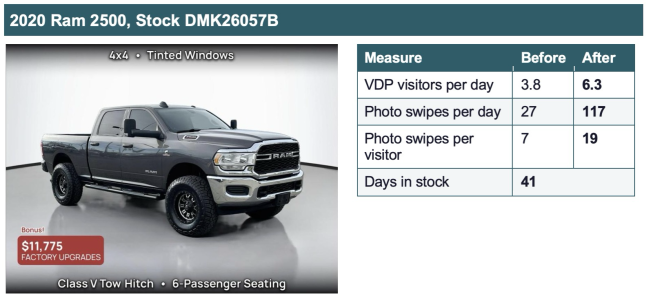
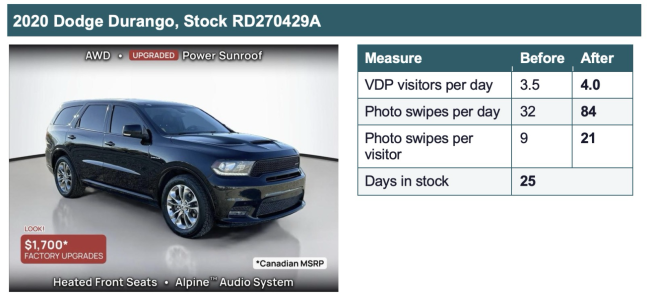
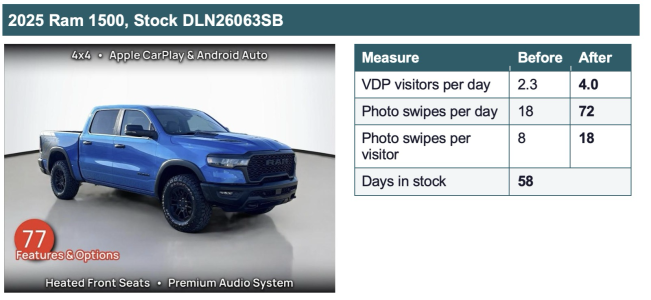
[shameless pitch] AutoMagic Labs has evidence that great merchandising can lead to
1. deeper shopper engagement
2. which causes higher conviction
3. which causes higher tool use (payments, trade)
4. which leads to higher lead gen rates (phone, form),
5. which opens up more CR opportunities (roadster included).

IMO, the hallmark of the bed rock of merchandising must be aimed at deeper shopper engagement. Our newest Beta version at a CDJR store looks promising:

1795088955268.png

1795088986704.png

1795089011401.png

Pretty bad ass Beta, 3.5 years in the lab, it's mission is to keep the shopper connected to your VDP as long as possible. I am proud of this one. :unclejoe:
 
Last edited:
Does a person have to follow that exact sequence in order to complete the process? The context: shoppers come to websites to research vehicles, book service, calculate a payment, value a trade-in, typically in that order or close to it (We ran that study for years at TradePending). Rarely is it to essentially complete the purchase process.

The gist: If someone's required next step is to complete a credit app, of course the drop-off is gonna be HUGE. That immediately whittles down the shoppers from the researchers to the purchasers.
 
The context: shoppers come to websites to research vehicles, book service, calculate a payment, value a trade-in,

Hi Matt,
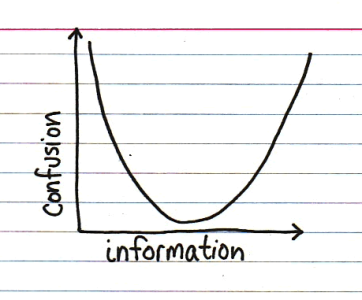
In my small mind, this is my car shoppers map.
1795101607379.png
This chart sums up the Internet Shopping Experience.

THERE ARE 2 SLOPES, a down slope and an up slope.
  • Emotion rules the shopper on either slope.
  • Gathering of Information and consumption of time are directly correlated. (same axis)
  • Shoppers on the down slope are seeking “information satisfaction” (the apex)
  • The shopper on the UP slope is investing time and not getting answers (becuase their questions are far more complex)
  • Shoppers on the up slope have passed “information satisfaction”, are now seeking an exit
Give me Mr. Up Slope! This is the car shopper that wants Collaborative Retail.


p.s. Love your mission at Home - Compfluence
 
  • Like
Reactions: ryan.leslie

✨ AI Highlights

A Canadian Hyundai dealer shares Roadster digital retail funnel data showing steep drop-off at every stage — from VDP views to payment tool use to credit apps (zero completions) to just 20 orders placed — and asks whether the tool is broken or the results are normal. Replies from industry veterans suggest the data reflects a fundamental mismatch between how shoppers use dealership websites (research, not purchasing) and what digital retail tools demand from them, with the emerging consensus being that self-serve online transactions are rare and that the smarter goal is using these tools to generate phone or collaborative retail opportunities rather than unassisted sales. The thread also surfaces a possible tracking issue with the zero credit app completions, recommending dealers test and verify their CRM and analytics handoffs before blaming the tool entirely.

Replies Views 11 751 Started Last Reply