






@DealerInt @joe.pistell @DjSec
SRPs are NOT the problem. Your legacy vendor is.
The reality we have to face is that OEMs and legacy vendors (like Cox/Dealer.com and CDK) have decided that harvesting third-party customer data is more valuable than actually selling whips.
I just ran a deep architectural sweep on a competing legacy site. Before a customer even clicks on a vehicle, the machine drops 11 server-side cookies, captures exact GPS coordinates, drops network fingerprint hashes, and runs 4 separate GTM containers. They are strip-mining local, dealer-paid traffic to feed their national data ecosystems.
And dealers wonder why their ad spend is bleeding out while their SRPs choke on a 10.7-second load time and an "E" performance grade.
I got so tired of this deception that I walked out of my GSM role last month and built the infrastructure myself. No bloat. No third-party data extraction. Just a clean, headless, server-rendered Next.js architecture.
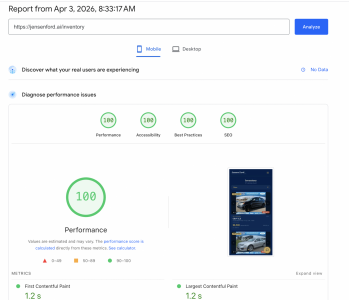
Getting a 100/100/100/100 on Google PageSpeed Insights on an image-heavy SRP is not hard. It is actually basic math if you just ditch the tracking cookies and offload the animations to the GPU.
We just pushed a live inventory SRP this morning. The empirical math:
The "shiny shell" era is dead. If your platform isn't hitting sub-1.5s LCPs and passing Core Web Vitals, you don't own your digital retail infrastructure—you are just renting a slow, legally hazardous data-brokerage from a vendor who is using your own traffic against you.
The math doesn't care about their excuses.
Trent Sliefert
Founder, Darkhorse Data Solutions LLC
SRPs are NOT the problem. Your legacy vendor is.
The reality we have to face is that OEMs and legacy vendors (like Cox/Dealer.com and CDK) have decided that harvesting third-party customer data is more valuable than actually selling whips.
I just ran a deep architectural sweep on a competing legacy site. Before a customer even clicks on a vehicle, the machine drops 11 server-side cookies, captures exact GPS coordinates, drops network fingerprint hashes, and runs 4 separate GTM containers. They are strip-mining local, dealer-paid traffic to feed their national data ecosystems.
And dealers wonder why their ad spend is bleeding out while their SRPs choke on a 10.7-second load time and an "E" performance grade.
I got so tired of this deception that I walked out of my GSM role last month and built the infrastructure myself. No bloat. No third-party data extraction. Just a clean, headless, server-rendered Next.js architecture.
Getting a 100/100/100/100 on Google PageSpeed Insights on an image-heavy SRP is not hard. It is actually basic math if you just ditch the tracking cookies and offload the animations to the GPU.
We just pushed a live inventory SRP this morning. The empirical math:
- Largest Contentful Paint (LCP): 1.2s
- Total Blocking Time (TBT): 40ms
- Lighthouse: 100 / 100 / 100 / 100
The "shiny shell" era is dead. If your platform isn't hitting sub-1.5s LCPs and passing Core Web Vitals, you don't own your digital retail infrastructure—you are just renting a slow, legally hazardous data-brokerage from a vendor who is using your own traffic against you.
The math doesn't care about their excuses.
Trent Sliefert
Founder, Darkhorse Data Solutions LLC


