








• This thread is just the tip of the iceberg.The people ahead of the curve aren't Googling for answers — they're already in here, having the conversations you haven't found yet. DealerRefresh is free.Get the full picture →

Used Car Acquisition Costs - 1st Party vs. Auction

Alex Snyder

President Skroob
Staff member
May 1, 2006
4,112
2,986
Awards
13
First Name
Alex
Did a little digging in a few years of DMS data. I wanted to see the dollar difference between auction-sourced cars and trades/street buys/lease captures.

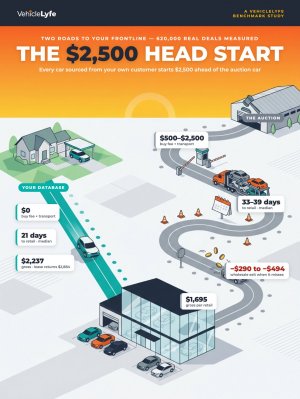
Customer-sourced cars grossed $3,102 and sat 23 days. The auction cars grossed $2,100 and sat 36 days.

Take an interactive tour of how it all adds up. Build yourself an argument for why your store should invest in better ways to pull great used cars from your own database (+ service drive). Acquiring from your Customers vs. Buying from the Auction - VehicleLyfe
known-car-advantage-infographic-v2.jpg
 
Did a little digging in a few years of DMS data. I wanted to see the dollar difference between auction-sourced cars and trades/street buys/lease captures.

Customer-sourced cars grossed $3,102 and sat 23 days. The auction cars grossed $2,100 and sat 36 days.

Take an interactive tour of how it all adds up. Build yourself an argument for why your store should invest in better ways to pull great used cars from your own database (+ service drive). Acquiring from your Customers vs. Buying from the Auction - VehicleLyfe

View attachment 11596
Alex, this is where the real advantage of buying from your own customers shows up.


It is not just the $1,002 more gross. You are also looking at 13 fewer days in inventory, no auction fee, no transport, and usually a much better idea of what you are buying before it hits recon.


The part I would want to see next is total net after acquisition cost, recon, holding cost and wholesale loss. That would tell the whole story.


Auction is always going to have a place because you cannot build the entire inventory mix from trades and service customers. But if a store has a big CRM and service drive and is still treating the auction as its first acquisition source, there is probably a lot of gross sitting right in its own database.


The best used car to buy is often the one you already know.
 
  • Like
Reactions: Alex Snyder
Great write up Alex...I'm only 1/3 of the way through reading it all. I still can't believe the difference in gross is only $1000.....Quick thought would it would be more gross on the cars bought in the lane versus auction but then as I type this I'm thinking I'd have zero issues stepping up on a car in my lane, especially if I have a multi-point inspection knowing exactly what I have to deal with as far as recon goes, and if it helps me be aggressive to get a deal now.

I just wish it wasn't so hard to find salespeople willing to put in the busy work to work the lane. It's easy to get people to start but keeping them going is the tough part (and that's with a good comp plan and incentivizing the writers for the referrals). :banghead:
 
Love the visuals!

I see lease returns breakout, any chance to look at other sourcing? Service acquisition as a stand alone would be very interesting.

Thanks Joe! Yeah, I can break anything down further. When it comes to service, we see two types: no service lane working at all (some new clients for us) and those who have been using something else (switched to us) or are using our software.

It looks like the dealer who does nothing at all can convert 0.23% of their service repair orders monthly into acquisitions. Those who put an effort into the lane via automation (what we do) or placing a body out there can bring that number over 1%. Those percentages don't sound like much, but when you consider the average store does 1,100 ROs per month, that is a big swing. The math pencils out quickly when you also show that you're $2,500 ahead on every car you source from a customer instead of the auction.

If you don't know how many ROs your service drive does in a month, you should know how many used cars you sell. ~23% of used car sales are on vehicles traded or acquired from service for those dealerships who don't do much to work the lane. The better stores that do work the lane are in the 40% territory.

Acquisitions from service vary by RO count too - right, it is just volume/math. It is that 0.23% vs. 1%+ that adds up quick. For stores that do more than 1,800 ROs a month, it can start to make sense to put a full-time body in the lane too.
 
Great write up Alex...I'm only 1/3 of the way through reading it all. I still can't believe the difference in gross is only $1000.....Quick thought would it would be more gross on the cars bought in the lane versus auction but then as I type this I'm thinking I'd have zero issues stepping up on a car in my lane, especially if I have a multi-point inspection knowing exactly what I have to deal with as far as recon goes, and if it helps me be aggressive to get a deal now.

I just wish it wasn't so hard to find salespeople willing to put in the busy work to work the lane. It's easy to get people to start but keeping them going is the tough part (and that's with a good comp plan and incentivizing the writers for the referrals). :banghead:

I didn't even ask for this softball :lol:

First off, thanks Dan. I did use some Claude, so it is probably a bit too wordy.

Think of it less as a $1,000 difference on the top line. You've got auction fees to avoid and a faster turn rate that slashes the floorplan interest too. That is where most of the "$2,500 ahead" comes from. What isn't accounted for is the increase in sales because most people trade instead of sell.

Just having a system that asks service customers if they're interested is alone a nice pop!

The softball to me: VehicleLyfe is built for autonomy with the option for your people to get more aggressive. It does the farming and serves customers to your regular sales team as leads. The only thing to do is treat these customers a little differently than your usual lead because they're already your customers.
 

✨ AI Highlights

Alex Snyder shares DMS data analysis showing customer-sourced used cars (trades, street buys, lease captures) gross $3,102 and sell in 23 days versus $2,100 gross and 36-day turn for auction cars. Replies dig into the full net picture including recon and holding costs, with participants noting the operational challenge of keeping salespeople consistently working the service lane. A key insight from Alex is that even modest service lane automation can push acquisition conversion from 0.23% to over 1% of monthly repair orders, which adds up significantly at average store volumes.

Replies Views 7 321 Started Last Reply