




• This thread is just the tip of the iceberg.The people ahead of the curve aren't Googling for answers — they're already in here, having the conversations you haven't found yet. DealerRefresh is free.Get the full picture →

Inventory Pages Are Often Underutilized

What is the score? like one of these cars has a 94/100. Is that for this YMM, or this individual VIN? What goes into a score? Why is this Bronco Sport a 94/100? Is it a particular amazing example of a bronco sport?

I like high scores don't get me wrong. I just don't know what it's telling me. Other than 94/100 being "excellent" in the key below the score.

And I know you can click on it to get a breakdown, but a new car having a 10/10 accident / ownership / maintenance / mileage just seems regular rather than noteworthy.
 
What is the score? like one of these cars has a 94/100. Is that for this YMM, or this individual VIN? What goes into a score? Why is this Bronco Sport a 94/100? Is it a particular amazing example of a bronco sport?

I like high scores don't get me wrong. I just don't know what it's telling me. Other than 94/100 being "excellent" in the key below the score.

And I know you can click on it to get a breakdown, but a new car having a 10/10 accident / ownership / maintenance / mileage just seems regular rather than noteworthy.

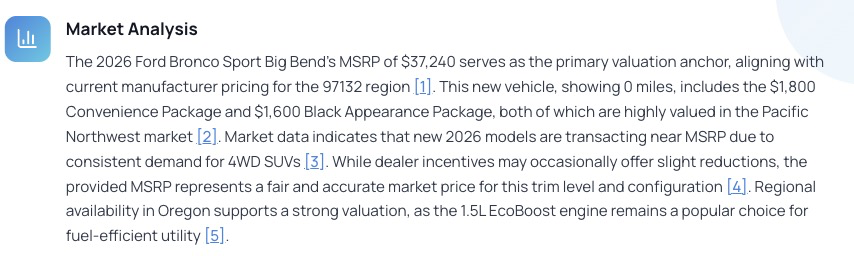
Great questions. So, the score is calculated for that specific VIN and that listing's price, and it checks the price against a fair-market valuation built around this exact build: the trim, engine, drivetrain, and the optional packages on the window sticker.

A loaded Outer Banks and a base trim aren't measured against the same number. So a strong score on a new car is really saying that for everything this build includes, you're paying a fair price, which is the hard part to judge on your own.

The report around the score fills in the rest. It breaks down the trim and which packages are actually on the car, and folds in owner and community feedback on the model so you know how people who live with it feel.

So read the score less as "is the title clean" and more as "is this particular car, optioned the way it is, a smart buy at this price."
 
Great questions. So, the score is calculated for that specific VIN and that listing's price, and it checks the price against a fair-market valuation built around this exact build: the trim, engine, drivetrain, and the optional packages on the window sticker.

A loaded Outer Banks and a base trim aren't measured against the same number. So a strong score on a new car is really saying that for everything this build includes, you're paying a fair price, which is the hard part to judge on your own.

The report around the score fills in the rest. It breaks down the trim and which packages are actually on the car, and folds in owner and community feedback on the model so you know how people who live with it feel.

So read the score less as "is the title clean" and more as "is this particular car, optioned the way it is, a smart buy at this price."
Thanks for the response. I’m thinking this makes much more sense on a used car than new. New will just always score high, based on the multiple 10/10’s that they will all have.
 
Thanks for the response. I’m thinking this makes much more sense on a used car than new. New will just always score high, based on the multiple 10/10’s that they will all have.
Funny enough, we'd originally launched the product targeting used. Our first client requested we launch across both, and to even our surprise we still saw the same engagement/session duration & conversion lift...

We basically learned, new or used, people are doing research on a car before we buy. We just prevent them from defecting to Google, LLM's or Reddit where they see competing ads by bringing answers to the questions there asking on a VDP. We just tailor the product dependent on new or used VINs we process to get data for the most relevant queries.

Y'all are amazing. Really appreciate the feedback we've gotten just in this thread.
 

✨ AI Highlights

The thread opens with an SEO tip about enriching dealership inventory pages beyond specs, pricing, and photos — adding FAQs, buying insights, and schema markup to capture more organic search traffic. The discussion shifts to a specific tool called Carvia, a VDP widget that generates VIN-level scores and content to keep shoppers engaged on-site rather than defecting to Google or Reddit. Key practical feedback covered mobile UX issues (nested scrollbar bugs since fixed), confusion about what the vehicle score measures, and clarification that the score reflects price-to-build fairness for that specific VIN — and that engagement and conversion lifts held for both new and used inventory.

Replies Views 24 1,149 Started Last Reply