


- Apr 16, 2026
- 19
- 20
- Awards
- 2
- First Name
- Emily
Hey DealerRefresh! It’s been a minute. Some of you might remember when Jake Hughes used to drop Widewail’s weekly newsletter, the REV, in these forums.
I'm Emily Keenan, a Content Marketer here at Widewail. I've been with the team for over five years, and I've officially taken the wheel on writing the REV. We've been away for a bit, but we're bringing it back every week to share data-driven insights on automotive reputation management, local SEO, and dealership marketing.
If you want to catch up on what you missed, you can check out our full library of past REV issues here: https://www.widewail.com/rev
Otherwise, let's dive into this week's data on how AI is completely changing organic search.
Welcome to the REV. A weekly briefing on what the Auto industry can learn about customer experience from millions of Google reviews. Every Thursday, we Rank, Explore & Visualize automotive reputation & sentiment data.
Our latest research report analyzes 5.5M Google Reviews from 18,000 U.S. dealerships, revealing what customers are saying across the auto industry. Get your copy below:
Report: 2026 Voice of the Customer Report
Read online. Subscribe to REV
While traditional SEO gets you indexed, AI models incorporate structured signals, including review content, in how they construct answers.
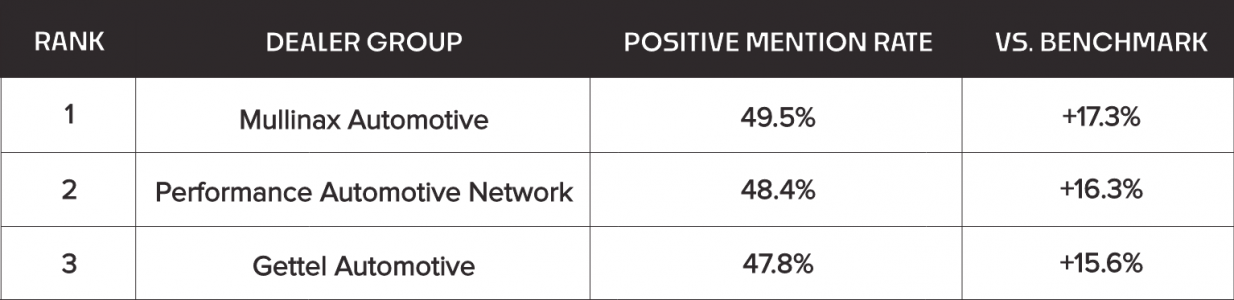
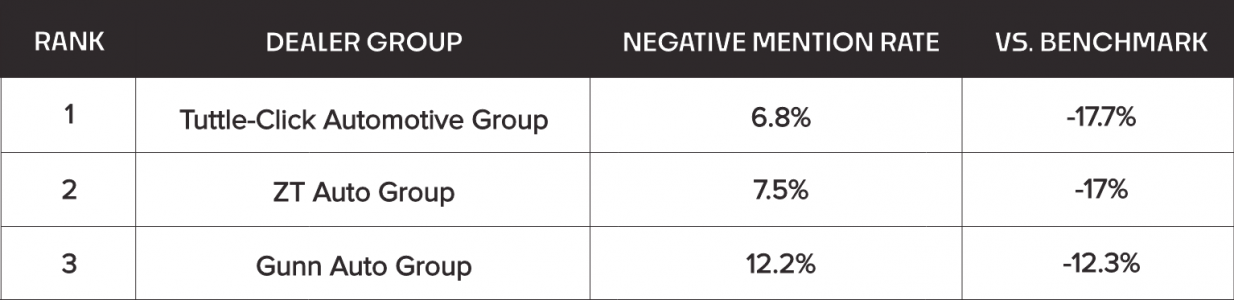
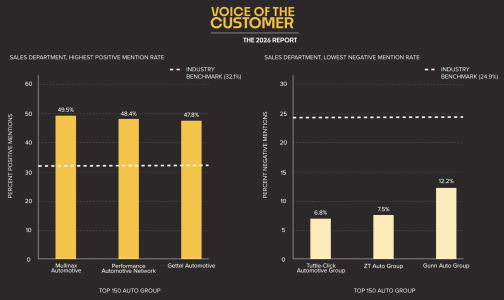
To find who's generating that kind of signal, we looked at the Top 150 Auto Groups producing at least 20 reviews per month and ranked their Sales Department feedback against the 2025 industry benchmarks: 32.14% positivity, 24.49% negativity.
Sales Department — Highest Positive Mention Rate
Sales Department — Lowest Negative Mention Rate
Mullinax leads the dataset on positivity. Nearly half of their positive reviews explicitly praise the sales experience. That dense footprint is worth paying attention to in the context of how search attribution is shifting right now.
The cause isn't a lack of shoppers; it's a change in how they search. As Reunion Marketing CEO Dave Spannhake explained on Daily Dealer Live, AI is expected to capture 30% of all search traffic by the end of the year. With LLM traffic already up 550% year-over-year, the traditional search journey is being rewritten.
Instead of clicking through to a website, users are getting their answers directly in the chat window. When a shopper asks for the best lease on a 3-row SUV near me, AI synthesizes the options right at the top of the page. If your store appears in that summary, the buyer's next move is often a direct search for your name. Not a link click.
The attribution and conversion points shift. The customer may not.
A traditional query — 'Car dealerships Orange County, FL' — returns the expected mix of aggregators and competitors built on traditional SEO. Mullinax doesn't surface in the top five.
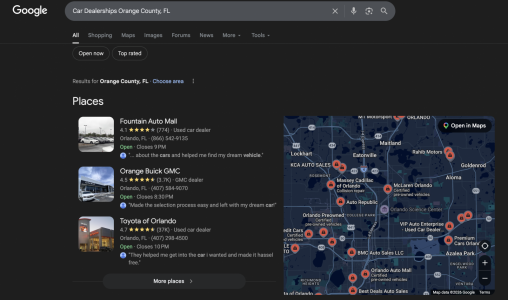
But shift the query to match how buyers interact with conversational AI — 'Best car buying experience Orange County, FL' — and the picture changes. Because the query explicitly asks for an experience, the results shift away from traditional SEO signals toward aggregated sources of reputation and sentiment. Inside the AI Overview, Mullinax appears as the top result in this case.
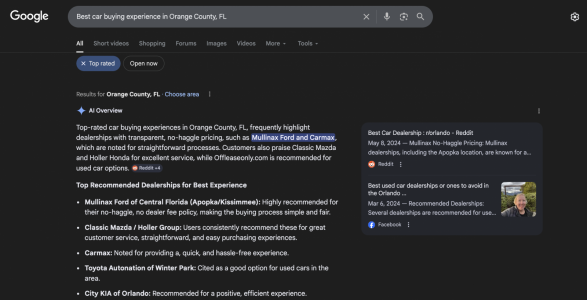
I’m not claiming a 1:1 correlation. Search visibility involves many variables. But the pattern is consistent with what Spannhake and others are describing: AI models use structured, consensus-driven signals, often including review content, in how they construct answers. Reviews that explicitly praise the sales experience give those models exactly what they're designed to surface when a customer takes a more conversational approach to their search queries. Generic five-star reviews largely don't.
Whether or not Mullinax set out to optimize for AI visibility, their customer experience is generating the language that may surface in those systems.
That's the throughline. Reviews have always been a differentiator. The data suggests they're now also the infrastructure that determines whether you show up before a buyer ever scrolls search results.
Understand the shift in local search. Read our full analysis to see exactly how conversational AI pulls from your online footprint to answer shopper queries—and what it means for your visibility.
Read the article here.
See you next week - Emily, Marketing @Widewail
Explore more Data & Insights. Book at Widewail Demo.
I'm Emily Keenan, a Content Marketer here at Widewail. I've been with the team for over five years, and I've officially taken the wheel on writing the REV. We've been away for a bit, but we're bringing it back every week to share data-driven insights on automotive reputation management, local SEO, and dealership marketing.
If you want to catch up on what you missed, you can check out our full library of past REV issues here: https://www.widewail.com/rev
Otherwise, let's dive into this week's data on how AI is completely changing organic search.
Welcome to the REV. A weekly briefing on what the Auto industry can learn about customer experience from millions of Google reviews. Every Thursday, we Rank, Explore & Visualize automotive reputation & sentiment data.
Our latest research report analyzes 5.5M Google Reviews from 18,000 U.S. dealerships, revealing what customers are saying across the auto industry. Get your copy below:
Report: 2026 Voice of the Customer Report
Read online. Subscribe to REV
RANK
The Groups Earning the Best Sales Feedback
In REV #053, we opened up the AI visibility conversation — the reality that buyers are increasingly building consideration lists through AI tools and summarizing answers before they ever scroll through a traditional page of search results. This week, we're looking at what the data shows about the review language that may actually drive that visibility.While traditional SEO gets you indexed, AI models incorporate structured signals, including review content, in how they construct answers.
To find who's generating that kind of signal, we looked at the Top 150 Auto Groups producing at least 20 reviews per month and ranked their Sales Department feedback against the 2025 industry benchmarks: 32.14% positivity, 24.49% negativity.
Sales Department — Highest Positive Mention Rate
Sales Department — Lowest Negative Mention Rate
Mullinax leads the dataset on positivity. Nearly half of their positive reviews explicitly praise the sales experience. That dense footprint is worth paying attention to in the context of how search attribution is shifting right now.
EXPLORE
What Review Language Means for AI Visibility
Across the broader marketing industry, brands are reporting organic web traffic drops of 10% to 40%, concentrated at the top of the funnel — research pages, inventory categories, high-volume keywords. Automotive is not immune to this shift.The cause isn't a lack of shoppers; it's a change in how they search. As Reunion Marketing CEO Dave Spannhake explained on Daily Dealer Live, AI is expected to capture 30% of all search traffic by the end of the year. With LLM traffic already up 550% year-over-year, the traditional search journey is being rewritten.
Instead of clicking through to a website, users are getting their answers directly in the chat window. When a shopper asks for the best lease on a 3-row SUV near me, AI synthesizes the options right at the top of the page. If your store appears in that summary, the buyer's next move is often a direct search for your name. Not a link click.
The attribution and conversion points shift. The customer may not.
How This Shows Up in Search Behavior:
To see how visibility can differ by query type, we ran live incognito searches focused on the top performer for Sales experience, Mullinax, and their home market of Orange County, FL.A traditional query — 'Car dealerships Orange County, FL' — returns the expected mix of aggregators and competitors built on traditional SEO. Mullinax doesn't surface in the top five.
But shift the query to match how buyers interact with conversational AI — 'Best car buying experience Orange County, FL' — and the picture changes. Because the query explicitly asks for an experience, the results shift away from traditional SEO signals toward aggregated sources of reputation and sentiment. Inside the AI Overview, Mullinax appears as the top result in this case.
I’m not claiming a 1:1 correlation. Search visibility involves many variables. But the pattern is consistent with what Spannhake and others are describing: AI models use structured, consensus-driven signals, often including review content, in how they construct answers. Reviews that explicitly praise the sales experience give those models exactly what they're designed to surface when a customer takes a more conversational approach to their search queries. Generic five-star reviews largely don't.
Whether or not Mullinax set out to optimize for AI visibility, their customer experience is generating the language that may surface in those systems.
That's the throughline. Reviews have always been a differentiator. The data suggests they're now also the infrastructure that determines whether you show up before a buyer ever scrolls search results.
VISUALIZE
Top 150 Dealerships, Sales Department Mentions
Understand the shift in local search. Read our full analysis to see exactly how conversational AI pulls from your online footprint to answer shopper queries—and what it means for your visibility.
Read the article here.
See you next week - Emily, Marketing @Widewail
Explore more Data & Insights. Book at Widewail Demo.