• This thread is just the tip of the iceberg.The people ahead of the curve aren't Googling for answers — they're already in here, having the conversations you haven't found yet. DealerRefresh is free.Get the full picture →

iOS 10.0.2 Just Became Your #1 Lead Provider

Admittedly, iOS 10.0.2 is a challenging shift for many iPhone users. I’ve yet to find anyone who understands how to “Press home to open”.

Me, I just repeatedly hit the button on my iPhone until something happens and then recover from there.

BUT!  I have discovered the lone reason why iOS 10.0.2 alone has singularly improved the automotive buying process more than any other mobile Operating System in the history of mobile Operating Systems... AutoFill!!

auto_mobile_form_fill.jpg


Yes, the most important element of a dealership's website that no one has ever attributed a sale to.  And, the actual name of the function has our favorite industry spelled out into it!  Auto… fill.  Love it!

Autofill is that simple feature where when you, as a user, select a form field the browser prompts you to select a preset value for that field such as <Name>, <Email>, <Phone Number>, or even <Credit Card Number>. Chances are you have been have using AutoFill in your daily lives for years now on your desktop browser - but the utilization of Autofill in mobile browser’s has been sloooow to evolve.

So let’s break down the news and the benefit…

News

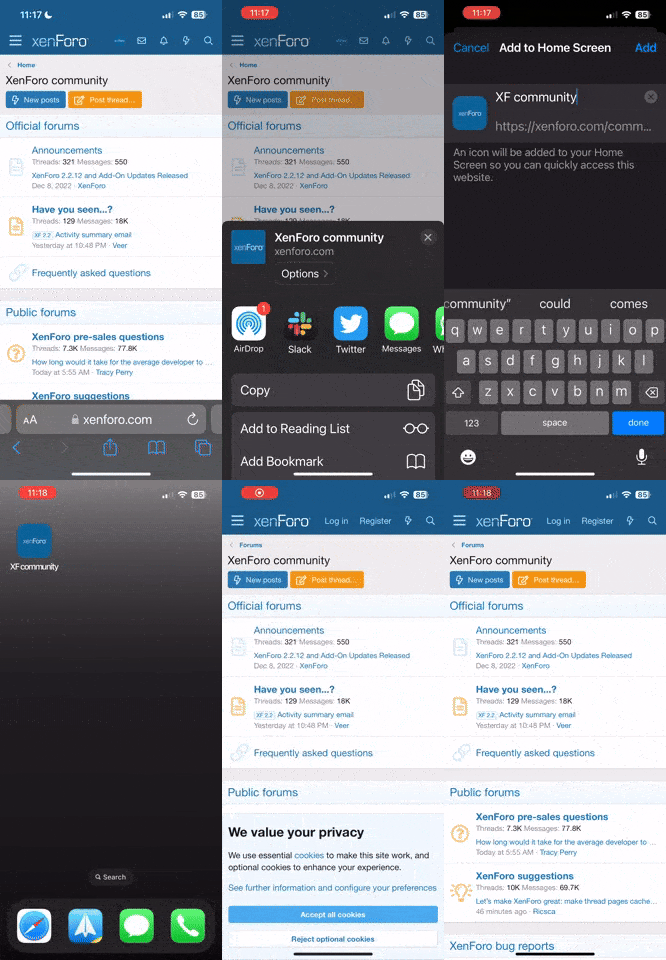
The feature to turn on mobile Safari has always been there but was rather hidden. For me and every other user I’ve spoken to that feature was not turned on and to turn it on you had to got to SETTINGS > SAFARI > AUTOFILL > then select yourself as the contact.

*Chrome users, here is an article on how you too can use AutoFill

Now, once you upgrade to 10.0.2, iOS automatically associates you with a user in your contacts. It's this step that automagically enables AutoFill. This is a key advancement as now when a mobile user confronts any form on your website, they are immediately prompted for a singular finger selection to fill in the requested field.

That is… IF the form owner has done their due diligence. You see, it is the responsibility of the developer of the form to use best practices to enable Autofill (in browser and mobile) to work.

Benefit

My company has captured 100s of thousands of leads for our dealership clients through our SNAP trade-in tool. Our average customer has benefited from a very mobile-optimized widget and our average dealership generates nearly 70% of their leads from mobile vs. about 46% of their unique traffic from mobile. 

If you have an average organic form submission of 200 leads total, all sources including: ePrice, trade tool, finance, etc. and you can affect conversion by just 15%, that's 30 additional form conversations you can capture each month. Apply your desired close rate on a per lead basis (let’s use 15% since we are talking about leads from our website) and you could get 4-5 additional sales per month, just for optimizing all of your forms for simple mobile conversion.

Add the fact that most of those new conversations should come through users on a phone or other mobile device and I could argue you are engaging with in-market shoppers within a critical area of the purchase funnel - the point at which your site visitors are using a mobile device.

Actions

Take a proactive approach and test your own website forms for accurate and simple Autofill options. I encourage you to check across multiple browsers such as (and with % of users next to each): Chrome (59%),  Firefox (14%), Internet Explorer (10%), and then Safari (10%).  

Then check it on mobile iOS Safari and Android mobile Chrome.

Test all access points of form-fill. If you find any gaps, email your website provider and any 3rd party plug-ins that utilizes a form [mobile] for conversion.

Here's a bit more information and even a simple guide to how to take advantage of modern mobile form-fill.

Is your dealership website forms AutoFill friendly?  

[highlight color="#F0F0F0" font="black"]I posted a video of this in action over in the dealer forums. Go check it out and let us know what you're finding out when you try and use AutoFill on your dealership websites by mobile.[/highlight]


How to Turn Shoppers from Third-Party Automotive Sites into Buyers at Your Dealership

This is a great time in the auto industry for dealers looking to capitalize on technologies that drive leads and grow sales from third-party automotive websites. Consumers have evolved and continue to command more and more seamless and transparent digital engagement with dealers, forcing companies and dealerships to evolve as well.

One such emergence over the years as dealership websites continue to improve in their ability to engage visitors, is the importance of driving quality website traffic. There are numerous tools and products available for dealers to generate specific types of website traffic, and the discerning dealer has much to consider when implementing tactics and techniques to attract shoppers online from third-party automotive sites.

Acquiring Shoppers from Third-Party Automotive Sites

When a shopper searches the web for vehicles, they initiate an experience that for most is bewildering. Studies and tests have shown that the average consumer does not intimately know or grasp the nuances of finding the best vehicle to meet their needs, and when they begin searching for answers, there is an abundance of information now available.

The web is littered with thousands of websites designed to take advantage of this by acquiring visitors through search and paid media and then monetizing this traffic through advertising, capture forms, and now by referring these visitors to paying dealers.

The problem for dealers, however, is that while they are paying to acquire these website visitors, qualifying this traffic and vetting it out to determine the true value of these website visitors is difficult. Practically speaking, dealers are relying on their websites to do the vetting. Because of this, it’s imperative for dealers to take the time to know more about the sites sending them traffic. In order for acquired paid traffic to achieve a meaningful ROI, dealers must partner with qualified auto publisher sites, or sites within qualified publisher networks that have proven track records of delivering low-funnel and high converting traffic.

Pay-per-click ad technology that engages consumers at automotive websites with highly relevant offers based on the specific makes and models they are researching, and their geographical location, are more likely to send low-funnel, high converting consumers to your website. Additional low-funnel in-market consumer traffic to your website each month means increased sales opportunities.

Customizing the Shopper’s Third-Party Site Experience

Even though millions of serious car buyers visit automotive websites every month, many don’t become leads or click through to dealer sites because they haven’t completed the research phase yet, not because they’re not ready to buy a car. To fully engage consumers and turn shoppers into buyers, be sure your offers cater to their vehicles of interest, and to a person’s market area. Also take advantage of custom solutions that allow you to use your own images, logos, ad copy, vanity URLs and destination URLs. Tactics like this help avoid significant bounce rates on your website.

Offer a Variety of Vehicles and Choices, Not Just a VDP

A common misconception about online shoppers when they click on a vehicle ad on a third-party site is that they only want to see that particular vehicle. We know this isn’t true about web leads. Just because a shopper submits a web lead on a particular vehicle doesn’t mean that’s all they are interested in. This is why when we design the sales process we are sure to offer the customer several options and choices of the same vehicle and similar ones as well.

When we acquire shoppers from third-party sites we want to direct their attention to a range of vehicles in your inventory, versus only the white sedan to which the ad directed them. Directing car buyers to areas of your website such as a Vehicle Search Results page, to give consumers more options by offering a broader range of models, or a look at additional inventory, ultimately leads to a better buying experience.

Engaging Shoppers on Your Website - Audio/Video Chat and Text

Engaging with customers on your website, your virtual showroom, is a tremendous challenge. Technology that enables you to see exactly what customers are doing on your website as they navigate from car to car and from page to page in real-time is of growing importance.

So too is technology that enables you to communicate one-on-one, in real time with your customers, in the manner they prefer (chat, text, audio, or video) while they are on your website be it from a tablet device, a smartphone, or on a desktop computer. By engaging with website visitors in real-time to help guide them through the sales process and your inventory much like you would if they were in your showroom, you enhance the buying experience by building trust and rapport.

What is the Optimal VDP Views-to-Days Ratio?

Sponsored-Blue.png
It’s a widely accepted fact in the automotive industry: VDP (Vehicle Details Page) views drive sales. As the watershed Cobalt study from 2013 declared, “If they see the highlights, you’ll see the taillights.”

In that study, Cobalt found that the number and duration of VDP views were two of the top four online sales predictors. They also found that VINs with more than 30 VDP views spent 44% less time on lot.

On the flip side, driving significantly more than 30 VDP views to a particular VIN does not proportionally reduce its time on lot, while quickly diminishing returns.

So, what is the optimum pacing of VDP views? LotLinx proprietary research indicates it’s 30 views in 30 days.

Based on that goal, a dealer’s best digital strategy is clear: drive 30 VDP views in 30 days to every VIN on the lot to maximize inventory turns and eliminate wasted digital ad spend.

But is that, in fact, what’s actually happening on dealers’ lots today? LotLinx decided to investigate.

We studied 299 dealers and their 483,715 VINs between January 1, 2016 and June 30, 2016 and sought answers to two important questions:

  1. Are dealers driving 30 VDP views to every car on their lot?
  2. Are the VINs receiving 30 VDP views in 30 days selling at a higher rate?

Get the Exclusive Report Now

To see what we found, LotLinx has prepared the, “Data From 2016 VDP View Study Illuminates Wasteful Digital Ad Spend,” report available as a free PDF download. Simply follow this link to obtain your free copy.

LotLinx-2016VDPViewStudy-Download1-1024x394.png


Assessing the Limitations of Print Advertising for your Dealership

Remember waking up to the Saturday morning newspaper and racing to the comics section? Mom and dad going through, clipping the coupons for the afternoon grocery run while reading up on the week's newsworthy events. It was a perfect collation of everything you needed to know in one broadsheet wrapper. The daily and weekly newspaper have been a part of society since our great-great-great grandparent’s day and possibly even before. As with many things in the modern world, the things that have historically been the norm are now changing and evolving. The print industry is no different.

The cost of producing a daily/weekly newspaper has always been high. However, with the decrease in readership and the increase in the use of mobile devices, reading what you want when you want (even when you're on the go) has served to reduce the need for the daily. Add to that the massive debt level, difficult labor agreements, and the social perception of trees for newsprint and you've got a problem. This reduced readership paired with the lack of advertising attribution and it’s obvious why print has, in many cases, become an afterthought when it comes to the advertisers and marketing teams.

Due to these limitations, there are only a few circumstances in which I believe you could benefit from the use of print as part of your dealership’s advertising spend.

When You Could Use Print

Dealerships all over the country still use print advertising; that is a fact. Print is still impactful - a fact that many digital media pundits would rather ignore. The thing is that there are still people out there that prefer to read news media in the printed form, rather than using their computer, tablet or their smartphone. Not every person in your market lives the connected lifestyle that most of us do. In fact, I met with the head of a large newspaper company a few months ago. This man (who was pushing 80), was adamant that car buyers bought vehicles using his paper. I was talking about the standard online consumer percentages and he abruptly stood up from the meeting table in his office, pulled a newspaper off the top of the two-foot pile of past days papers, opened it to the center spread which was an ad from a local dealer. He planted his hands firmly on the pages and stared me in the eyes, and said - “THIS… This is where people shop for cars.” So, you may say, “ya, but he's 80” or “sure, but how many people actually read the paper.” But I gave him even more credit when he predicted that I was likely some loyal Volvo driver … which I am.

[highlight color="#22b1e6" font="#ffffff"]
>> Tip: Two Emerging Technologies to Attract In-Market Car Buyers

Why Dealers Need a Vendor Management System and How They Can Benefit

Sponsored-Blue.png
Auto dealers are faced with tremendous operational challenges today. The pressure to always be increasing sales volume, service and retain customers, train employees, etc., and do it all profitably, is no small feat. It also cannot be done alone, which is why dealers depend on strong partnerships with many different providers.

While there is a multitude of services and solutions available that are designed to help dealers do everything they need to grow and maintain their businesses, the industry lacks solutions designed to enhance the dealership experience of its numerous partner relationships and systems. For lack of a better term, there is no Vendor Management System.

Technically the definition of a vendor is a “person or company offering something tangible for sale,” but the term vendor has become the de facto label of outside companies providing any sort of product, service, or solution for dealers.

What is a Vendor Management System (or VMS)?

A true VMS in this context is a web-based solution that can be accessed from any device, e.g. smartphone, tablet, laptop, desktop, etc. and that serves up all the information, access, and resources you need from one centralized interface. It is software-as-a-service (SaaS) solution designed to make life simpler for dealership owners and operators and their multitude of providers.

The Benefits of an Effective Vendor Management System

The primary benefits of a dealership VMS are centralization, authentication, and simplification. Additionally, you will benefit from intelligence and statistics.

Imagine you bring on a new employee in your sales department. In order for him or her to operate and succeed, he or she will require access to numerous different antiquated systems. The new employee will also require training not only from each provider but also from other team members.

Should your team members be providing this training? In some instances, yes, but in other instances, no. Regardless, how would you know which training has been completed or started on by the new employee? Also, which existing employees are utilizing which systems, and how often?

To determine this, you have to log in to each individual system to find out, assuming that information is even available. If it’s not, and in most instances it isn’t, you have to request a report from the provider.

Can gathering this type of intelligence be more efficient?

Centralization

With an integrated Vendor Management System, you will have access to such activity from all users across all platforms and systems. You would know which training videos have been viewed and not viewed for each employee user, which systems are being underutilized, or not utilized at all, and by whom. You would also have a better feel for which resources are integral parts of your operation.

Identity Management

This type of centralization leads to other benefits such as user and identity management. Rather than your employee users being forced to keep track of multiple different systems logins, team members can instead log in to one central location to which they are able to access whichever systems they’ve been granted. And as already stated, when they do (or don’t), you’ll be able to report on it.

These levels of information lead to efficiency and accountability, two things a savvy dealership needs in order to remain competitive and profitable.

DealerHQ-Vendor-Management-Tablet-1024x683.png

DealerHQ - Connecting Dealers with Innovation

Introducing a Vendor Management System at your dealership is simpler than you might realize, and the benefits outweigh the risks. DealerHQ was founded in 2014 to be the only fully integrated platform built for Dealers to access, optimize, and enhance their vendor/partner relationships.

And now, through a unique partnership with DealerRefresh, DealerHQ is able to bring the simplicity and efficiency of its solution to even more dealers by offering a freemium version of the DealerHQ VMS to DealerRefresh Members for a limited time on a limited basis.

To learn more about how your dealership can benefit from this innovative approach to managing dealer-vendor relationships, go here to initiate the process of connecting your dealership with all its innovative resources.

btn-learn-more-orange-gloss-300x107.png

Removing Sales People and Utilizing Product Specialists at Your Dealership

Before pricing information websites, salespeople were the gatekeepers.

When it came to vehicle features, availability and negotiating, it was a dealer’s market. However, today the playing field has changed immensely.

Many prospective car shoppers walk into a showroom already armed with all the information they possibly need, including the car's invoice price, dealer inventory listings, competing dealer bids, color options and even any discounts they are eligible to receive from manufacturers. According to a study conducted by J. D. Power, the average car shopper spends more than 14 hours online researching cars before making a purchasing decision.

Studies show that buyers already know what they want and how much they want to pay well before they step foot into your dealership. This shift in thinking has led many dealers to eliminate commissioned pay incentives altogether and instead price new vehicles closer to cost and reward their staff members for generating higher sales volumes.

The era of the old-school car salesperson has come to a close, and in its place begins the era of the “product specialist.

A product specialist’s role is to provide information and insight about each and every vehicle line, as well as present themselves as a resource if customers have any specific questions. They are the first point of contact for a growing number of businesses and help create a low-pressure atmosphere, while coming across as both helpful and knowledgeable.

The Effect of a Product Specialist

Customers aside, dealership staff is also benefiting from this sea change. When sales associates become product specialists, they no longer have to spend their time focusing on playing middle man between customer and manager; instead, once they get someone interested, they pass them off directly to the sales manager closer. This allows them to go back out to the showroom and continue to educate anyone looking for help.

As far as pay is concerned, bonuses are given out every time a product specialist successfully connects a customer to a sales manager, instead of direct commission, which alleviates the “hard-sell” pressure.

This shift in thinking has helped yield positive results. In 2014, notable Florida dealership JM Lexus saw a sales increase 27 percent between 2012 and 2013 after eliminating the sales associate position and instead replacing them with product specialists. Other dealerships have followed suit and have adopted the product specialist model to help provide their customers with a smooth and transparent sales experience.

A Different Candidate

For owners and hiring managers unsure of where to begin searching for these candidates, it’s important to know what to look for. The primary role of a product specialist will be aiding customers as they bring their web-based research to the showroom floor. Ideally, these candidates should not only be friendly and personable, but they should have a high emotional intelligence, presenting themselves as a credible, trusted advisor. Their main concern becomes the customer’s needs - not maximizing the dealership’s bottom line. When that relationship is established, the whole sales experience becomes smoother and easier to navigate.

The change in dealership structure is also affecting the way these dealerships recruit and the types of candidates they are attracting. According to Automotive News, the average novice product specialist can earn up to $60,000 a year, which can be very attractive to new college graduates.

This trend has made it so that staff members are younger and easier to immerse in a particular dealership’s culture. Owners can create career paths tailored to newer staff and help foster growth within the organization.

Getting Started on the Right Foot

To find the right product specialists for your dealership and keep them there for the long haul, it’s critical that the recruitment and onboarding process is working from the start.

A great onboarding program is designed to educate and engage your employees so they can become productive members of your organization. Since a lot of product specialists are typically inexperienced hires, your dealership’s onboarding program is essential to your success, allowing you to instill the best practices of your dealerships quickly and effectively.

Have you considered replacing your traditional commissioned sales professional with a product specialist? 

Let's continue this conversation over in the dealer forums....

How to Attract In-Market Buyers at Every Stage of the Journey

Sponsored-Blue.png

As digital marketers, it’s your job to attract buyers that are shopping online, and as GMs, you have seen the impact that online media has on sales and the bottom line. However, with new players coming into the fold and existing dealers upping their investments, it will be increasingly difficult to reach car buyers with your dealership’s message.

One way to increase your message reach is to customize your marketing on different parts of the buyer’s path to purchase.

In 2012, Microsoft Advertising created a report that identified the stages of a car buyer’s journey from the initial realisation of a need (or want) all the way beyond the purchase to ownership.

Each of these stages has a variety of media outlets and online information sources which are useful at each stage. Back in the day (or until just a few years ago) we marketers would have to rack our brains to determine the best time and place to display each ad. Fortunately, in today’s digital marketing age we can get extremely targeted with our messages and our content.

Thus, the ability to move from "educated guessing" to "data driven certainty".

What we found missing from the stages that Microsoft had outlined is that car shoppers aren’t actively engaged in shopping 100% of the time. As a result, we need to add another dimension to these stages.

  • Active Auto Shoppers
  • Passive Auto Shoppers

[highlight color="#314e51" font="#ff8403"]
>> Attract In-Market Buyers, Sell More Cars <<
[/highlight]


Active Auto Shoppers

Actively shopping shoppers can be classified under two prime categories - Actively Researching and Actively Searching. Traditionally, the only way to get your dealership’s message out to car shoppers in the research phase was to promote a generic offer. New inventory display advertisements now allow dealerships to show these buyers their actual inventory while they are researching.

Actively searching shoppers can be reached with SEM and listings campaign, but competition is high which causes prices to be high. Inventory Display Ads are effective to attract shoppers at this stage but do not suffer from the high competition found in SEM and listings ads.

Passive Auto Shoppers

Typically, dealerships rely on retargeting or demographic targeting for this phase. However, retargeting only works if the buyer has gone to the dealership’s website and targeting by demographics paints everyone with a wide brush and may not be as effective as you think.

A better method would be to combine retargeting from the dealer’s site and behavioural targeting based on the shoppers actual online auto browsing history, learned by a Data Management Platform (DMP) in the Active Stage. By doing this, you can deliver advertising that is relevant even in an environment that is not automotive specific.

Nobody knows your market better than you and auto shopping behavior changes constantly and quickly. Don't be left playing catch-up in an increasingly competitive marketplace. Take the time to sit and brainstorm the next evolution in your dealership's marketing direction.

ssm-aan-attract-buyers-small.png

Two Emerging Technologies that Attract In-Market Buyers

Sponsored-Blue.png

These days you (the marketer) need to be hyper-focused on all of the changes in the auto industry and beyond. Everyday you need to decide; will you put things off in favour of playing catch up with your competition or will your dealership be a leader.

Competition is at an all-time high and doing the same thing as your competition won't get you better results, it'll get you the same results - or worse. What you need to do is look at different tools and techniques.

Here are two emerging technologies that attract more in-market buyers to your dealership.

[highlight color="#CCE6FF" font="black"]

[Learn How to Attract More In-Market Buyers to Your Website]

[/highlight]

Facebook Ads and Social Media Marketing

PROS: Unlike traditional advertising methods, Facebook Ads are targeted by using user volunteered information and many other metrics. You can refine the targeting in many ways. With Facebook's Ad Manager you can select demographic profiles and interests like:

Males; Age: 25-45; Education: College or University; Employed; Interests: Sports, Outdoors, Active Lifestyle; Relationship: Married with children.

CONS: No matter how focused you can be on a demographic, you are still targeting based on assumptions. What if an in-market buyer that falls within this profile is NOT searching for an SUV or Crossover? What if dad is searching for a sporty sedan to drive to work? Your campaign will be ineffective and you risk the potential buyer blocking any future ads from your store.

This method, like newspapers or billboards, relies on showing your ads to a wide range of people in hopes of potentially having just the right buyer see one post. Fortunately, cost-per-click payment formats will help to protect you from this waste.

Hyper-Dynamic Inventory Display Advertising

PROS: These dynamically generated ads of immediately available inventory are much more successful at converting traffic than their traditional counterparts (Based on countless tests against Price and Offer style ads). If I am a motivated buyer, and I see what I want and that it’s available at my local store, there is a very good chance I will click and engage.

As with regular display ads, these inventory display ads are distributed in large online ad networks so you can reach people where they are spending the most online time. The reach is significantly wider than search and Social Media combined, each of which according to a recent study respectively occupy only 10% and 15% or a consumer’s online attention. Using the right combination of a vast array of websites you can reach well over 90% of your target audience.

CONS: Not everything is perfect, though, even dynamic display advertisements. Unless automated, creating these ads can be difficult and time-consuming. Constantly updating your inventory in many dynamic environments requires the personnel to stay on top of it.

Nobody knows your market better than you and auto shopping changes constantly and quickly. Don't be left playing catch-up in an increasingly competitive marketplace. Take the time to sit and brainstorm the next evolution in your dealership's marketing direction.

ssm-aan-attract-buyers-small.png

The Absolute Best Places you can Trim your Advertising Dollars

“There is no bad press!” has been attributed to a multitude of famous, and pseudo-famous, people that were usually getting bad press at the time but none-the-less were still profiting from the exposure. Is the same true in automotive advertising? Can you effectively throw money at any form of advertising and still sell cars?

Yes, you probably could, but how much of that spending is useful to the dealership and how much is just not bringing value at all? Let’s break down the main forms of advertising that automotive dealerships generally and historically have engaged in and why they maybe should not be the top priority for your advertising dollar.

Disclaimer for Full Disclosure

I am the VP of Sales and Marketing for Speed Shift Media and we work with customers in these fields of advertising. We also have many friends in companies I may be relating to. So in all fairness, many of these advertising products hold value at the dealership level and can be used effectively to advertise their business.

Typical or Traditional Display

I’ve written at length about the inherent difference between typical display and inventory display advertising, so I’m not going down that rabbit hole again. Instead, I want to go into this by demonstrating where traditional display works and why it just doesn’t deliver for your dealership if you’re trying to sell specific cars.

I often refer to traditional display advertising as the McDonald’s or Coca~Cola style advertisements. Simply put, these types of ads are great at building brand recognition or announcing events. You’ll often see the banner or billboard ads online, and they’ll read “Ford Family Pricing EventⓇ” or “Mercedes-Benz S-Class: Benchmark in SophisticationⓇ” or “Hummer: Everyone should get one.” Not one of these banners told you where to buy one, how much or if your favorite trim package was in stock. This is not the intention, the point of these ads is to evoke a response, a feeling or emotional connection with the brand.

This should help you understand why this type of advertising doesn’t help you sell individual cars on your lot. If you are one of three dealerships in your city that sell Mercedes-Benz cars, then the S-Class banner would inspire an enthusiastic shopper to visit the first dealership they could find, not necessarily yours.

A piece of advice, as banner ads are usually just part of the marketing mix, use them. Just don’t count on them to sell more cars. Use them to do what they do best, build your brand recognition or showcase a make & model specific sale your dealership has going on. To target in-market buyers on a very granular level traditional display advertising just falls short, and you could spend your advertising budget more wisely elsewhere.

Print Advertising? Do people still read print?

This is one of those industries that falls under the full disclosure above. I worked with a print media company to help them transition to a more digital world. I have a soft spot for print whether it’s newsprint or magazines. Print transcends generations when it comes to delivering information to the masses but let’s be clear, like traditional display advertising, it too has a time and place.

First, let’s address what and who print advertising works well for. If you live in Austin, TX, then taking out a full page in each of your local weekly papers is probably quite expensive and likely goes (for the most part) unnoticed.  If you live in Lexington, TX, on the other hand, taking out a full page in your local weekly may be a good spend. Why is that, do you think? Let’s talk about demographics and population size for starters. Austin is very plugged in, metropolitan and modern so it can be assumed that most people in Austin don’t read the printed newspaper and would be more aware of advertising in the digital world. Whereas Lexington is a good distance away from the big city, has a smaller geographic footprint, and it stands to reason that its’ population likely relies more heavily on their local weekly newspaper to deliver the events and coupons the residents need.

Print is not dead; it’s simply aging. Not as many people read the newspaper in print form anymore. For this reason, your advertisements here simply won’t carry the same impact as they did before. National dailies like our Globe & Mail deliver a vetted collation of the information you should know. The local dailies  like our Vancouver Sun carry the information of local interest in the same way. Both of these publications though are much like typical display advertising, the amount you would spend advertising on their pages cannot be justified by the few people the ads would reach.

In the long run, if you have a special event and a little money left over in your ad budget, why not take out a print ad. It can’t hurt and may serve to reinforce your digital messaging.

Premium Listings: To List or Not to List?

Listing sites fall under that umbrella of the most recent additions to Traditional media. They have been around for a long, long time, and now it’s become a question of the value you get vs. what you can get from your site. True, but listing sites were and still are the best place to put your inventory in a safe, unbiased environment for customers to search and discover. A lot of consumers still discover their local dealership from a listing site first. For this reason, alone, I would keep advertising on listing pages.

The question is whether premium listings (or other upgrades) provide you with the best bang for your advertising dollar.

To answer that let’s look at why listing sites became popular in the first place. Let’s look to the stereotype of the pushy car salesman trying to get you to buy the car with his best margins, not necessarily the one you need or want. With listing sites, buyers can browse, unfettered, with no pressure and find just what they want. When you look at it this way it’s no wonder that listing sites and their predecessor, the listing catalog magazines, became so popular. Of course, the savvy dealership always wants to be the top of the list to sell the most inventory, and this ushered in the premium listing.

This was a great add-on until the online consumer became savvier as well and realized that these so-called “premium listings” were becoming no different than the pushy sales guy. As a result, now, even the consumers you were capturing previously with a flashier car listing are now ignoring these advertisements and moving deeper into the listing pages to find the vehicle they want.

Listing pages are a valuable spend. No question. Paying for premium is likely not something you need to do as aggressively as once thought.

The Best of the Rest?

TV commercials. Billboards on the interstates. The inflatable flappy arm guy. Paying your niece or nephew to dress up as the mascot to wave at motorists. There is no shortage of places to throw money to sell just one more car. Let’s consider what is a good practice if you’re having a difficult time sorting where the spend should go.

As the dealership marketing manager or team or even GM, you know what has worked for you in the past but let me give you a fairly simple template to follow.

  1. Your priority in advertising is to get as many people as possible to view your inventory, your Vehicle Detail Pages (VDPs). As the marketing person or team, this is your priority and likely where you are going to spend the bulk of your ad dollars. Once you’ve exhausted all these avenues and you have budget remaining ...
  2. The next focus should then fall into getting people to your Search Results Pages (SRPs). This is the equivalent of bringing people to the dealership door and having them cruise the lot. Once you’ve exhausted this avenue, then …
  3. Focus on driving as much quality traffic as possible to your website through SEM, SEO, and other promotional methods.
  4. If you still have some extra money in your advertising budget, then and only after all other higher converting avenues are exhausted, look into direct mail, TV, billboards and other forms of marketing that you feel are giving you a positive return.

Follow this funnel and you will always be able to justify your advertising spend to your leadership. Obviously, success is measured differently at different dealerships but following these basic premises will at least ensure you are spending your advertising budget appropriately.

The big wrap-up

I don’t like to say this is the right way, or this is the only way because it assumes that I know your market better than you. This isn’t the case. In my experience, though, certain types of advertising have historically been successful regardless of geographic market. As technology has evolved and delivery mediums have changed, these historically successful means of delivering advertisements have improved and only gotten stronger which is why I take certain stances.

Over the course of an advertising year, there will always be a place for some, if not all, of the technology discussed in this overview in some form. My goal is to use my experience to help you determine where the best use of your ad dollars are. It is up to you to determine what will bring the buyers to your door, ready to drive away in the vehicle of their dreams.

Are You Demanding Accountability From Your Social Media Agency?

Last month, I participated in a panel discussion about social and digital marketing at the Digital Dealer 21 convention in Las Vegas. In attendance were hundreds of automotive dealers ready to learn best practices in digital and social media.

As the panel discussion unfolded, one issue kept coming up again and again: accountability. Dealers wanted to know what kinds of results they should expect using social media. They wanted confirmation that they were getting adequate bang for their buck. They wanted to know the strategies that could help them grow their businesses.

I found this odd. While traditional media offer varying levels of accountability, social media (especially Facebook) is off the charts regarding accountability and transparency. In fact, it’s more accountable than the previous champion, direct mail, with only 20% of the cost.

Social media measures everything: open rates, clickthrough, and time of engagement. Given Facebook’s recent alliance with R. L. Polk, not only can social media target better than any medium in history, it can now track sales and ROI like never before.

You read that right. Social media generates proven sales. It conquests at impressive rates. And each sale can be tracked right back to the social media campaign that generated it.

But these clients aren’t even seeing this information. Why? Are their agencies not aware it exists? Are they even gathering the info that’s available to them? Are they withholding it from their clients instead of letting it guide everyone’s day-to-day decision-making?

Considering that social media has answered most of the accountability questions that older media can only raise, I thought it would be a good time to clear the air by providing the questions that every client should be asking their social media agency right now.

  1. “What sales can I expect from my social media campaign?”Direct response marketing in this powerful two-way medium is about results. And getting results starts with setting achievable goals. Your agency should know how many Facebook users are in-market for your products in any given geographic area. This will help you set your budget and estimate ROI before you spend a penny.
  2. “Who exactly are you are targeting with my campaign?”Are they targeting owners or conquests? Within what geographic area? Intenders or in-market shoppers? What are their hobbies and interests? Make sure your agency knows and can easily tell you. If they can’t, start shopping for an agency that can.
  3. “Can you show me why your creative will work?”Ask your agency for sample creative early in the process. Ask what specific ad units they will be running. Carousel ads? Video ads? How many per month? This will give you a feel for their strategic direction as you seek to generate clicks and leads.
  4. “What is your strategy for turning shoppers into buyers?”What’s their conversion strategy? Urgency? Offer exclusivity? Social proof? Reciprocity—like a $50 test drive offer? If you want your social media campaign to drive sales, you need the right conversion strategy suited to the right customer.
  5. “Will you deliver leads directly into my dealership CRM system?”Unfortunately, most social media vendors still deliver Facebook leads into their client’s Facebook business page account. There, they get lost or ignored. Your agency must deliver all your hot leads directly into your dealership’s CRM system in real-time. And for free!
  6. “Will you give me a campaign performance guarantee?”Social media is so accountable, that it’s also predictable. So you should demand at least a minimum level of performance. If your agency isn’t confident enough to provide a sales guarantee, that may be telling you something about their capabilities.
  7. “Once my campaign begins, will you keep me updated, and prove that you are delivering the results I was promised?”Are you getting weekly or monthly updates on key campaign metrics, like leads, showroom visits and sales? You should be. Real-time sales matching is now possible on Facebook through their partnership with R. L. Polk. Ultimately, you should know your cost per impression, cost per shopping activity, cost per lead, and cost per sale. (Try and get that from a TV buy!)
  8. “Will you give me the service I need?”When you have a question or concern, make sure you know who your Account Manager is. Does he/she have lots of other clients? Will he/she take your calls and answer your questions? Will they be pro-active and call you with ideas and concerns? If you aren’t receiving this level of service, you’re not getting your money’s worth.
  9. “Will you give me a full sales match?”If your campaign includes lead generation ads, you should get a sales match on all leads. EXAMPLE: Your campaign generates 300 leads. You end up selling to 60 of them—or 20%. What happened to the other 240 leads? Did they buy? If so, from whom? A competitor? Another brand? Insist on receiving a complete sales match so you really know who you’re competing with.
  10. “Are you keeping me up-to-date with best practices?”Social and digital media are constantly changing. Your agency should be at the cutting edge, speaking at industry events and sharing their knowledge with you. Insist on receiving free newsletters and white-papers with the latest thinking, strategies and tips.

That’s it. A list of ten simple questions to ask your social media vendor. If you ask them today and get solid, intelligent answers, you are going to make money using social media. But if you ask these questions and the answers don’t pass muster, the enormous power of social media may be passing you by.

Text Sells: Improve Your CSI and Repeat Business with SMS

Sponsored-Blue.png
Are you looking for ways to improve your Customer Survey scores? Do your service advisors wish they had a clone to do all the follow-up for them? Would you like to see more first-time customers return to your service department repeatedly?

Naturally these are things all dealers desire and there are many ways to achieve them. But how these things are achieved and how efficiently they are achieved will vary from dealer to dealer and with mixed results.

Improve Your Dealer's CSI

You know how hard it is to move the needle on Overall Satisfaction with your CSI. Averages are all too easy to decline, yet improving your average score can be like climbing Mt. Everest. Therefore, every single percent increase counts in a big way.

[highlight color="#cc652d" font="#ffffff"]
>> Free Download: SMS Compliance Guide for Auto Dealers

Adapt or Die: The Auto Dealer's Digital Adaptation Survival Guide

Sponsored-Blue.png
If there is one thing that remain constant throughout the automotive industry today, it is that change is inevitable. Change will never cease to come along and disrupt the way we sell cars and service customers. If we aren't willing and prepared to adapt our thinking, our strategy, and our tactics then we might as well as fold up our chairs and step aside to make way for those that are.

Much like with the game of baseball, dealerships and OEMs must continue to introduce new rules into their playbook due to the inescapable realities of change and evolution, especially when it comes to their digital marketing strategies.

There are three myths that dealers must consider right now when it comes to their automotive digital marketing strategy.

Combined they speak to common misunderstandings about the way consumers behave online and how should approach them digitally:
Myth #1: “It’s all about driving traffic to your website.”
Myth #2: “Most consumers click on search and display ads.”
Myth #3: “If you do paid search right, you won’t waste ad dollars.”

Because of these misconceptions, SEM costs are on the rise. In February 2016, Google removed paid ads on the right side of SERPs – leaving less ad real estate and of course, more competition amongst dealerships.

The result of this change? Industry-wide panic followed by increases in cost per click (CPC). Based upon the laws of supply and demand, as well as the history itself of search engine marketing (SEM), these increases will undoubtedly continue to rise.

Contrary to the market’s alarmed reaction to this change, the fact that paid search ad costs are surging is nothing new to search marketers. A few years ago, AdGooroo performed a study examining the rise in CPCs from 2012 to 2014 across nine different industries. Automotive had an 83% increase in CPC - the second highest out of all nine categories.

Dealers unaware of these changes and making adjustments to their strategies are willingly throwing money in the garbage.

This eBook from AutoHook provides automotive marketers with four vital rules that will give you the adaptation skills you need to prepare for the imminent digital disturbances of the future:

RULE #1: Constantly Reevaluate Your Game Plan
RULE #2: Seek Out Change Before You Strike Out
RULE #3: Never Settle for Mediocre Players
RULE #4: Deliver a Grand Slam Ballpark Experience
Adapt or Die and download your free copy today of the Auto Dealer's Digital Adaptation Survival Guide or click below for more information.

AutoHook-Adapt-or-Die-Learn-More1.png

Online Vehicle Checkout: An Interview with Drive Motors CEO Aaron Krane

As early as 2006, a little known sole-proprietorship known as Ai-Dealer was attempting to introduce the idea of an online shopping cart for consumers to purchase their vehicle on a dealer’s website. CRM trailblazer Brian Hoecht had begun working with a handful of dealers to integrate their DMS with his technology to support online shopping and financing directly on the dealership’s website. At the time, the idea was a stretch for consumers and dealers and the industry alike.

Fast forward ten years, there are now multiple companies providing dealers with the ability to allow website visitors the option to purchase online, each with their own unique approach and features. However, there appears to be quite a division in thinking throughout the industry as to the role that online vehicle checkout plays and what it means to the industry and to consumers.

Recently, while at the 21st Digital Dealer Conference in Las Vegas, I had the opportunity to conduct a phone interview with the CEO of one of these companies - Aaron Krane of Drive Motors, along with DealerRefresh Chief Editor Jeff Kershner. Drive Motors builds commerce experiences for auto dealers. During our conversation Jeff and I were able to get a glimpse of Aaron’s vision for how he sees consumers and dealers responding to this growing capability.

[highlight color="#CCE6FF" font="black"]Don't Miss the Hottest Discussion in the Forums: Online Shopping to Online Buying[/highlight]

Below are excerpts from our interview:

DR: What percentage of consumers want the ability to purchase their vehicle online and how do you know?
AK: Our dealership customers tell us that presently, at least 40% of their customers would prefer to buy their vehicles online, and this figure will only increase. A recent Accenture study reported that three out of four car buyers would prefer to complete the entire buying process online.

DR: What is the feedback like from dealership personnel at dealerships offering consumers this option?
AK: Dealership staff love that customers who use online checkout will not only sell themselves, but also upsell themselves, while the store is closed. That means orders through Drive Motors convert to sale at over 10-times the rate of leads, and have a higher PVR than many stores’ averages. Moreover, in the words of one dealership, online checkout customers are “ecstatic.”

DR: How do online vehicle purchases affect financing and other aspects of the sale?
AK: Drive Motors lets dealerships offer any lease or financing plans they want, and it actually has the most comprehensive and up-to-date source of rates, incentives, and rebates, in the entire market. That means customers get clear monthly payment indications, and they don’t grind on rates.

DR: How are dealers handling the trade-in and financing aspects of the sale when conducted online? What is the customer experience like?
AK: With online checkout, the customer can place an order for a dealer’s vehicle, add a trade-in, choose financing, and the customer feels “closed.” However, the dealership does not actually commit to the sale until it is transacted in-person, and the dealer has verified customer information, as well as inspected the trade-in.

DR: How does online checkout affect front-end gross and profitability?
AK: Sales through Drive Motors online checkout consistently exceed a store’s average profit per vehicle, often by hundreds -- if not thousands -- of dollars. This is because online checkout lets dealerships offer customized add-ons, and when customers are in their comfort zone, they upsell themselves.

DR: What do you look for in a dealership to ensure that offering online checkout is a good direction for them?
AK: Online checkout is a fantastic option for any dealership, but it’s much more effective when the dealership has an impressive website, and also an active online-advertising strategy. Of course, car pricing is also critical.

DR: What are some of obstacles and challenges dealers experience when offering customers the option to conduct their purchase online?
AK: There is no real challenge to trying online checkout by Drive Motors; we’ve made it a no-brainer. Setup entails cut-and-pasting one line of code into the dealer website; no further inventory connection is required. Then, when sales occur, the complete data is shared seamlessly into the dealer’s existing financing software.

DR: What is one on-point message you’d like the industry to know around the idea of consumers conducting their vehicle purchase online?
AK: “Let your customers close and upsell themselves with online checkout, day or night, and you’ll get more sales, with more sale profit, while your store is closed.”

divider-1024x166.png

Aaron is one of a handful of key thinkers and innovators we have spoken with on this subject, including dealers, auto group leaders, and thought leaders alike. As you can see, he claims that as many as 40% of consumers prefer online checkout, a statistic consistent with what Prodigy CEO Michia Rohrssen suggests in his piece Online Sales Isn’t the Future of Car Buying...

As Bill Playford said, "Today’s buyers are online, like it or not. They’re using their smartphones to do research about cars and pricing (even when they are on your lot,) utilizing technology to be as savvy as possible throughout the entire experience. How does anyone expect them, or anyone who comes after them, to stop using a buying channel that they’re used to?"

As Edward Latham suggested in his 2007 Auto News article, "...you just know it's going to spread."

[highlight color="#CCE6FF" font="black"]Join the Discussion: Online Shopping to Online Buying[/highlight]

Sell More Trucks Without Spending More Money

An Experiment Using AdWord’s Demographic Targeting

Background

A while ago I read an article on the Washington Post about how the F-150, and most other trucks, became a plaything for the rich. A quote from the author got me thinking about a using a new approach to my PPC truck campaigns for my clients:

The truck's turn from rugged back-roads to glitz and luxury has driven its price twice as high as the average car or truck sold in the U.S. this year - pricier even than upscale SUVs from Porsche and Mercedes-Benz.

If the article is true, that the F-150 and other trucks have gone upmarket, then I should re-work my PPC campaigns for my volume truck dealers. If the campaigns are optimized according to what the article states then I could save my dealerships thousands in ad spend by targeting only demographics that are more likely to convert - high income households.

The goal of this experiment is to lower the CPA while increasing conversion volume so we’ll be able to spend less in the future and receive more qualified leads. I’ll be taking advantage of AdWord’s advanced demographic targeting to help me find the winning campaign.

Let's see what happens...


DR-Demographic-Targeting-Paid-Search-Campaigns.png


The Control

The control is a successful campaign in the Display network from a large volume dealer in the North East. This campaign will be cloned 4 times and paused while the experiment is running. The results of the 4 experiments will be measured against this campaign.

The Experiment

I used a set of rules that each campaign must follow to help me determine the winner:

  1. Create 4 identical Truck campaigns, each with the same targeting, bidding, settings and ads.
  2. Separate the 4 campaigns by adding Demographic targeting. Target by household income tier.
    1. Campaign #1: Top 10% Income
    2. Campaign #2: 11 - 20% Income
    3. Campaign #3: 21 - 30% Income
    4. Campaign #4: Lower 50% Income
  3. Run for six weeks.
  4. Analyze results to determine which experiment exceeded the control in conversion volume and CPA.

Once the top performing campaign is determined we can scale it and pause the other experiments.

The Results

After running the experiments for six weeks I was excited to see a clear winner emerge. Here’s 3 views on how the demographic targeting based on household incomes reacted:

View 1
dr-view3.png


The amount of clicks, impressions, and costs that accrued over 6 weeks are relatively spread even. The Top 10% income earners had the highest CTR, but the bottom 50% had the best CPC.

Now let’s add conversion data to this set:

View 2
dr-view2.png

The Top 10% earners are the runaway favorite when looking at conversion data. An impressive 156 converted clicks, and a conversion rate that’s more than double the experiment average of 4.23%! In fact, the converted click volume for the Top 10% is greater than all the other demographics combined.

We’re not done yet. The conversion data is impressive, but let’s take a look at the site engagement metrics:

View 3

dr-view3.png

Another knockout punch by the Top 10% - we have a clear winner.


In fact, just by comparing rates between all experimental campaign we can see that the Top 10% wins in almost every category:

dr-view-finalrates.png

It was at this phase when I decided to pause the other experiments and increase the budget for our winner. I’m pleased to say that this experiment ended up being a big win for the dealership.

What do you think?
Are you utilizing Demographic targeting within Paid Search Campaigns?
Have a question or something to add... join the conversation over in the dealer forums 

3 Benefits of a NEW HIRE Onboarding Program

The onboarding process begins on your new hire’s first day and ends after all the HR paperwork is signed and filed, right?

Well... not quite.

The truth is, onboarding begins long before the employee ever officially clocks-in and can last months or even up to a year before an employee is fully immersed. Onboarding occurs throughout the entire selection and hiring stage, as prospective employees receive their first look into the inner workings of your dealership - including the HR process, organizational hierarchy and different levels of communication.

That’s why an effective onboarding program is critical.

A great onboarding program is designed to educate and engage your employees so they can become productive members of your organization quickly and effectively. The more comfortable they feel, the more inclined they will be to stay employed at your dealership.

Still not convinced?

THREE Reasons to Institute a Comprehensive Onboarding Program

Here are three reasons why your dealership should institute a comprehensive onboarding program.


  1. Engage Employees Early On

According to a recent study conducted by the National Automobile Dealers Association, the annualized turnover rate for all dealership positions is 39.4 percent. For sales consultants, turnover is 71.9 percent, with a three-year retention rate of just 32.8 percent. It’s clear that employees are not engaged in their positions. A solid onboarding program can help your dealership properly facilitate early success and help to retain talent.

Engagement is the number one objective when it comes to your onboarding program, not just because it helps build company culture and rapport among new staff, but also because it directly drives your dealership’s growth. According to a study done by Gallup, employees who reported themselves as “highly engaged with their company” had 147 percent higher earnings per share than those who were “not engaged.”


  1. Assimilate Your Employees

Most of the time, the only way new hires learn about the culture or the subtle nuances of a dealership is after they have done something they shouldn’t have. This “trial by fire” approach is not conducive to helping create an employee that wants to stay with your organization and grow. Being unable to assimilate isn’t only frustrating for new hires; poorly assimilated employees can create a great deal of conflict within your organization and have a severe effect on the overall team morale.

A well-thought-out approach to onboarding can serve to assimilate new staff members and provide them with clarity regarding their roles, responsibilities, and team goals, along with effectively working with other departments in your dealership to help them all reach the same page and best work together.


  1. Encourage Open Communication

According to a study done by the University of Missouri Business Development Program, two of the top 10 reasons why employees quit their jobs were attributed to inadequate training and poor communication. New employees may often feel scared or intimidated to share concerns or feedback about their new role and surroundings. They may not feel comfortable asking questions or expressing their opinions and that could negatively impact their work, as well as motivation to stay on board.

An onboarding program can give your dealership’s new hires a proper communication structure to help them get answers to questions about their new workplace without the unneeded pressure. Encouraging them to feel comfortable and honest can do wonders in creating a space where they feel secure and part of a team. If this is something that is established early on in the onboarding process, it translates to more confident workers and a better outcome for your dealership.

Improve Onboarding and Decrease Turnover at your DealerShip

Implementing a solid onboarding program ensures a better employee/employer relationship right from the start, as well as making communication easier - keeping employees engaged and interested in staying for the long haul.

Your dealership’s onboarding program is not only essential to its success, but can go a long way towards growing your culture and increasing your bottom line. What’s stopping you from retaining your dealership's employees?


Digital Dealer 21 Review with Kevin Frye #DD21

IMG_0220-768x1024.jpg

Helping Jerry Thibeau rehydrate in the Vegas heat at Digital Dealer 21

When it is 104 degrees, do you enjoy:

  1. Replacing the shingles on your house
  2. Laying down some new asphalt for your driveway
  3. Going to Las Vegas in August...

Aw c'mon, it's a dry heat, right?

Kinda like the inside of one of those convection ovens I suppose. Yes, it was HOT in Las Vegas, and it was even hotter with some of the best in automotive gathering for Digital Dealer 21 at the MGM Grand for several days of learning, networking, and gambling.

Did I say gambling?

Well, if you pursue some of the ideas that I heard, I would interpret that as gambling, but more on that later. And take a moment now to open your Twitter account - I have linked as many of these folks with their Twitter handles as I can throughout this review. While you're at it, follow me @kevinfrye1 if you are brave enough.

IMG_0255-1024x768.jpg

Celebrating our 25th Anniversary in Las Vegas

My lovely wife Julie and I arrived early on Saturday to enjoy Las Vegas entertainment and hospitality while celebrating our 25th Anniversary. We enjoyed a great meal and a Cirque de Soleil show that evening, and took advantage of the spa facilities at the MGM on Sunday morning. We did spend some time at the pool as well, and I must share I felt like it was MTV Spring Break in Panama City as the pool was packed.

Without going in lengthy detail, I was not a huge fan of the MGM Grand as a location. While the conference facilities were great, the hotel and casino were fair to ok. Very young crowd due to the cheap room rates. It always seemed chaotic - just ask the folks about the lines for check-in. Speaking of which, even after a hefty tip at check-in, I could not even get an upgrade to celebrate our anniversary :-(

IMG_0143-1024x768.jpg

Entering Digital Dealer 21 Exhibit Hall

If you have not figured it out yet - ALWAYS take advantage of picking up your conference badge early on the day before the conference. Thank you Digital Dealer for offering this. It never fails that the morning the conference begins there are long lines of folks trying to get their badges.

IMG_0169-1024x768.jpg

With 2 friends I highly respect - Tony Rhoades and Alex Jefferson

If you were groggy when you awoke on Monday morning, I promise you were awake after the mile long walk to the conference facilities. Take a look at how many steps Arnold Tijerina recorded each day at DD21 - I believe it!

arnold.jpg


Are you "paschionate" about education for auto dealers?

Brian Pasch certainly is - and he has had my respect for a long time as one of our industry leaders. This was a great session to start off with as Brian shared how using machine learning predictability models is key to the dealers' future success. I agree - and we have been testing some solutions with fair to poor results. Why? This is new technology to our industry and I think it is still being refined to work well, be timely, and most important be actionable in a simple manner to our dealerships.

In a modern market where it can be difficult to get our shoppers to identify themselves with a phone call or form submission, using buyer detection technology can give you a competitive advantage by identifying those shoppers who are in the market, and allowing you to market to them.

IMG_0162-768x1024.jpg

Brent Wees using his new "switch-comb" give-away

We'es all going to see Brent Wees, how about you?

Canada continues to antagonize us with the antics of Brent Wees and his session "Quiet is the New Loud". Brent nailed it with a brilliant demonstration on how we as dealers are making so much effort to drive traffic to our websites, and then we fail to best work those opportunities.

How did he do it?

One brave dealer stood upfront while he was pelted with "lost opportunities" from every direction. There is great truth in this analogy as we as dealers are constantly spending money to drive more traffic to our dealerships, but would it make sense to better work the incoming traffic we already receive? The answer is YES!

Speaking of Brent Wees - I not only consider him one of the great leaders of positive change in our industry, I also consider him to be a greater person and I am humbled to call him friend.

IMG_0279-1024x768.jpg

Enjoying the White party with Mike Roscoe and Erich Gail

If we pack any more C4 in here, this place is going to explode!

Justin Cook with C-4 Analytics and Candace Jordan with Google packed the room with their session "7 Ways to Increase Your Market Share Using Advanced Digital Marketing."

Justin shared a great question - "What slows down your growth? Doing the same thing as everyone else..." then he offered some great tips on how to differentiate your dealership with your marketing.

A few points caught my attention. Are you getting beat consistently by another dealer in your market? Take a close look at the individual models that they are selling, eg. if they are selling a lot of Nissan Altimas each month, but you have few in inventory, how can you compete with them? Using this same situation of a competitor consistently beating you, have you ever went to your Tier 2 OEM site and submitted some test leads from different addresses? Are you not getting leads from zip codes that should belong to you that are instead going to your competitor?

One point shared was to bid against Tier 1 and Tier 2 with your SEM spend to get the first and second positions. Hmmm, are we able to compete with the SEM budgets of Tier 1 and 2? Where does this magical money come from to do this? Overall lots of great info here, even if I disagreed with some.

IMG_0140-1024x768.jpg

Courtney Hennessey, Igor Kalassa, Kathi Kruse & Subi Ghosh learning at DD21. Courtney & Pat Hennessey's "Be Less Typical" Podcast is a Must Subscribe!

On your mark, get set, go!

I missed the first keynote as I worked to set-up for my session early Monday afternoon - "Have You Lost Your Mind? The Demise of Common Sense in Automotive."

This was a different direction for me with my sessions in the past, but it dealt directly with a concern I have with many of our dealers today. In our quest to implement the latest and greatest ideas and solutions for automotive, we are often failing to use common sense. The reality is that GREAT business decisions are based not only with facts and data, they are also grounded in solid common sense.

IMG_0168-768x1024.jpg

Lindsay Kwaselow, April Rain and Julie Frye at DD21 Exhibit Hall

One example I shared is the endless debate of "can you track ROI with social media?"

The answer is yes! I excited many dealers a few conferences back when I showed how they could build attribution models and see for themselves how they could track a return for their social media efforts.

While it is great that we can use leading strategies to accomplish this, isn't it common sense that social media can help you sell more cars? There is a timeless principle with selling, and that is building and maintaining relationships. With today's modern social media channels and understanding that 78% of Americans have a social media profile, only a fool would fail to understand that you can build and maintain relationships with social media which help you sell cars.

IMG_0223-1024x768.jpg

Kathi Kruse, Mike Correra, and Renee Stuart - trio of talent!

If I may - many of our social media leaders have been questioned and ridiculed in past years with their efforts to educate and encourage dealers on how to use social media. May I share my admiration and respect for some of our early social media pioneers to include Kathi Kruse, Kate Frost, Joey Little, and many others.

Thank you for being patient with us as dealers - and I encourage you to continue your efforts to lead and educate in this area.

IMG_0183-1024x768.jpg

Shawn Morse and Tony Rhoades debate politics while the others... well

I addressed several key areas of debate in my session, to include "BDC or Cradle to Grave."  The real question is not do we need a BDC?, it is do we need a BDC because we cannot get our people to do what they need to do, which is make phone calls and send great emails.

How do you get people to do what they need to do to be successful?

It's called LEADERSHIP and our industry is suffering a lack of leadership during this key time of transition for automotive. With my military background, leadership was a key fundamental that we were taught and expected to display. Why? Let's go back to common sense - who in their right mind wants to risk their life? If you can get people to risk their life to accomplish a mission, I think you have an idea of how leadership can get people through a difficult challenge. Leadership in today's market will focus on building relationships with our customers with great phone skills before, during, and after the sale.

IMG_0152-1024x768.jpg

Always some original give-aways during my session - does John Woodman travel the farthest with his dealership in Hawaii?

Of course we could argue about this endlessly, but let me share the reason why I am so passionate about this. The biggest threat our industry faces at this time is the de-personalization of how we sell cars with "advanced" ideas of how to sell online. We as dealers need to be very cautious about how we implement concepts such as BDC or online sales transaction tools. Ask yourself, are you removing or diminishing the relationship aspect of selling when you implement the latest and greatest strategy or tool into your dealership?

Do you want to transition how we sell cars into a commodity based model where it is difficult if not impossible to build value into the transaction?

In past years we have watched our average markup drop from 3.5% to 2.4% with sales transactions. How much further do we drop in our efforts to have the "optimal" digital presence?
Are we failing to use COMMON SENSE in what we are pursuing today?

IMG_0207-1024x768.jpg

Where you sit is a reflection of your motivation - love seeing our Toyota rep - Dave Cayia - sitting front and center at DD conferences

The theme throughout my session was the importance of RELATIONSHIPS in today's market. Your greatest challenge is to personalize the car buying experience in today's digital market. Using the phone is key (funny how that is another TIMELESS skill that sales professionals need to develop and nurture to build and maintain relationships), while also taking advantage of tools like video and social media to personalize yourself behind an impersonal Internet.

Does it work?

Um, it has worked since the stone ages folks - the basis of any sales training course is "If I can get you to like me and trust me you will buy from me..." And why is it suddenly so difficult to teach people how to be great on the phone when our industry has done it for decades in the past?

IMG_0248-1024x768.jpg

Matt Raymond and Subi Ghosh join David Villa with AutoDealer Live - great to see you onstage Matt!

Thank you, thank you very much - Elvis Presley, Hilton International in Las Vegas, 1971  Well, I didn't say this as early as Elvis did, but thank you Digital Dealer for inserting dedicated time slots during the conference for "Innovative Products & Service Demonstrations", aka "Exhibit Hall".

If you look at my previous reviews, I have asked for this on behalf of dealers. Why? The most important thing you can do at Digital Dealer is to build relationships with fellow dealers AND your vendor partners.

More on a bit with some great new solutions...

IMG_0167-1024x768.jpg

Erich Gail presents "Fortress Dealership" Keynote

Secret agent? Or agent of positive change?

Erich Gail has a great stage presence, and his keynote was spot-on with "Discipline & Math Metrics to Build a Fortress Dealership."

Eric posed a politically incorrect question to the audience with - Do you have the courage to start at start? Meaning - do you have the humility to admit that you don't know everything and that you need to educate yourself on the fundamentals of digital?

Many dealers are afraid to admit that they don't understand many key performance indicators (KPI's) for digital performance and more important how to make actionable decisions based on KPI's. Perhaps having the courage to display humility in starting at start with your understanding of KPI's is the key to future growth for our industry. Well done Erich, and I appreciate your passion for making the industry better.

IMG_0244-1024x768.jpg

Shaun Raines interviews Erich Gail with Greg Gifford filming

When you help others succeed, you find success yourself...

Shaun Raines and Greg Gifford with DealerOn were roaming exhibit hall with a camera and microphone to gather short clips of advice from auto pros on how to become better in the upcoming year. I am always impressed with the team at DealerOn with their efforts to give back to the automotive community, whether it is their webinar series hosted by Eliana Raggio, speaking sessions by Shaun and Greg, or these short videos. Thank you for contributing to the success of automotive digital DealerOn!

IMG_0277-768x1024.jpg

Jarrod Glandt brings 10x Energy to DD21

The best thinking is done over drinking...

It's true. It's in print right here - or maybe I was drinking shots while taking shots and writing this review just for you. Hippety hop, I think I was bustin' a rhyme right there. Time to wind down with friends and vendor partners over some drinks while building RELATIONSHIPS at Digital Dealer. And after a long day, I had built up an appetite.

IMG_0173-1024x768.jpg

Team Jeff Wyler represents with Bridgett Imhulse, Michael Ingram, Cecil Bolling & Jenny Harris

The Jeff Wyler Automotive Team gathered at the Tom Colicchio Craftsteak restaurant at the MGM Grand to enjoy an incredible dinner, first class service, and to build RELATIONSHIPS with each other. Dinner was delicious and worthy of the top 10 rating from USA Today for top steakhouses. We followed up dinner with a great party at one of the SkyLofts hosted by Dealer eProcess and Phone Ninjas and then wrapped up the night at the MGM Lobby Bar. We caught a lot of the folks returning from Joe and Shaun's Karaoke party and ended a typical day in Vegas - maximum fun and minimal sleep.

IMG_0259-768x1024.jpg

Ryan Gerardi was filming during all of DD21 - excited to see it

Tuesday? Twosday? DayTwosday?

Time to get a cup of coffee (did I say "cup", I meant "cups"), some breakfast, and start my day with "Content Creation in a Mobile World" with Robert Donovan (DOM360).

There has been a lot of online speculation and debate about Google's next algorithm adjustment, and indicators point to Google favoring websites that have a fast loading speed. Robert shared a great link to test your site at with How speeding up your mobile site can improve your bottom line . How does your site perform?

For the folks sitting around me, none of our automotive websites (different providers) scored well. Mark that down - what can I do to improve mobile website performance...  Did you know that the average size of a fingertip on your mobile device is 57 pixels?

Robert had multiple tips to start the day for us and shared a classic book on marketing that is still relevant today "My Life in Advertising" written by Claude Hopkins in 1923. My copy is already on its way from Amazon...

IMG_0210-1024x768.jpg

Scott Empringham, Kelly McNearney & Alex Jefferson join April Rain

Purple Rain or April Rain, which do you prefer?

April Rain lead a panel discussion with "The Naked Truth - Digital Marketing Mysteries Exposed", with my good friend Alex Jefferson, Scott Empringham with Flashpoint, and Kelly McNearney with Google.

Gotta admit, I am usually not a big fan of panels at the conferences, but I really enjoyed this one. Alex shared some great tips on how he leverages Facebook to move aged inventory, as well as some honest insight that their dealerships saw a significant decline in leads when they tested an online transaction solution (heads up - we did as well).

Wow, Scott Empringham is very well spoken and offered a lot of tips, to include creating a custom audience within Facebook for each of your dealerships that you can utilize for customer retention marketing. Kelly kept me laughing while sharing some great Google tips, though I strongly disagreed with her assertion that cost per click for dealerships has not risen since Google's decision to remove all right rail adsand go with the 4 positions at the top.

Hmmm, if the Google Adwords cost model is driven by the competition for each position, and you now have MORE people bidding for the top 4 slots instead of all of the slots that used to be on the top and side rail, doesn't that increased competition drive up cost?  Kelly - we need to talk. My cost is rising...

Alex Jefferson - it's time for you to speak again friend - the dealers in the room were hanging on your every word.

IMG_0217-1024x768.jpg

Amy Bannor and Mike Davenport - you can't argue with their tremendous success using social media to sell cars

Drumroll, and the winner is....

Mike Davenport and Amy Bannor gave my favorite presentation with "Converting Facebook Fans to Revenue."

Yes, I am biased towards fellow dealers speaking as they are on the front lines each day, and Mike and Amy bring a lot of street credibility to the table. Mike was at the door greeting attendees as they came in while Amy was engaging folks up front before we even started. They then walked through step by step how they use Facebook to not only sell cars, but to sell LOTS of cars.

How, you ask?

They are building RELATIONSHIPS with social media and they have the courage and drive to test and see what works best. Do you want to know how? Follow them on Facebook and Twitter. Mike and Amy - both of you have my highest respect and admiration because you are getting it done and done exceptionally well in today's demanding market, and you are doing it by building relationships.

IMG_0160-904x1024.jpg

Larry Bruce loves the righteous give-away he won in my session

Fast Times (and food) at Digital Dealer

Time for a quick bite and then lots of demos in the exhibit hall. I could hear Grant Cardone motivating the audience as I learned more about the latest and greatest at the booths outside the door. Heads up on a couple solutions that caught my attention. With the prevalence of bot traffic with digital marketing today, wouldn't you have greater piece of mind knowing that you are getting some real shoppers with your digital spend? Daniel Kim with Orbee showed me how their solution can give you the peace and answers you are looking for. David Solar impressed me with Catalogs.com and how you can take a mobile ad and put it on steroids when you point to one of the mobile friendly catalogs you can create with their tool.

FlickFusion also had a new virtual reality tool that caught my attention.

IMG_0227-1024x768.jpg

Networking with Jason Knight, Mark Boyd, and Jerry Thibeau - leaders & friends

My best networking moment was...

I sat down for fifteen minutes with Mark Boyd and Jason Knight with LotLinx, and we were joined by Jerry Thibeau with Phone Ninjas, and I think we all laughed for most of that time. Great networking is a combination of asking questions, sharing ideas, and having fun while building relationships with your peers. Best discussion I had at DD21 and it was only a short visit.

Cheers to each of you - I have a lot of respect for what they do, and more important they excel at being PARTNERS,  not vendors. If you don't know the difference, partners care about helping you to achieve your goals, while vendors do minimal effort for maximum money.

IMG_0268-1024x768.jpg

Greg Gifford, Barbie Brand, and CJ DePasquale at White Party

Once, twice, three times a lady

Enough! I draw the line with Lionel Richie analogies, though I think I could have sculpted a torso of Brian Pasch better than the one in that horrendous music video. Brian packed the house as he shared some of the results from his just released SEM study available here. There is not enough space here for all of his tips, but I loved his idea of using your DealerRater ratings for remarketing ad campaigns. Doesn't that make great sense when you are trying to convince a shopper (who is likely on your competitor's website) to come back and choose you as the consumer's choice for best dealer?

There were other areas that I strongly disagreed with - eg. a third party vehicle detail page (VDP) is more valuable than your own website VDP. Am I to believe that a VDP that has competitor's ads on it and is only a step away from inventory from multiple other dealers is better than my own website? That a site that takes 8-16 times more VDP's to convert to a sale than my own site is more valuable? I think a lot of dealers walked away with the recommendation that you are a fool if you do not use third party sites in your digital marketing mix.

IMG_0243-1024x768.jpg

Daniel Kim with Orbee - love his solution, check it out

Listen, I will never argue that sites like Cars.com and AutoTrader don't have a lot of great brand power and strong traffic, BUT can you earn a great return for your marketing dollar with the high cost of these sites? Have you ever searched for your inventory on these sites and realized how many competitor's ads and cars that your shopper has to get past before they even find your car, which can be more difficult than finding a needle in a Haystak unless you pay a fortune for Premium Deluxe Preferred Diamond Club placement?

As dealers, are we in business to help third parties make as much money as possible while we struggle to break even with our investments?

I am always working to best identify what works best for our digital marketing investment and common sense and data has shown me that this is not the case. I know that Chip Perry with TrueCar walked out of Brian's session with a big smile, but I could not do the same. Brian and I spoke afterwards, and I look forward to working with my longtime friend to look at this more closely, and I know that we will both challenge each other with our efforts.

IMG_0238-1024x768.jpg

Peer roundtables at Digital Dealer 21

Hop to it mister!  I gotta pick up the pace here

Peer Roundtables were good, though they did not seem to be as well attended as earlier sessions. Famous Rhodes and Abram Sirignano gave a solid keynote on "Car Shopping: The Final Frontier for eCommerce". Remember this sage advice, with so many new digital tools available today, don't abandon what is working for you now for some shiny new object.

Famous shared this tidbit that caught my attention - one out of 6 car shoppers would consider buying a car without a test drive. Perhaps that is an indicator of the future use of virtual reality for these folks. And per online car buying, yes, it has my attention - but per my earlier rant, we need to find a solution where we can continue to build value through relationships.

IMG_0270-1024x768.jpg

Jenny Harris, Julie Frye, Subi Ghosh, Amy Bannor & Veronica Dunford turning heads at the White Party

I haven't seen this much white since the 1980s party scene (sniff, ahem...)

Loved the White Party on Tuesday night, and spending time with many great friends in the industry. I understand that vendors need to pay to attend this. IMHO - let them in at no cost please. These are some of the same folks that we are trying to build relationships with at Digital Dealer. I am tired of ANY of the automotive conferences that tend to push vendors to the side, and I think the whole "no pitching" idea is overblown. Call me what you like, but if a speaker/vendor spends 40 minutes giving me valuable information to learn from at a conference, I am perfectly fine with them taking a few minutes at the end to pitch their product/service. The reality is that most of our vendor partners bear the great expense for these shows and I am appreciative of that.

IMG_0269-768x1024.jpg

Tom Lapointe was a little confused about dressing for the White Party

Day Five and I am still alive

And very tired. Started the morning with a Keynote Panel with Kathi Kruse, Joni Stuker, and Brian Pasch (damn, that makes 3 times...) and moderated by David Villa. This was a neat session where the folks in the audience could submit questions via their smartphones to the experts on the panel on various issues. I loved how Joni shared that we should teach our new sales reps how to sell backwards - I agree! Teach them the prospecting and follow up skills you need to be successful before you teach them how to directly sell the car.

Brian emphasized that he does not like the traditional open floor concept and that we need to transition as an industry to a better solution (did someone say Next Up?). Kathi shared the importance of how one should ensure their Facebook efforts enhance your brand, and not be sloppy/funny, and she also shared the importance of personal relationships in today's digital market (YES!). With the ugly election process going on now, knowing that what you don't post on Facebook can be more important than what you do post is imperative.

IMG_0311-1024x768.jpg

Joining Candice Crane to absorb some final knowledge

Did someone say "free pizza?"

My final session - Candice Crane presented "Implementing Small Teams: How Amazon and Google Would Redesign Your Sales Floor."

Candice is a strong voice in the market for improving how we setup our dealership personnel to succeed, and she shared how a small team's concept worked for one of her dealerships. How big a team? If you cannot feed the team with 2 pizzas, it is too big. Small teams can enable better communication and performance by not allowing anyone to hide behind a large group, while speeding up the timeframe of getting things done.

I want to state here that while I don't agree with all of Candice's strategies, I have strong admiration and respect for her passion to make our industry better. She has written several articles here on DealerRefresh, and while there have been some big disagreements, she is courageous with her stance. Well done Candice, keep it up, we need agents of positive change like you.

IMG_1001-768x1024.jpg

Learning with Jenny Harris & Cecil Bolling from the Wyler team

Final tips from Digital Dealer 21

I have often encouraged you to look outside of the automotive industry for great insight. Let me share this simple tip (which is a requirement for all Jeff Wyler employees attending a show in Las Vegas). Next time you go to Vegas, set aside time and set-up a tour at Zappos. Cost is $10 and they will pick you up at your hotel and take you back, and during your 90 minute tour you will learn how they create a "wow" experience for their customers with their exceptional service. And btw - they not only get people to be good on the phone, they make them exceptional on the phone with training and LEADERSHIP.

I have to share that one of our team members showed up early for the tour. And they asked if they could shine his shoes while he waited. Now that's service.

IMG_0329-1024x768.jpg

Farewell from Julie and Kevin until Digital Dealer 22 in Tampa

Wow, I think I am wore out writing this review on this rainy Saturday afternoon as I was tired after Vegas. As I look back at this conference, and at our industry at this time, my passion is to lead dealers and our vendor partners in a common effort to provide the best experience for our shoppers - and that is based on personal relationships. Relationships must work, maybe that is the secret to Julie and I celebrating 25 years of marriage this year.

My challenge to you is to rekindle your passion to be an agent of positive change where you work each day. Lift up those around you who are making our industry better. Matt Raymond, Brad Paschal, Mike Correra, Rebecca Black, Christy Roman, Ian Cruickshank, Gina Reuscher, Glenn Pasch, John Luciano, Glen Garvin - I just wish I had enough time to spend with all of you during this great conference. Cheers to all of my friends, and much love from Julie and myself.

A Big Old Can of Nonsense: Who Needs Loyal Customers Anyways?

With all of the recent epiphanies that thought leaders in ours and other industries that businesses should be spending time and effort cultivating relationships, spending money and basically treating customers right, I thought it time to re-visit this whole “customer loyalty” phenomenon.

Customers don’t really care about car dealers, do they?

I mean, dealers are ranked below Congress in surveys about trustworthiness. They don’t like coming to dealerships for ANY reason much less to buy a car. In fact, companies are popping up out of the woodwork with the sole benefit of making it possible for people to buy cars WITHOUT going to dealerships.

We know through many articles and trends that customer loyalty is dead. The Gen Y and Millennial generations could care less who they do business with. Sure, they’ll show up for that $19.95 oil change special but is it because they’re loyal? No! It’s because it’s a deal. And believe me when I say that they will eagerly go to another dealership the next time they need their vehicle serviced that offers a coupon or special when you don’t have one at that time.

People need to buy – and service – cars and regardless of whether you’re a franchised, independent or buy here, pay here lot, dealers are all they have. It’s way too much work for consumers to obtain financing, process paperwork and facilitate a private party sales transaction. In addition, most of these are “as-is” transactions so they’re essentially throwing the dice hoping they aren’t getting a lemon.

As for service, there’s a Jiffy Lube or other independent auto service center promising convenient, fast and friendly oil changes upon demand. Sure, maybe they’re using generic parts that might not fit perfectly but are serviceable. Who cares? They’re cheaper, right? Who needs certified technicians, nice waiting areas or free coffee? They’d rather go buy a $12 Triple, Venti, Half Sweet, Non-Fat, Caramel Macchiato than drink the Keurig produced coffee dealers provide for them.

As a business, dealerships have been wildly successful acquiring new customers for the past decades. It’s easy. Sure, maybe it’s gotten more expensive over the years but what’s $640 per customer when dealers can high gross them on the huge profit margins manufacturers give them to work with.

And rewards? Really? Dealers are seriously expected – yes, expected – to give away free stuff to customers who happen to give them money? Get serious.

The bottom line is that dealers sell and service cars. Dealers have this industry so tightly wrapped up and in control that even Elon Musk with all his money, influence and consumer backing can’t even manage to convince many states to let him sell his cars direct to consumers. The new companies promising excellent customer experiences and complete online transactions account for such a small percentage of sales that they’re inconsequential. Consumers HAVE to buy their cars from a dealership and they certainly have a monopoly on warranty and recall work, too.

So let’s all just calm down and sit back while OEMs take used car inventories online and auction prices skyrocket (goodbye used car grosses), the NHTSA opens up recall work to independents (see you later recall revenue), the CFPB begins to regulate consumer financing (so long F&I reserve), new car front end margins shrink (you didn’t have these anyways) and complete online buying experiences become the preferred car purchasing experience…

Wait a minute. Who needs loyal customers? Dealers do.

[highlight color="#CCE6FF" font="black"]Arnold's article was originally published on his blog StoryTailer. Be sure to check it out! While you're over there and if you're a fan of Pokemon, be sure to read this fun article as well. [/highlight]

Three Ways Dealerships Fall Short Marketing Their Cars (And How to Fix the Problems)

Sponsored-Blue.png

Driving quality in-market car buyers to your dealership's website is hard work. There are many ways to drive traffic to your website, but not all traffic is the same.

Obviously, there’s a lot of competition out there. You compete with dealerships from other OEM’s, dealerships from the same OEM’s, you even have to compete with dealerships within your dealer group, and why not, competition is good - especially when you win!

With all of this competition, you and your dealership need to stay ahead of the curve. Being that you are reading this blog, you are already a step ahead.

Here are three ways that dealerships fall short with their marketing and how you can fix the problems.

[highlight color="#CCE6FF" font="black"]

[Learn How to Attract In-Market Buyers to Your Website]

[/highlight]

1) Investing in ads that drive traffic to generic offer pages (or worse, the Homepage of your site)

The Problem: Traditional display advertising or generic SEM advertising that drives traffic to a non-specific landing page on the dealership’s site. Buyers can’t indicate interest in a specific car on typical landing pages. This means you’ll need to get this buyer to a VDP from the landing page. On most sites this process can take up to 4 steps.

Any digital marketer worth their salt will tell you that the more pages a person needs to navigate to find the information they’re looking for, the more site abandonment you can expect. Assuming half of the traffic continues on after each page, you can only expect about 12.5% of traffic coming from a landing page to ever reach a valuable VDP.

The solution: Invest into ads that drive traffic directly to your VDP. By doing this, you eliminate site abandonment and effectively only pay for ads that bring you highly valued VDP traffic.

2) Targeting your advertising only based on demographics & psychographics

When you target by demographics and psychographics, you are painting everyone in that category with the same brush. By doing so, you completely disregard the buyer’s personal preferences, and people are unique. You don’t have to look far to see examples how this type of targeting falls short.

Simply look to your peers: do they all drive the same type of car? Of course not. Even though they are similar to you, they all have their individual preferences.

The Solution: Try to target based on behaviour, real live action from an individual. The easiest way to do this is to use an ad technology that builds the profile of each buyer it encounters using a Data Management Platform (DMP). Marketers talk about segmentation of demographics and psychographics to find the right group of people more likely to have an interest in your cars. Today’s ad technology allows for a segment of 1.

By targeting the actual behaviour of the buyer (rather than the demographics or psychographics of potential buyers), the traffic generated in this way has a significantly higher probability of filling out a form or performing other meaningful actions on your site. This effectively increases your conversion rate and reduce your CPA

3) Only targeting active car buyers

When you only target in-market buyers, you're missing out on a huge segment of potential buyers. The cost of purchasing a vehicle makes impulse buying prohibitive for most people. As a result, car buyers will spend numerous hours researching and selecting the vehicle that best fits their needs. This process takes 60 to 90 days or more in many cases. By only promoting your inventory through SEM, listing sites or other “active shopping” environments you are missing a massive opportunity to get your right vehicles in front of the right buyers.

Nobody knows your market better than you and auto shopping behavior changes constantly and quickly. Don't be left playing catch-up in an increasingly competitive marketplace. Take the time to sit and brainstorm the next evolution in your dealership's marketing direction.

ssm-aan-attract-buyers-small.png

Is Your Used Car Manager in Love with the Auction?

The new adage in the used car business is to buy a lot and sell fast. As one industry expert has stated, “Margin compression in used car operations means dealers must disrupt old practices that result in high vehicle acquisition costs and slow time-to-market speed.”

One way to improve acquisition volume and vehicle quality is to source inventory internally. This means not only sourcing trade-ins from existing customers and service lane customers, but also outright buying cars from consumers, alas having a buy center.

Establishing and growing a high-profit used car buy center within your franchise dealership that acquires used cars from private sellers and moves them quickly through (retail) or off (wholesale) the lot is proving to be a competitive growth strategies for many dealers.

Internally sourced units save auction fees and transportation costs, an average gross savings of $600 to $800. These vehicles are typically newer with mileage lower than auction candidates and they don’t need as much reconditioning so they’re frontline ready faster. Simply put, buying from consumers is more profitable.

Why then are the majority of dealers reluctant or hesitant to go this route? If dealers are looking to grow market share and improve profitability, why do so many balk at a method or strategy proven to be more profitable?

[highlight color="#CCE6FF" font="black"]
Free Download - More Profitable Auto Buyers Handbook

[/highlight]

Cop Outs and Excuses

Many dealers will tell you that buying from consumers is difficult and not worth the time and effort. Many will tell you they don’t have time to find the right vehicles or reach out to the private sellers. Many will tell you they don’t have the people or process to private sellers trying to sell them their car.

But these are really excuses. The question is, excuses for what? Not becoming more profitable? Not growing the business?

My father always told me to “follow the money” whenever you’re trying to understand is motivating someone to do (or not do) something. Time and again when you look under the surface you’ll find that people change course or stick to what they are doing because it’s benefiting them in a monetary or material way.

When it comes to auctions, I believe some dealers are attached and in love with them. Car auctions seem to have a way of luring and keeping wholesale buyers in a non-evolving state of complacency that, mind you, are eating up your profit.

Auctions give buyers and used car managers a chance to get out of the dealership, do some dealing, have lunch, loiter with comrades, you name it. It's where the action is. There’s plenty of perks that go along with keeping the auction a vital part of the acquisition strategy, which may very well have a lot to do with why so many buyers aren’t eager to let them go and replace this source with alternative approaches.

Take a hard close look at your used car operation.

  • What percentage of vehicles come from vehicle trades through and equity mining in the service lane?
  • What percentage comes from auctions?
  • What percentage comes directly from private sellers?

If you want to increase your profit and grow market share, adjusting the dials on these percentages to steer more business towards the ones that are more profitable is often a good place to start.

You F'ing crazy car dealers

I haven't worked in a dealership for more than 6 years now. Today I'm a vendor; one who works closely with OEMs and dealers... for those of you who don't know me. During that time, I have been explaining to coworkers and manufacturer representatives how to make life easier for dealers. Unfortunately, neither will ever understand.

People who buy and have their car worked on at car dealerships are the root of all our communication issues.

That's basically because they're fukingz crazy!

If car buyers were sane we'd all drive Hyundai Accents (perfectly reliable way of getting from A to B affordably). But we're emotional predators who not only want bling, but we want it without paying full price.

So, when our customer side comes out, we make most of our buying decision in an emotionally irrational manner. And our emotional side is fed like a fire. Fed by someone else's emotions: our sales agent. He reinsures that we're making good decisions, so we more easily say "yes."

And that's the key.

An emotionless sales agent cannot sell to most buyers; she needs to be short-sighted and excited. So a dealership's sales success is based on how well the sales team can empathize with a bat-shit crazy customer.

To put it another way:  being bat-shit crazy is good business.

Unfortunately for our industry we have clashes between car dealers, vendors, and OEMs because bat-shit crazy is not good business where detailed planning is necessary. The building of software and automobiles requires deep rational thought with long-term visibility. It is almost robotic on the emotional scale.

I'm fortunate to have been a bat-shit crazy car dealer most of my life and have gained the experience to operate as a stone-cold boring robot. Both have their upsides and their downsides.

Not many people have had the chance to live on each side of the fence, but it is the only way to truly understand both parties. One must live it and feed your family from it.

On your next frustrating call, please remember that culture is causing your communication breakdown.  And that culture has good reason to exist.

Click here to comment in the dealer forums?

How to Reach Buyers at Every Stage of the Journey

Are you finding that your digital marketing is less and less effective every year?

That’s not because you’re doing anything wrong, it’s more the fact that there are just more players coming into the game every month which is diluting the playing field.

ssm-attract-more-buyers-overlay.png

This isn’t anything new. Even in late 2014, Media Post found that “... ad budgets are up 17% [for the automotive sector]. Online media accounts for 95% of this year’s increase.”

As digital marketers it’s your job to attract buyers that are shopping online. As General Managers you have seen the impact that online media has on sales and the bottom line. However, with new players coming into the fold and existing dealers upping their investments, it will be increasingly difficult to reach car buyers with your dealership’s message.

One way to increase your message reach is to customize your marketing on different parts of the buyer’s path to purchase.

[highlight color="#CCE6FF" font="black"]
High traffic, Low Conversion?
Learn how to turn Browsers to Buyers with Hyper-Relevant Dynamic Display Advertising.


[/highlight]

In 2012, Microsoft Advertising had created a report that identified the stages of a car buyer’s journey from the initial realisation of a need (or want) all the way beyond the purchase to ownership.

Each of these stages has a variety of media outlets and online information sources which are useful at each stage. Back in the day (or until just a few years ago) we marketers would rack our brains to determine the best time and place to display each ad. Fortunately, in today’s digital marketing age we can get extremely targeted with our messages and our content.

Thus, the ability to move from "educated guessing" to "data driven certainty".

What we found missing from the stages that Microsoft had outlined is that car shoppers aren’t actively engaged in shopping 100% of the time. As a result, we need to add another dimension to these stages - Active Auto Shoppers vs. Passive Auto Shoppers.

Actively Shopping

Simply put, this is when shoppers are actively researching or looking for a vehicle.

Actively Researching

During this time, shoppers are looking at review, research and comparison sites to determine which car best fits their needs and wants.

Historically, one of the only methods to reach these buyers with your dealership message is through basic display advertising. Typically, this is a branding or offers strategy with messages that talk about financing or general dealer incentives.

However, in recent years, new inventory advertising products have been able to provide dealerships with the ability to show live dealership inventory during this stage to entice buyers to visit their website.

Actively Searching

During this time, car shoppers have selected the car, their car of the moment, and are then looking for where they can find one to test drive or evaluate in person.

Reaching buyers during this mindset is relatively straightforward as people are actively looking for vehicles. As long as you have your inventory listed, and have a decent SEM campaign, you’re in the mix.

Traditionally, this is also where the bulk of the digital budget is spent. As a result, this stage is also where dealerships encounter the highest competition and see the most diminishing returns. As we mentioned above, the more players that come into the game, the less effective per dollar your digital marketing becomes.

Due to this oversaturation and highly competitive arena of vehicle listings and SEM, some savvy digital marketers have expanded into Inventory Display and other digital mediums to drive VDP traffic. Similar to vehicle listings advertising, Inventory Display feature interactive ads that link directly to your VDP. However, unlike vehicle listings advertising and SEM, Inventory Display does not yet suffer from a high level of saturation and competition

Passively Shopping

During this time, car shoppers have stopped actively looking or researching the cars they want to buy. These people are going about their other browsing habits in other environments that are completely non-automotive.

Typically, dealerships rely on retargeting or demographic targeting for this phase. However, retargeting only works if the buyer has gone to the dealership’s website and targeting by demographics paints everyone with a wide brush and may not be as effective as you think.

A better method would be to combine retargeting from the dealer’s site and behavioural targeting based on the shoppers actual online auto browsing history, learned by a Data Management Platform (DMP) in the Active Stage. By doing this, you can deliver advertising that is relevant even in an environment that is not automotive specific

By having tactics to reach buyers at every stage, you will be able to increase your chances of attracting more car buyers to your website and ultimately help increase the sales of your dealership.
What other strategies has your dealership employed to attract potential buyers at all stages?

Chime in on the DealerRefresh Dealer Forums

How to Use Display Ads that Drive In-Market Buyers

Sponsored-Blue.png

No, you’re not dreaming it. It is getting more expensive to attract the same amount of in-market shoppers as last year. What happened? As a digital marketing professional, how is it your budget gets bigger every year but the amount of in-market buyers you attract don’t grow by the same margin?

It's pretty straightforward - Everyone else is now using similar tactics to get valuable, in-market shoppers and the field is getting saturated.

Yesterday your dealership was one of the pioneers in the digital game, and you were reaping the rewards of a fairly open playing field. Today, anyone who has the budget can easily achieve what you have with a handful of vendors. Dealerships are competing with the guy across the road, across town, and across their own dealer groups and these guys are all using the same tactics you are.

You used to be able to invest a good chunk of your budget into listings sites online, a little bit extra for the top spot on SEM and BOOM! your showroom was the top seller in your area and your team thought of you as their “Digital Guru” (PS - don’t ever call yourself a digital guru). But now everyone is using precisely the same tactics.

That was then; this is now.

You can’t just go out and throw more money at the problem and expect to be back on the top of the heap. Dealership advertising has moved way past the “good ole days” listings and search solving all problems and the sooner you realize these problems, the better.

[highlight color="#CCE6FF" font="black"]

[Learn How to Attract In-Market Buyers to Your Website]

[/highlight]

Not All Display Ads Are Created Equally

While display advertising on the web is facing skepticism, display ads themselves aren't the problem. It’s how they’re used and measured that makes dealers feel like they hold little value for their local dealership. Display ads, like billboard ads, are similar standing on top of the tallest building in your town and shouting through a megaphone. Some people will hear you. Some may act on your speech and maybe one or two may buy what you’re selling.

As a GM, you want everything you spend your advertising budget on to generate opportunities and revenue (Leads and Sales). This is exactly where typical display ads have fallen short at the dealership level. They are great for advertising the big events, building up your brand and presenting evergreen ideas - Like: “Family owned for 45 years!” OR “The best service”. What they don’t do well is promote an ever changing and variable set of inventory.

If your goal is to get car buyers directly to your inventory where you know you stand the best chance for a sale then you’re going to have a challenge doing that with traditional display advertising.

Nobody knows your market better than you and auto shopping behavior changes constantly and quickly. Don't be left playing catch-up in an increasingly competitive marketplace. Take the time to sit and brainstorm the next evolution in your dealership's marketing direction.

ssm-aan-attract-buyers-small.png

What Do Dealers Really Want from the Vendor Community?

Fifteen years ago the auto industry, the world really, was faced with an extraordinary situation. We were at the dawn of the digital age and the World Wide Web was threatening to take down brick and mortar shopping, including car buying. At the time, most dealers hated “Internet shoppers.” These folks knew too much and were eating their profits.

Suddenly, a highly coordinated group of terrorists got hold of four airplanes in US skies and used them to attack the nation’s most sound and solid structures. For the next several months, car sales were on hold as consumers were frozen in shock. Dealers didn't know what to expect.

A decade and a half later, most dealers had a record year in 2015. But was it real? Some argue that your record year could be a bad thing and that if you're going to survive you need to always be growing your market share.

If you don’t know how you got to the top, you have no idea how to stay there. - Steve Stauning

What does it take to grow your marketshare today, and what will it take to continue doing so into the future? How are top dealers tackling this problem and what sort of resources are they leaning on to do so?

Dealers are overwhelmed with unsolicited sales calls and vendor inquiries, but if they tune everything out then how will they discover and learn about new things? Some (small) percentage have established a vendor protocol to handle it all. Most however struggle to find a passageway through the chaos.

At the end of the day, you only want to concentrate on the tasks at hand to sell cars and service customers. Thinking and overthinking the future is unpredictable, unreliable, and risky.

To explore these challenges I've initiated a discussion thread over in the forums titled simply What Do Dealer Really Want/Need?

Rather than producing content that tells you what is what (there's an overabundance of that out there), I'm hoping to get a better idea what dealers really want and need from the industry, from blogs like DealerRefresh.

  • Do you need more advice, more tips, more educational information?
  • Do you need a daily stream of emails and social content telling you what you should and should not be doing?
  • Do you need more training and trainers? Consultants? Coaches?
  • Do you need more conferences, expos, and workshops? More 20 Groups?
  • Do you need more relationships with people/vendors you can trust?

On that note, what are some resources you've come to rely on?

  • Which blogs, conferences, and media outlets are important to you?
  • What aspects of the auto business are proving solid for you and growing your business?
  • Which ones are not growing your business?

Please chime in and share your thoughts I'm anxious to see what Refreshers have to say because it will help us come up with ideas for new content and features on DealerRefresh. 

How to Make Conquesting Easier from Your Service Drive

Sponsored-Blue.png
Soft credit pulls provide the needed insight to truly understand your service drive to see which customers are in equity position whether they previously bought from you or not. While this approach to conquest business is on the rise, Dominion was the first to offer real-time bank agnostic soft credit pulls where you retain full ownership of the firm offer credit.

These real-time pulls do not require customer consent, social security number, or date of birth. They are quick, easy, and fully compliant with the FCRA.

Think of real-time pulls as the on-demand pull of preference. They are perfect when immediate information is needed on a customer in the service drive.

Batch Processing

A second pull that Dominion offers is batch processing. The batch process runs overnight guided by a pre-determined set of dealer criteria.

The service drive will have a new batch of credit and equity summaries available to them each morning. The approach creates a steady stream of new business opportunities without the need for human interaction.

Want to learn more about how Dominion's unique approach to soft credit pulls and how they can make conquesting easier from your service drive? Click on the image below.

Dominion-Dealer-Deal-Activator-Find-Out-More.png

Are you a “System” team or a “People” team?

A dealer owner recently caught me by surprise.

Chatting about the business, past, present and future, the conversation turned to opportunity and people. He explained that while there are opportunities “around,” without the right people to nurture and manage these opportunities, it didn’t make sense to pursue them. He then expanded upon what amounts to a very people-centric philosophy toward running his businesses.

I thought, “How rare.” 2016 marks 20 years in and around dealerships – I started selling Honda’s in 1996. I find it refreshing and rejuvenating that I can still be pleasantly surprised and learn a thing or two in the dealership.

I’ve been chewing on this for a few weeks, and with the NFL draft recently conducted, and NBA free agency in full swing, I see some parallels.

Are you a “System” team or a “People” team?

Chip Kelly – Oregon and then the Philadelphia Eagles – hell of a system! Really, based on a numbers game – up-tempo means more plays, more plays create more opportunities to score (sound familiar?)

Chip is a “System” coach. He is going to find players that fit into his system, and when he does - look out! At least for a while…

The perfect system matched with the perfect personnel for that system will be successful, at least until someone figures-out how to beat the system. And of course, the players come and go - so finding the perfect match is a constant effort.

Phil Jackson – NBA, Triangle Offense. Sure worked great with Jordan and Kobe executing! But what’s happening in NY with the Knicks? About the same level of success as the Eagles, I’m afraid.

The Triangle, the Triple-Option, the Run-and-Shoot, the Spread – all good, successful systems, for a time. And then there’s the "People" approach. In Sports, it’s the idea that you’ll take the best available talent, and coach around those talents.
Ever wonder why some teams are just always good?
Why some teams seem to have a culture of excellence and winning year after year?

The Pittsburgh Steelers are an excellent example – and as much as I don’t want to admit it – the New England Patriots. While both teams of course have systems, both organizations are renowned for creating space for their talent, coaching the people to maximize and capitalize on their talents. It’s not about finding round pegs for round holes. When there’s a square peg (or triangle, or trapezoid), you create and nurture a square space and the organization at large benefits.

I think a lot of businesses say they are people-centric. Can you imagine a business owner saying that they are not? LOL – preposterous. But how many really focus on maximizing talent vs. finding the round pegs that fit their round job descriptions? How many create an environment to systematically understand their talent vs. systematically filling the roster the system demands?

Dealerships are by and large systems operations. We’ve had largely similar processes in place for over 100 years, and we’ve been successful!! We fill our rosters with the best candidates we can find to operate the system. But has someone/something figured-out how to beat the system? Is there another game, another team that is showing us that the system has seen better days?

Are we still running the Power-I in a passing league? I love running backs too, but…the answer is obvious.

What would a people-centric approach look like in your business?

Filter

🔥 This Week 5 threads · 31 posts
General
Slate - the vehicle we have been needing
Dealers and industry pros discuss the Slate EV, a $25,000 bare-bones electric pickup that emphasi...
Announcing: LVL Up Auto - Vendor Management Platform
Jon Berna announces LVL Up Auto, a vendor management platform built specifically for car dealersh...
Operations
EVA Tax Credit Rollout
Dealers discuss their experiences enrolling in the IRS EV tax credit program, with early adopters...
Marketing & SEO
AI = Awesome Intelligence
Dealers and vendor partners share experiences with AI tools, with discussion centering on Anthrop...
Community
What causes more frustration in vendor relationships?
Dealers and vendors debate their biggest frustrations in vendor relationships, with overpromising...
Get this delivered every week