• This thread is just the tip of the iceberg.The people ahead of the curve aren't Googling for answers — they're already in here, having the conversations you haven't found yet. DealerRefresh is free.Get the full picture →

Touching Your Customer


Which billboard ad does your customer drive-by and view 50 times per day?


Which newspaper ad do your customers look at 65 times per day?

Which online banner ad does your customer look at 100 times per day?

I’ll bet you don’t have a marketing initiative that touches each one of your customers 50-100 times per day. At the end of this article I’ll share two new marketing channels dealers are using to win first mover advantage with their customers.

Touches

In the world of marketing “touches” matter. That’s why as marketers we’re in the local paper, on facebook, on a billboard, or sponsoring a local charity auction. Good marketers know that building a brand doesn’t happen with one super bowl ad. Marketing takes variety and it takes strategic repetition.

We want to be first in mind when our customer thinks of taking a purchase or service action with a vehicle. Easier said than done. In order to be there when the timing’s right a lot of “reminding” needs to happen weeks, months, or even years before.

In the car business, especially among the same brands, we all sell the same end product. As a result we need to differentiate - build a brand that jumps to a customer’s top of mind when they think of purchasing or servicing a vehicle. This requires a strategic mix of traditional and cutting edge marketing initiatives.

Breaking Through the Noise

remarketing_train.png
An innovative marketer is constantly looking for, and experimenting with, new unique ways to get thier brand message in front of the customer.

Why?

While traditional approaches, such as print advertising or paid search marketing, seem like a safe bet, the truth is these channels are now overcrowded. Overcrowded with marketers who are late to the game. Our messages continue to get lost in the mass of competition trying to do the exact same thing we are.

The true value in many of these channels has already past! Those early-in were able to reap tremendous benefits before effectiveness started to wane with the mass of “me-toos” joining the party. Think of the first marketers who really leveraged Google’s paid search program. Boom! Top spot in multiple categories for pennies on the dollar.

How about those who leveraged Facebook early? You’ve heard the success stories.

“Wait, Ben. Facebook doesn’t work for our dealership”.

Translated: Facebook doesn’t work for our dealership, NOW. Those “early all in” marketers were able to leverage a solid, effective channel before it became overcrowded. To do this, innovative marketers try and make all kinds of mistakes.

Without a doubt, many a dollar was spent poorly “testing, trying, and failing”. The reward, however, for those who find a solid new marketing channel can pay off huge in marketing reach and marketing ROI.

“Ben, are you saying we shouldn’t invest in print or paid search marketing?”

Of course not. A quality marketing strategy has a well-balanced approach. My goal is to stretch you, to get you to experiment, test, try, and fail. You don’t need a massive budget to dip toes in the water. Remember your customer is changing day-by-day – previous marketing channels that were successful are losing their effectiveness.

Marketing Channels to Watch

So what innovative channels should you be experimenting with right now? I’ll share two with you. Retargeting and Smartphone Home Screen Marketing

Retargeting

If you aren’t utilizing retargeting with Google, you are missing a substantial opportunity. Retargeting gives us the ability to touch a qualified customer with a message multiple times per day on multiple websites, no matter where they choose to browse.

See how it works: visit http://automotiontv.com. You’re a quality candidate to me. As a result I happily pay Google for the opportunity to market to you over the next month - all around the web. This is an undercrowded opportunity for your dealership right now. Start a retargeting campaign with Google today.

Smartphone Home Screen Marketing

Your customer has a smartphone. It’s more precious to them than their wallet!

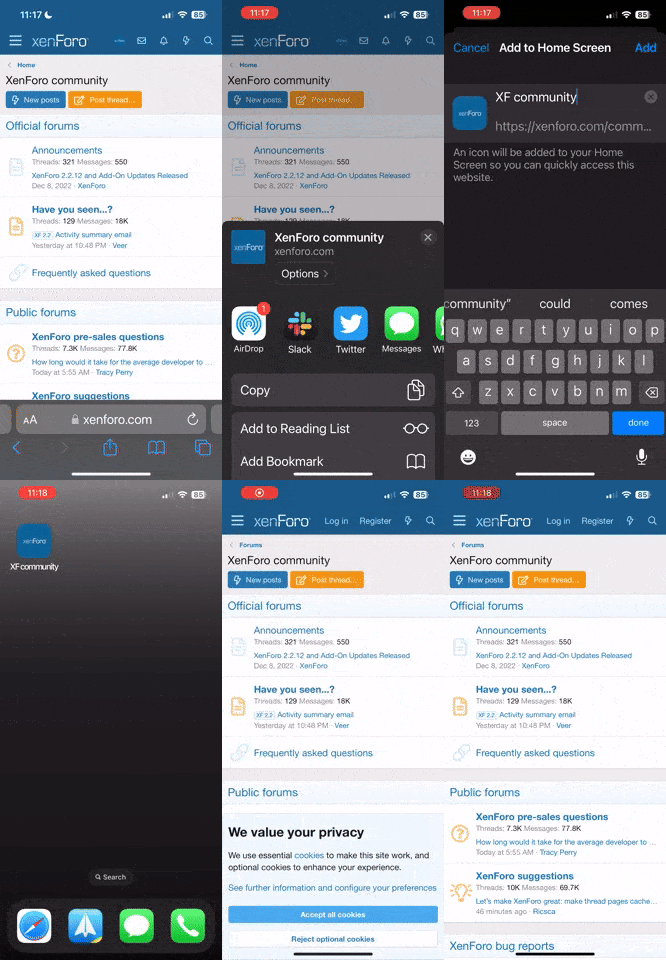
How many times do you look at your smartphone home screen per day? Is it 50? 75? I’d be willing to bet for some of you it’s more than 100 times per day. Smartphone home screen real-estate is some of the most valuable for today’s marketer. There simply isn’t another form of media your customer looks views with this frequency. Have you noticed no matter where you go on your iPhone or Android device, you are constantly prodded to download an app?

Visit USAToday, eBay, or Zappos from your mobile browser. Why are top companies encouraging you to download an app? An app download requires an icon be placed on your home screen. Whether you open that app or not, you’re seeing it on your screen many, many times per day. These “touches” make it much more likely that the next time you’re interested in current events you’ll think of and open the USA Today App. The next time you think of shopping for shoes or that new computer, you’ll open the Zappos or Ebay app. After all it’s one touch away.

If your customer downloads your dealership mobile app early in the sales process, you have created a “lock in” effect. The next time they think of searching inventory or scheduling service they think of you. Not only is an app a multi-touch branding opportunity, it offers one touch convenience for a next step action.

For the cost of mobile app for your dealership, I can't think of few better values “per touch” right now.

What other cost effective ways are you "touching" your customers? 

Dale Pollak VS Google at DSMC

I have been following the Google Cars program closely (with what information is readily available), as I am sure this will be a game-changer. I am willing to tackle your 3 questions Jeff...
 
1) I don't necessarily think this is the end of 3rd party leads, unless Google chose to not allow 3 party sites to utilize SEM to drive traffic. That would not make sense to me as Google is a for-profit company, which is the same reason they are creating google.com/cars - to make money. Make no mistake about it, this is not a "feel-good" project by Google designed to help consumers buy cars, it is a strategic move to make millions of dollars from the automotive industry in return for having their inventory displayed.
 
2) Yes, Google has this right, or should I say "of course". This is Google's platform, and they can decide to use their marketing solution and prioritize it over AutoTrader, Cars.com, or any other provider. Now whether they will do this cheaper than AT or Cars.com is another story. I would believe that Google will charge the most money that the market will bear in return for their services.
 
3) I don't believe that people are not sending leads because they are afraid of solicitation. The proxy model embraced by many providers is built on the assumption that customers do not want to communicate directly with dealers (which is an indirect way of saying "you should not trust car dealers"). If you are watching your key metrics closely, lead counts remain strong and are growing, with phone calls coming back much stronger than email leads as smart phones and "click to call" links are becoming more prevalent and convenient.
 
Thanks for the video clip, and great job to Dale for standing up!

Email IS Your Biggest Loss of Business

So the real issue is how do we implement email standards and consistently audit performance to hold our team members accountable?
 
The keys are standards, consistency and accountability - and I know of very few dealers who are willing or able to invest the resources necessary to achieve these goals.

Email IS Your Biggest Loss of Business

Thanks Joe and Jeff.  We can all definitely agree there is a long road ahead.
 
Since I posted this a few Internet Managers have reached out to me directly.  It sounds like they do see where things severely fall down within email communications coming from sales agents and managers.  They've been looking for ways to approach these individuals, and all I can say to that is:  people like to know how to improve.  Help them understand that customers don't all appreciate a lot of lol's, ttyl's and things like that (also a big problem).  Customers just want their questions answered in a timely manner.  Feel free to use this article as an ice-breaker toward your own coaching.

Email IS Your Biggest Loss of Business

It sounds like Ron Henson at DrivingSales and I are having the same epiphanies at the same time.  Ron is specifically looking at Internet lead responses and I'm talking about any email from the whole dealership.  However, they do go hand in hand.  Read Ron's article:  http://www.drivingsales.com/blogs/ronhenson68/2013/02/15/internet-lead-response-inspect-expect

Email IS Your Biggest Loss of Business

We've always known about our phone answering problems, but I rarely hear anyone talk about what we're saying to customers via email.

Did you know that you can measure all sorts of things around email to discover who is doing it well and who isn't? My favorite is to look at the number of emails sent against the number of emails a customer replied to.

For example: Joey sends 800 emails in a month and only 100 customers reply to him ...100 ÷ 800 = 12.5%.  When I see this number at a percentage less than 35% I start reading emails.

And what do I find when I start reading the emails that aren't being replied to?

Everything from people putting FU (more seasoned sales people believe this means "Follow Up") in the subject to "we don't provide prices over email." I even see messages where sales agents tell customers the dealership's advertisements are a joke. And the vast majority of the emails I read do not answer the customer's questions.
Email is where you are losing the most opportunities. Maybe as much as half.

There are two main email lessons to teach your staff:

  1. Email needs to benefit the consumer (and all communication for that matter).  Happily answer their questions and provide a path for them to follow.
  2. Consistency.  You're not having one on one communication with another person; you're a representative of the dealership.  They're not going to be friends with you after the sale.  If you say something wrong they'll turn on you in a second.  Be sure that your message is consistent with the one the dealership is saying, and never berate it.

Managers, please start measuring the difference between the number of emails sent to the number of emails your staff is receiving.  And then read the emails being sent from those individuals under the 35% mark.

I predict that most dealers are under a 20% email response average from their customers. That means that up to 80% of what you're sending might be telling a customer to buy their next car somewhere else.

Whats your dealers email response average? 

Overcoming Camera Shyness on Both Sides of the Lens

@AutoLawJD Cheers for that. General "media readiness" is a subject I'm going to put some real focus on, as it's only going to be more important as time goes on. It's easy to get all worked up over the big concepts in social media "science," but if you don't have content to begin with, none of that other stuff will do you any good. :)

Overcoming Camera Shyness on Both Sides of the Lens

Great post... lots of good tips in there, and something we've faced for years here at handycars.  Everyone wants video, but nobody wants to talk, be seen on, or shoot said video.  It'll be nice to see if some of these tips get people into the swing of things (and maybe a little top-down mandate might help as well...).

Overcoming Camera Shyness on Both Sides of the Lens

A huge stumbling block to creating interesting, original social media content is the fear of the lens. Time to get comfortable.


By now, I’m sure you’ve read all about why using video is important in your dealership. Videos of vehicle presentations, employee introductions, customer testimonials, special events, kids, and general silliness (among other things) can help communicate the personality of your organization in ways no other medium can.

If the employees in your dealership aren’t used to having a camera around, it will take some work to get everyone accustomed to it. If your dealership does embrace video--fantastic, but there still might be some ongoing challenges to overcome. Perhaps this scenario sounds familiar...

It’s a weekday morning, and the showroom is empty except for a few service customers reading their iPads and drinking coffee. A creative urge strikes, and you grab your video camera to start on that idea you wrote down last week. As you walk from station to station, looking for willing subjects, you’re met with a string of rejections, like ”I’ve got a migraine,” “you know I don’t do well on camera,” “ask so and so--he’s the real star,”  “I’ve got people coming in” and “not today.” Maybe someone actually grunts at you. Your creative momentum comes to a screeching halt, and the camera goes back in the bag with the dim hope that sometime soon, you’ll get another chance. 

This scenario highlights what I believe is the biggest obstacle to making videos at a car dealership: Camera shyness. Not just on the part of the subject, but the camera operator as well.

Obtaining someone’s agreement to be on camera is very much a sales exercise, and, come to think of it, camera shyness has a lot in common with a car shopper’s anxiety. Both involve a lack of trust and the fear of making a mistake.

Take heart. Embrace the spectrum of personalities of the people you film -- it’s what will make your videos come alive. As much as you might be tempted to, you just can’t keep taking pictures and video of the front of your building or of the cars on the lot. People want to see other people, so here are some suggestions I’ve compiled based on my experience as an in-house video guy...

Be prepared. Approaching people with a fully formed idea is more effective than asking “would you like to make a video?” Remember that good video is about telling stories, and turning on the camera and telling someone to “do something” will not result in a compelling story. Even if you’re asking someone to describe to the camera how their job fits in to the organization, have a quick conversation about what the goals of the video are, and how this person fits in to the achievement of those goals. Five or ten minutes alone with a pen and notepad before the lens cap comes off will work wonders. Remember to think in terms of shots, not just dialogue and action. The time of day has a huge impact on which shots will work in what locations, whether customer traffic or the position of the sun.

Give your subjects time to prepare. Sounds fair enough, right? It isn’t realistic to expect everyone to always be ready to shine on camera, and I’ve found that scheduling an appointment to film works wonders. Recently, I filmed some introduction videos for the ladies of our BDC, and we had a fantastic time because they knew what would be happening and came to the session relaxed and prepared. Granted, sometimes videos need to be made right now (filming a walkaround for a hot out-of-state lead, for example), but when that happens, use the situation as an opportunity to bond with the others involved in the project.

Be specific about what you want from people. People respond to direction, and the more you can explain to them what will work best for the photo or video, the more comfortable they will be losing themselves in the moment. Saying, “so, yeah, just be natural, you know what to do” isn’t enough. You MUST be the director. Even if they seem in a hurry, they’ll appreciate you taking the time to tell them how to look their best.  Also, it may seem simple, but giving directions in reverse (okay, move to the left, no, my left, your right, etc) takes practice, so give that some thought, too.

Experiment with props. You can’t buy new props every time you want to make a video, but if you’d like to see a lot of people get involved, this could be a great way to start. Hiding behind a huge white beard or silly hat is great for the nerves.

Try setting up a decoy situation. I’ve found that just setting the camera up and recording nothing in particular will encourage people to goof off or try to undermine what they think is happening. This is a gamble, however. Sometimes, this goofiness makes for good video, and many times, it does not.

Identify and utilize your camera-friendly allies on the sales team. Having your go-to people will help you get projects done when you’re in a hurry and can encourage others to get involved. Invaluable.

Create a culture of safety and trust. Salespeople know that customer trust is a precious, fragile thing. A cameraman must treat the trust of his subjects the same way. Avoid hidden camera pranks and let your subjects see the finished video before its uploaded for public viewing. Blow it once, and you may not get another chance.

Start reluctant subjects off with small parts in a video--maybe two sentences or less. Don’t expect too much too soon. Often, if someone agrees to give you two sentences, they’ll usually give you more than that once you start rolling. You might even ask for a single word or a particular facial expression which, if edited in at the right time, can bring the house down. Perhaps Vine, the new video-sharing app for Twitter that limits creations to just six seconds, would be a great way to start.

Know your talent, and know your audience. If an idea seems way out of character, there’s a good chance that it won’t make for an interesting photo or video unless the absurdity is exaggerated for comic effect. Use discretion here, however. With that being said, don’t be afraid to push your subjects outside of their comfort zones if you feel they can handle it.

Sometimes, just leave people alone and let them have fun. If you’re always focused on capturing the next unexpected YouTube sensation, you’ll miss out on a lot of opportunities to connect with your coworkers, which is an essential element of your job. I can’t stress this enough. Yes, you want a working environment where people understand the importance of video, but more than that, you want a working environment where people feel comfortable having fun ALL the time. Spoil too many moments by uncapping the lens, and you’ll be regarded as a fun vulture.

Show your willingness to be on camera at any time. Taking the stance that “I’m the camera man, not the talent” does not set a good example. Demonstrate that you wouldn’t ask anyone to do what you wouldn’t do yourself.

Some people will never be willing, so once you’ve identified them, leave them alone or you’ll never get anything done. Don’t torture yourself.

But what about...

What about asking for a video testimonial from a customer? When a salesperson comes into my office and asks me to record a customer testimonial, I make sure to always go out to where the customer is sitting without the camera. A conversation with the customer will remind everyone that you’re a human being, too, and not just “the intimidating camera person.” Letting the customer know what’s going to be happening and asking for their input on the process will put them at ease.

What about when someone gets upset that you’ve edited out their favorite part? I don’t hear this complaint much, to be honest. If you do, you can use this as an opportunity to have a discussion about what they feel their on-camera strengths are. You could also return to the footage in question and use the moment in a blooper reel montage.

How do you respond when someone insists on commenting negatively about their own weight, hair, appearance, speaking ability, etc? Offer reassurance, but avoid dishonesty.  Usually, such comments aren’t asking for a response, so do your best to stay on task.

Finally, enjoy what you’ve created. A beloved video can be a source of pride and laughter for years to come, so embrace this opportunity to help write your company’s history. Now, get out that camera and start shooting!


Can Your Email Find Love The Second Time Around?


With Valentine’s Day around the corner, I thought I’d share some ideas on how you can get a little more love for your email campaign by giving it a second chance.

Let’s say you sent off your email and the results aren’t what you expected. Since you’ve already put your time and effort into crafting your message – maybe it has a great offer or it’s a newsletter with helpful info – any additional opens you can get is a bonus without a lot of effort. Here are two scenerios where this is worth trying and a couple of techniques to help it work.


Scenario #1:


When you look at your email open rates broken down by email provider (please tell me you ARE doing this), you notice that one is pretty far off compared to the others. Example: Hotmail opens = 27%, Gmail = 33% and Yahoo = 12%. In this situation, why not try resending your campaign ONLY to Yahoo email addresses that didn’t open the first time?

Scenario #2:

You're reviewing the open rate and although your content was relevant and helpful to your customers, your open rates are pretty far-off compared to previous campaigns.

First, let’s consider why people who want your information may not have opened your email. Maybe:

  • The subject line didn’t appeal to them so they never opened it.
  • They were on vacation and yours was included in the bulk delete they did upon their return.
  • They saw it come in and intended to open it but it got buried before they remembered.
  • It got delivered to their spam folder and they never saw it.

These are people who may be interested in a second opportunity to see your message so why not try resending to those that didn’t open.

But before you hit the send button for the second time, you first need to make some changes. Begin by changing your subject line. You might try:

  • Adding personalization if you didn't use it the first time.
  • Use a different hook / highlight a different feature.
  • Take a reminder approach: "In case you missed this - "

Next, target a different time to send your message:

  • Change the time of day
  • Change the day of the week

And finally, select your recipients. Using your analytics from your last email, create a database of people who didn't open it. To be cautious, I would revise this list to include those people who didn't open this email, but have opened previous emails from you.

Wait a week or so since your original email (or whatever your analytics define as the drop-off point for your opens) and then resend.

A few words of caution... if you have a bad email reputation or you are filling up your customers' inboxes with info they don't want, sending an email a second time around is going to make your spam complaints skyrocket.

This technique is best used cautiously and when you have a special message that warrants a second chance or you’ve identified an issue with a specific email provider.

Dealer.com Partners with Contact At Once! Embedding Live Chat Into its Integrated Solutions

Sounds like possible entry partnership into a full acquisition. Why partner?  Dealer.com has had their own chat for years but unsuccessful at selling it to dealers. COA has the largest dealer chat foot print; working with Cars.com, AutoTrader, CarFax, OEM's and direct to dealers. That's a lot of dealers but more importantly, that's a lot fo DATA!! :)  Personal hunch. Not going on anything concrete.
 
What do you think?

Filter

🔥 This Week 5 threads · 33 posts
Community
What causes more frustration in vendor relationships?
Dealers and vendors debate their biggest frustrations in vendor relationships, with overpromising...
General
Slate - the vehicle we have been needing
Dealers and industry pros discuss the Slate EV, a $25,000 bare-bones electric pickup that emphasi...
Marketing & SEO
FB Marketplace auto-posters: the account-safety question most dealers skip
Dealers evaluating FB Marketplace auto-posting tools are largely ignoring the most important vari...
PPC Fraud and bad oversight - at 92% of dealerships
Steve Stauning warns dealers about rampant PPC fraud and waste, arguing that OEM digital ad progr...
AI = Awesome Intelligence
Dealers and vendor partners share experiences with AI tools, with discussion centering on Anthrop...
Get this delivered every week