• This thread is just the tip of the iceberg.The people ahead of the curve aren't Googling for answers — they're already in here, having the conversations you haven't found yet. DealerRefresh is free.Get the full picture →

5 Reasons to Forget About Your SEO

G

Guest Poster

Guest
There I said it. Forget about long-tail, short-tail, META tags, “page one domination”, link-building, URL strings, SEO training seminars and SEO wiz-bang nonsense. Forget it. At least for the moment.

Unless you have a website in development or are switching providers where an SEO strategy is vital during the implementation of your new website, your #1 priority should be to have a PPC (Pay Per Click) marketing plan and budget in place for 2011.

Obviously SEO is a massively important strategy - one that should be implemented carefully and with the right data and people in place to do so. But this industry has become borderline infatuated with SEO without giving PPC the attention it deserves. I have dealers consistently making suggestions about their Page Titles or META data (impressive), but then go on to ask me if that will help them show up in the “pink box” at the top of Google. No, those are “Ads”. You have to pay for those.

Below are 5 top-level reasons and stats to get your brain on the right track about Search Engine Marketing (SEM) – the umbrella of SEO and PPC.

GROWTH
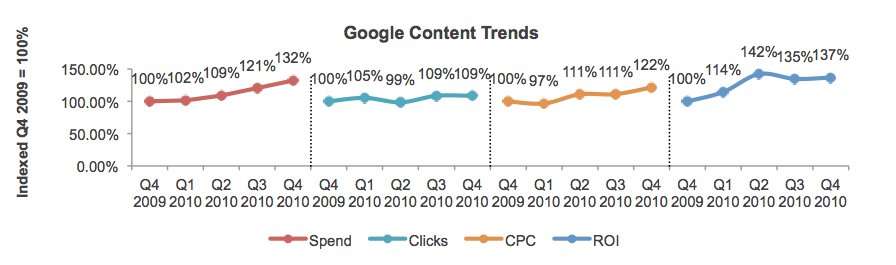
Automotive PPC spending for 2010 increased by 35% over 2009 along with increases consumer demand. OEMs, Tier 2 Associations and Dealers alike are increasing their budgets for 2011, which means if you don’t have a plan for Paid Search then most likely your competition does. (Source: Efficient Frontier)
Google-Content-Trends-SEM.jpg

TIMING
SEO is a long-term strategy with long-term benefits. It could be weeks or even months before you start to see the fruits of labor. New domains can take up to 12 months to hit their stride, but most SEO programs don’t plateau until between months 6-9. With PPC, you could be on the first page of Google inside of 48 hours.
Time-Periods-SEM.jpg

SEM-Map.jpg

CONTROL
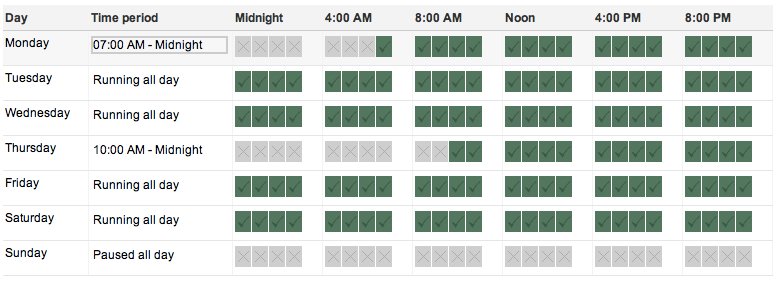
With SEO, you have minimal-to-no control over how you appear in the search engines. Optimizing your website requires a keyword strategy first – of which most dealers do not have. Once your site is optimized, Google will choose what it sees what it likes, and what to display. With PPC, you have direct control over where, when and how your ads appear. You control the ad copy, the day-parting, the sites you want to appear on, your geographical targets, and even the page you want your visitors to land on. Google is offering more and more tools to help you control your PPC campaign. Additionally, a solid PPC program will give you invaluable information such as top-trafficked terms which you can use to build a more effective and efficient SEO program

TRAFFIC
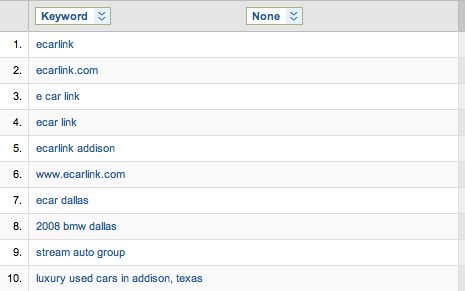
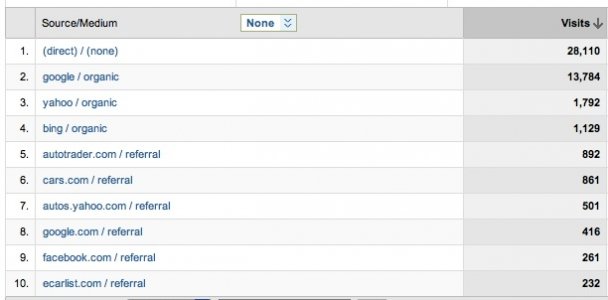
This one’s a biggie. Yes, your Google Analytics shows that 52% of your traffic is “Organic”. Guess what. The majority of that Organic traffic is for your Trademark terms. And it always will be assuming you have been around for a while and have done a decent job at branding. Take a look at the rest of the terms. There will be supplemental traffic from additional SEO rankings, but you won’t see the type of direct influence from SEO on individual keyword traffic as you will from PPC. Side note – a good SEO keyword strategy will include high-focus on 1-3 top-trafficked keyword phrases.
Analytic-Trends-SEM.jpg

Keyword-Trends-SEM.jpg

ROI
Here’s where it gets tricky. Although both PPC and SEO have been proven to produce the highest ROI when compared to traditional marketing, PPC should have a lower ROI in the short term, while ROI for SEO increases over the course of the program. For SEO, as organic rankings start to climb, traffic, leads and sales should go up thus increasing your ROI. However, with PPC your ROI can be measured instantly and more accurately. Within 5 days you should have your average Cost Per Click, your total spend, total traffic and total leads. From there, it’s a simple equation. More money = more leads. And it’s this direct affect that makes PPC an invaluable advertising medium.

Both SEO and PPC are changing dramatically, and obviously you as an automotive dealer (business owner) should have a solid handle on both. SEO has become more than just getting better /higher organic rankings with direct correlation to ORM (Online Reputation Management) and Social Marketing. PPC is also changing with new strategies and methodologies being adopted by the engines. Amongst many changes including comparative and more visual ads, we predict more emphasis by advertisers and the engines on CPA (Cost Per Action), which means you don’t pay unless someone takes action such as filling out a lead form or clicking to call.

Overall, it’s impressive to see the Automotive community come together, show interest and devote resources to improving their online marketing. My advice is to do your research, become knowledgeable and then put the right people in place to make it happen…preferably not you or anyone within your dealership. After all, you have cars to sell and customers to service.
 
Terrence - nice article. You're absolutely right when you say "Yes, your Google Analytics shows that 52% of your traffic is “Organic”. Guess what. The majority of that Organic traffic is for your Trademark terms. And it always will be assuming you have been around for a while and have done a decent job at branding."

I'm sure every website provider can prove this to be true for dealers who take the time to brand themselves (most do). It is very easy to get caught-up in your analytics to see organic search results having very high conversion rates, but that's because most of those results are based on dealership name searches. Dealership name searches = consumers specifically looking for you. They wanted to contact the dealership before typing [DEALERSHIP NAME] into Google, so naturally they're going to convert.

Visiting a dealership website is a means to an end. Simply visiting the website shows a strong buying sign.

If you want to entice shoppers earlier in the buying cycle your easiest search engine strategy is Paid Search. If you couple that with good SEO and relevant landing pages your success will be much higher than it is today.

If there is one thing I'd like to see people understand from Terrence's article it is that SEO and PPC are not two different expenses; they are two things that work together and you should be engaged in both.
 
Terrence, great post and Title. Dealers need both SEO and SEM for a comprehensive digital marketing strategy. There is no doubt that SEM produces immediate traffic, however it does not guarantee that the investment and traffic will be profitable.

I would like to add that SEM is only effective if the clicks are taking consumers to proven landing pages that convert on the click. The automotive industry is just waking up to landing page conversion optimization, and Larry Bruce has been like John The Baptist preaching to the deaf.

I believe that dealers who want to increase their market advantage in 2011 will need to increase resources to inspect their analytics and work on conversion testing. These are two of the top 5 things dealers need to prioritize this year.

Just as a bad SEO strategy is a waste of money, pumping thousands of dollars of Adwords spending to send shoppers to the home page of the dealership website or to an inventory listing page can be a big waste of money. I see this basic setup all the time.

In 2011, I would like to see more dealers understand that conversion of traffic, SEO and SEM, must be the next step in the evolution of automotive advertising. SEM has great control and instant traffic but it takes skills that most companies are not offering dealers to do a real controlled A/B test on landing page designs.

PCG is starting a free 8-week SEM study on February 15th to start educating dealers on how to setup, test, measure, and refine their PPC spending. I totally agree that PPC should be used by all dealers, and they should test the broad high volume phrases like "used cars", "used ford", "used nissan", "cars for sale", "toyota dealers" with a conversion focus.

Are dealers interested in learning more about Adwords? 110 dealers signed up for this free 8-week training program to date, so I would say that your article is right on the mark.

DealerRefresh members can still sign-up until February 1st at http://www.automotivesemstudy.com for this free study.
 
I agree, nice article. I even agree with the 52% organic remark. It's interesting though... That with an SEO strategy that 52% of organic traffic represented tens of thousands of website visitors versus the 1 thousand visitors it represented when we began with our SEO strategy in the fall of 2006. The ROI becomes infinite when you have your employee(s) trained to do this vs paying a company to do it for you.

I just don't see the urgency of ppc. With products like Dealer.com's dominator and ReachLocal there isn't a whole lot of need to get right on PPC. Sure, have budget... Now what?

Send a check. Problem solved. If you're suggesting a ton of strategizing needs to be done, this just isn't the case. Algorithms are far more successful managing bid strategies than people are. So where's the urgency?

$2k/month for rural small store. $5k/month for larger metro store. Next... I mean, back to SEO...which has changed DRAMATICALLY! AGAIN!
 
Tim, I am with you, but you can’t deny that since Google has jacked up local SERPs, the map based keyword SERPs are seen much more often and we all know these Map based results push organic down below the fold. We know Local SEO is H-O-T (local SEO is not organic). That being said, Top 3 positions in PPC have never worked better, whereas organic SEO is fighting to stay above the fold. I am not saying organc SEO is futile, I am saying its share of the pie on high volume generic terms is getting smaller.
 
We manage our PPC inhouse (My Son and I)! I have found there are boat loads of strategy to explore and exploit. Here's my view of the PPC battle field.

Dealer Inventory Profile.
Every car dealer has a different "inventory profile" and this profile will govern how you approach PPC. For example, let's say we had 2 dealers, one is an exotic dealer and the other is a mega-multiroof dealer. The Inventory Profiles of these 2 dealers greatly influences the "width" of the PPC campaign. The exotic dealer can't convert someone looking for "used cars" so he buys very narrow, low volume, long tail keywords (like: "used porsche 911"), where as the Mega-Store, deep in thousands of units for sale, can convert traffic from keywords like "used cars" (and lots of other generic high volume short tail keywords like “Chevrolet SUV”, “SUV for sale”, “minivan seats 8”, “awd minivan”, “AWD for sale”, and on and on and on.). So... we can see how the inventory profile drives your PPC attack plan.

In my case, my inventory profile rewards the wide open PPC funnel. PPC is 20% of my sites total traffic, it creates 16% of my lead volume and does it with <10% of our ad budget. That’s kick-ass ROI. For those PPC visitors that don’t submit a lead (a whole topic unto itself!), the traffic metrics all look like quality visits. Comparing PPC traffic to my organic traffic (who _also_ don’t leave leads ;-), everything looks acceptable: Number of pages viewed, time on site, bounce rate all look right.

Geo Opportunities (aka where are you?).
Also, as Tim mentioned, the stores location(s) adds a layer of opportunity (aka strategy) on top of Inventory Profile. There is rural vs metro AND don’t forget rural dealer close to metro.

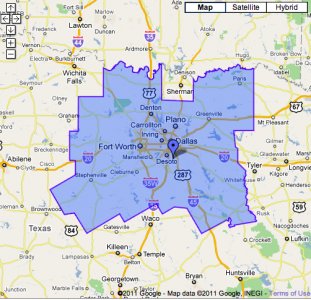
Because you can geo-position your ads, my plan was to build and optimize our PPC ads in our local market, then, copy them all into the “next market over”. In my case, I made 4 “next market overs” North, South, East and West. I can budget, track and optimize each region separately. For example, I have seen excellent results from us reaching into rural markets. With Googles new CPA* bidding optimizing campaigns out of my home market will be far easier. *Cost Per Acquisition [Acquisition = Lead]
 
Great post Terrance, PPC is a great source of highly targeted traffic and can result in a solid ROI provided everything is in good shape with a dealers website.

My suggestion to dealers is to first clean up all the issues on the site before launching a campaign (404's, pageload, keyword use). This is normally part of the SEO process in my opinion because SEO should always be underway because I've seen minor coding issues, or URL changes cause major problems (loss of pagerank) without the dealer even aware of it.

Dealers must have Google Analytics, Webmaster Tools, and a provider or trained inhouse staff to keep track of their rankings by monitoring the things that influence rankings, keep improving the site on all levels, but as far as SEO the main ones:

1. Inbound Links (from trusted sites like bbb, angies list, and other local directories)
2. Unique Content (create a good template, images, call to action, etc.)
3. Usability (can a user find what they wanted on the page or via a link on the page)

If the main pages of a dealers website do not have good titles, descriptions, or internal links (with use of rel="nofollow" to non-important pages like privacy page, print vehicle page (this often shows up as a soft-404) - then they won't be passing juice through properly and won't be able to rank for non-branded keywords.

Once the site has the ability to rank well for non-branded keywords (the real SEO work) and begins to compete for the ones that have a higher monthly volume it might then be time for SEM/PPC because the pages should have a good quality score (won't waste money overpaying for clicks).

Another issue is that all advertising should be tracked via tagged URL's (just Google URL tagging) so that it can be monitored in Google Analytics for conversion rate by campaign.

Once the data begins to identify the best sources of traffic, the budget can be adjusted accordingly. Campaigns that aren't producing can be shut down, and fine tuning of the others can begin.

Setting up microsites, blogs, etc are a great way to build additional awareness of the dealer brand, but again, they need to be part of the entire online marketing strategy.

Blogs build awareness simply because its in their DNA to be social and appreciated when they have remarkable content (good stuff that attracts links). This is very hard for dealers to manage on their own, even our clients hire inhouse staff to help produce quality content and engage their audience on Twitter, Facebook, etc.

Its really important that dealers really recognize how much this works and outperforms traditional marketing. Many of the dealers that are doing it well are seeing massive growth, and it's an exciting time to be involved in this industry.
 
Joe, you sound like an Adwords Certified Professional to me.

@Tim - the urgency is simply more immediate traffic and the rising costs of CPCs. I suggest driving as much traffic as possible and getting your brand out there while it's still relatively cheap to do so.
 
@ Brian Pasch
Your Comment "There is no doubt that SEM produces immediate traffic, however it does not guarantee that the investment and traffic will be profitable."

SEM doesn't guarantee it will be profitable, and SEO does? If SEM is done right a dealership will get a 20 Fold return over any investment in SEO.
If you build an ad that has transactional based ad text, targeted to the right page, run when people are most app to see it, placed on the right network, excluded from being seen by the wrong audience (negative keywords) the chances of PPC converting is at least 20 Fold that of SEO. We can prove it. We did a SEO vs. SEM study on a very large Honda dealer we have as a client that is top ranked (1 through 4 positions organically on Google) for 100's of keywords. To say that the SEM cannibalized the SEO would be, being polite. I'll post it to our site.

Your Comment: I would like to add that SEM is only effective if the clicks are taking consumers to proven landing pages that convert on the click.

This is exactly what the problem is with SEO.... With PPC you can bring them to the proper page, update offers on the fly and have transactional based traffic go to a page that is relevant - In real time. With SEO, it takes time for a site whose content is not updated regularly (Especially from a low Page Ranked Site) to get re-indexed for the current offers and when it finally is - the offer is expired.

Your Comment "I would like to see more dealers understand that conversion of traffic, SEO and SEM, must be the next step in the evolution of automotive advertising..."

A/B test landing pages is skill? How about phrase match vs. exact match or broad plus match with relation to negative keywords and transactional ad text.... PPC done right is KILLER, landing pages are important but not hard to figure out.

AND
 
@ Brian Pasch
Your Comment: "I believe that dealers who want to increase their market advantage in 2011 will need to increase resources to inspect their analytics and work on conversion testing."

Analytics...?? Dealerships have a hard enough time selling cars, now they should delve extensively into Analytics? Conversion testing? Lets think about this... What analytics should they look at? Bounce rate? Keywords? Here is just two of the many problems with just those two of infinite things that can be gleamed from analytics:

1) Bounce rates go up with PPC done right so dealerships would be mislead to believe that their site is performing worse due to a higher bounce rate

2) Keywords - Most dealerships with base SEO done right are found for thousands of keywords, when in reality there are a dozen (boiled down from how they are typed in) that convert steadily

A/B Testing?
Developing a good landing page with-in a site isn't rocket science... getting the right people to it using PPC, maybe close.

Here are 2 Things dealers must learn in 2011

1)Understand How Google Works
Know that Google is made up of 3 Networks
A-Search
B-Search Partners
C-Display
*Understand how each of them work, and how different ad styles perform on each. (For example Text Ads perform terrible on the Display Network).

2) How to hire the proper digital ad firm - Dealers need to learn as much as you they can so that they can interview the right firm to manage their web based advertising. (Google, Bing, Linked-in & Facebook Ads etc.)

Your Comment "Just as a bad SEO strategy is a waste of money, pumping thousands of dollars of Adwords spending to send shoppers to the home page of the dealership website or to an inventory listing page can be a big waste of money."

Agreed, but... if dealerships think "Geo Targeting", "Day Parting" and "Landing Page A/B Testing" are solely the answers, then they're wasting just as much money as they would driving traffic to their home page. PPC is predicated on Quality Score. And, in order to get good quality scores across your campaigns a dealer would need to understand ad text for mobile vs. computers, how ad extensions work, use of negative keywords and what ad to run on what network... for starters.
Very few if any dealerships should manage their own PPC. And, if they understood how the Reach Local's, Dealer.Com's & Cobalt's of the world managed it for them then they would do nothing but buy full page spreads in the newspaper..
Dealerships should take the time to find the right professionals to manage their campaigns, and read enough to know what to look for before hiring them. Conferences and seminars are full of self-promotional fluff. More can be learned from reading the right blogs and books then any workshop..