










- May 1, 2005
- 6,048
- 1,941
- Awards
- 12
- First Name
- Jeff



Do you believe there is any way to measure the number of customer you lose by hiding information behind leadgates? If I shop and a payment is important to me, when you don't have a DRT - I will go to Edmunds.com loan calculator, which is my experience is the best, or if it's a lease - I will go to Leasehacker, and both of them will do their best to distract me and to submit a lead to one of their customer-dealers, or in the case of leasehacker - a broker.We've tracked and measured these issues for more than a decade. In short:
1. A DR CTA that vomits payments on the customer before they've entered any data reduce conversions. ("Oh, $950 a month? I can't afford that.")
2. DR tools that take the customer away from the dealer website and make it hard to return reduce overall conversions (even when you add the DR conversions back into the total).
3. "Accurate" DR tools that build the entire deal for someone who lives in the market reduce closing percentages. Why? Because the customer already has all the information and either decides that now is not the time to buy or to shop your numbers with your competitors. (One recent example I can point to is a small Midwest group who closes their DR leads at 7-8%, yet closes their dealer website "Check Availability" leads at 23%+ - and all other metrics with the Check Availability leads are higher: Connection Rate, Set Rate, Show Rate, Appointment Close Rate. And no, adding a DR tool did not increase their total leads from website visitors. In fact, these were flat-to-down as a percentage of engaged users once the DR tool was added.)

The 7% stat makes sense when you think about where deals actually fall apart — it's not the channel, it's the desk. A customer can start online, get a payment quote, show up in person, and still walk out paying something completely different because of what happens between the manager and the salesperson in the last 20 minutes.7% of buyers report purchasing entirely online
7% of buyers report purchasing entirely online
7% of buyers report purchasing entirely online
7% of buyers report purchasing entirely online
7% of buyers report purchasing entirely online
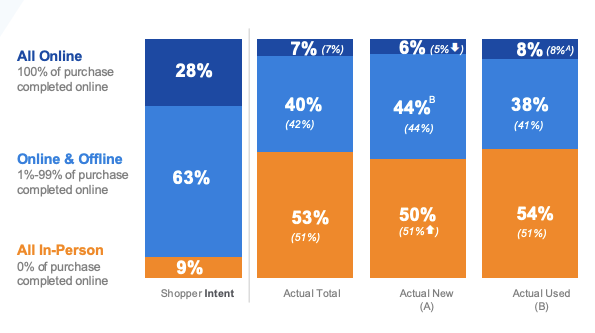
According to the latest Cox Automotive Car Buyer Journey Study: Report Summary 2025
ONLY 7% of buyers report purchasing entirely online.
ALL that damn work during the Covid years, manufacturers shoving online buying services down our throats and making it MANDATORY to have on our dealer websites. Company after company scrambling to capitalize. Acquisitions to have a solution to for dealers.
"Digital Retailing" wasn't just the new buzzword in the industry, TOTAL - from beginning to end online vehicle purchasing was going to revolutionize how dealers sold vehicles and how consumers were going to save time buying their next vehicle from a dealership.
BUT DID IT?
Dealers scrambled to offer a solution to this new wave of online BUYERS. BUT in many cases it proved to be a nuisance, became a commodity of the tech bundle and another standard service the OEMs forced upon us.
Most of us gave it an honest effort to make it work but seems as if MOST of us in the business and on the dealer side already KNEW how it was going to end.
Here we are, 5 years later and only 7% of buyers report purchasing a vehicle entirely online.
What happened - Are you surprised?

7% is not a mic drop, it’s a framing trick. “Entirely online” is an edge case, car buying is high-ticket, emotional, involves trade-ins, financing, test drives so smart people will not go 100% online. That was never the real battleground.7% of buyers report purchasing entirely online
7% of buyers report purchasing entirely online
7% of buyers report purchasing entirely online
7% of buyers report purchasing entirely online
7% of buyers report purchasing entirely online
According to the latest Cox Automotive Car Buyer Journey Study: Report Summary 2025
ONLY 7% of buyers report purchasing entirely online.
Just because the final step happens in-store doesn’t mean digital failed.ALL that damn work during the Covid years, manufacturers shoving online buying services down our throats and making it MANDATORY to have on our dealer websites. Company after company scrambling to capitalize. Acquisitions to have a solution to for dealers.
"Digital Retailing" wasn't just the new buzzword in the industry, TOTAL - from beginning to end online vehicle purchasing was going to revolutionize how dealers sold vehicles and how consumers were going to save time buying their next vehicle from a dealership.
Your ignoring who actually owns the customer"Digital Retailing" wasn't just the new buzzword in the industry, TOTAL - from beginning to end online vehicle purchasing was going to revolutionize how dealers sold vehicles and how consumers were going to save time buying their next vehicle from a dealership.
BUT DID IT?
Dealers scrambled to offer a solution to this new wave of online BUYERS. BUT in many cases it proved to be a nuisance, became a commodity of the tech bundle and another standard service the OEMs forced upon us.
Most of us gave it an honest effort to make it work but seems as if MOST of us in the business and on the dealer side already KNEW how it was going to end.
Here we are, 5 years later and only 7% of buyers report purchasing a vehicle entirely online.
What happened - Are you surprised?
Dealers debate whether digital retailing platforms have failed, citing a Cox Automotive study showing only 7% of car buyers purchase entirely online—far below the 20% many predicted five years ago despite massive manufacturer mandates and industry investment. Contributors argue that complex car deals with multiple variables, inadequate OEM tools, unreliable data, and fundamental buyer preference for human interaction have limited online adoption, with some noting that prominent digital retail CTAs may actually reduce overall conversions rather than improve them.