


• This thread is just the tip of the iceberg.The people ahead of the curve aren't Googling for answers — they're already in here, having the conversations you haven't found yet. DealerRefresh is free.Get the full picture →

What do dealership websites make customers do that we’d never tolerate in the showroom?

KennySmithAutoUnite

Sled Master
Jul 9, 2026
39
30
Awards
3
First Name
Kenny
Been thinking about this from the store side.

If a customer walked into the showroom and every few minutes a different person interrupted them, asked for their name and phone number before answering a basic question, made them repeat information they already gave us, and then made them start over when they moved to another part of the store, we’d call that a bad customer experience.

Online, we’ve somehow gotten used to a lot of it.

Popups. Chat boxes. Lead forms. Trade tools. Payment tools. Credit tools. Different vendors asking for the same information.

Some of those tools absolutely have a purpose. I’m not saying all of it is bad.

What I’m wondering is where we crossed the line between helping the customer and making the customer work around our systems.

What does your dealership website or digital process make a customer do today that you would never tolerate if the same thing happened in your showroom?

And if you could remove one piece of friction tomorrow, what would you remove?

I’m interested in both sides of it. Dealers living with it every day and vendors who think we’re looking at it wrong.
 
  • Like
Reactions: Vochi
Been thinking about this from the store side.

If a customer walked into the showroom and every few minutes a different person interrupted them, asked for their name and phone number before answering a basic question, made them repeat information they already gave us, and then made them start over when they moved to another part of the store, we’d call that a bad customer experience.

Online, we’ve somehow gotten used to a lot of it.

Popups. Chat boxes. Lead forms. Trade tools. Payment tools. Credit tools. Different vendors asking for the same information.

Some of those tools absolutely have a purpose. I’m not saying all of it is bad.

What I’m wondering is where we crossed the line between helping the customer and making the customer work around our systems.

What does your dealership website or digital process make a customer do today that you would never tolerate if the same thing happened in your showroom?

And if you could remove one piece of friction tomorrow, what would you remove?

I’m interested in both sides of it. Dealers living with it every day and vendors who think we’re looking at it wrong.

I don't think a customer walks into the showroom and says, “I'd like to use your inventory system now, then your payment system, then your trade-in system, and finally I'd like to talk to someone about credit.”

In my humble opinion, I believe most of them have a goal that want to accomplish.

“I need a reliable car for my daughter to get to work.”

“I've got three kids and need more room.”

“I tow a camper a few times a year, but I don't want to drive a truck every day.”

“I need to stay around $500 a month.”

And a good salesperson starts with that and works backward toward the right vehicle.

Online, we've largely reversed that.

We put the inventory in front of them and make the customer figure out which vehicle solves their problem. Then we bolt on a trade tool, payment calculator, credit application, chat, lead form, etc., with each one asking for another piece of information.

The customer isn't really shopping the dealership because they're busy navigating the tech stack.

I don't think the customer should start with the inventory, I believe they should start with what they're trying to accomplish, identify the best make & model fit, then search the inventory.

And the tools can be there but they should be connected to the inventory.
 
I think most dealership website shoppers know EXACTLY what they're after on a dealership website. They're much further down the funnel than website companies give them credit for. This is why leads from dealership websites are "the best" and leads from OEMs are "the worst."

I also believe AI is going to move my opinion closer to fact.

Get out of cars for a minute. Amazon is a weird example as it serves as an Autotrader and a dealer website. But if you think of something like B&H or Best Buy you're usually going there for a specific product and may be tempted into something else by reviews. You already decided you wanted an Apple laptop or a new Android phone. Now, you're just checking inventory to see how soon you can get it.

Dealership customers only have two questions: How much is it? And how soon can I get it? (Service = how soon can I get my car in?)
 
I think most dealership website shoppers know EXACTLY what they're after on a dealership website. They're much further down the funnel than website companies give them credit for. This is why leads from dealership websites are "the best" and leads from OEMs are "the worst."

I also believe AI is going to move my opinion closer to fact.

Get out of cars for a minute. Amazon is a weird example as it serves as an Autotrader and a dealer website. But if you think of something like B&H or Best Buy you're usually going there for a specific product and may be tempted into something else by reviews. You already decided you wanted an Apple laptop or a new Android phone. Now, you're just checking inventory to see how soon you can get it.

Dealership customers only have two questions: How much is it? And how soon can I get it? (Service = how soon can I get my car in?)

Unless I am reading this wrong the current industry data actually argues against what your saying, not saying how it is at your store, maybe your customers are more educated however, Cox Automotive's June 2026 research, developed with NIADA, found that 83% of independent-dealer buyers begin shopping without knowing which vehicle they want. They visited more than five websites and spent an average of 16.5 hours researching online.

Cox's 2025 Car Buyer Journey Study found essentially the same thing across the broader market: only 29% of buyers knew what vehicle they wanted when they started shopping, meaning 71% did not.

New Cox Automotive Research Reveals Independent Dealership Buyers Are Driven by Necessity—Not Aspiration - Cox Automotive Inc.

Cox Automotive Car Buyer Journey Study Finds Efficiency, Digital Tools and AI Drive Record Satisfaction - Cox Automotive Inc.

I agree that dealership websites are generally later in the funnel. In fact, Cox has shown dealer websites are particularly important toward the end of the online journey.

However “I'm ready to buy” and “I know exactly which vehicle I should buy.”

Seems to be more of what's happening??

A customer can be very close to buying while still trying to answer:

“I have three kids, what's the best fit for us?”

“I need something reliable for my daughter.”

“I tow a camper twice a year, but don't want to drive a truck every day.”

“I need to stay around $500 a month.”

That's exactly what a good salesperson does in the showroom: they start with the customer's objective and work backward toward the vehicle.

Cox's 2025 Drivers of Car Shopping Satisfaction research identified four major drivers of satisfaction:
  1. knowledgeable/supportive staff
  2. transparency
  3. feeling well-informed
  4. and being in control
Their top stress points included determining what the buyer could afford, trade-in, financing, F&I, and finalizing deal terms.

While I'm not saying your dealership isn't different however the data doesn't show customers only want price and availability, at least not at the average dealership.

It shows something closer to they want to make the right decision with as little friction and as possible.

Of course price and availability are critical once they've narrowed the vehicle down.

However I believe there is a huge opportunity: That the dealerships have skipped.
 
The other day when I was auditing some Ford sites I kept seeing this banner come up on the homepage comparing oil change prices to other shops in the area and I couldnt help but think how silly of a strategy that is

Like if I physically walked into a store, any store, coffee shop, BestBuy, Costco, the grocery store, HomeDepot, I don't see active ads saying how much cheaper they are

But you know who does this that is automotive adjacent? Harbor Freight

Anyway, I thought it was a massive waste of resources. If I am already coming to your website to schedule service, a random banner on the homepage with price comparisons is not going to make me schedule service harder :rofl:
 
  • Like
Reactions: Vochi
Unless I am reading this wrong the current industry data actually argues against what your saying, not saying how it is at your store, maybe your customers are more educated however, Cox Automotive's June 2026 research, developed with NIADA, found that 83% of independent-dealer buyers begin shopping without knowing which vehicle they want. They visited more than five websites and spent an average of 16.5 hours researching online.

Cox's 2025 Car Buyer Journey Study found essentially the same thing across the broader market: only 29% of buyers knew what vehicle they wanted when they started shopping, meaning 71% did not.

New Cox Automotive Research Reveals Independent Dealership Buyers Are Driven by Necessity—Not Aspiration - Cox Automotive Inc.

Cox Automotive Car Buyer Journey Study Finds Efficiency, Digital Tools and AI Drive Record Satisfaction - Cox Automotive Inc.

I agree that dealership websites are generally later in the funnel. In fact, Cox has shown dealer websites are particularly important toward the end of the online journey.

However “I'm ready to buy” and “I know exactly which vehicle I should buy.”

Seems to be more of what's happening??

A customer can be very close to buying while still trying to answer:

“I have three kids, what's the best fit for us?”

“I need something reliable for my daughter.”

“I tow a camper twice a year, but don't want to drive a truck every day.”

“I need to stay around $500 a month.”

That's exactly what a good salesperson does in the showroom: they start with the customer's objective and work backward toward the vehicle.

Cox's 2025 Drivers of Car Shopping Satisfaction research identified four major drivers of satisfaction:
  1. knowledgeable/supportive staff
  2. transparency
  3. feeling well-informed
  4. and being in control
Their top stress points included determining what the buyer could afford, trade-in, financing, F&I, and finalizing deal terms.

While I'm not saying your dealership isn't different however the data doesn't show customers only want price and availability, at least not at the average dealership.

It shows something closer to they want to make the right decision with as little friction and as possible.

Of course price and availability are critical once they've narrowed the vehicle down.

However I believe there is a huge opportunity: That the dealerships have skipped.
This sounds like an AI response. Which is annoying because they're so damn wordy... and completely lack instinct.

Let me start with what AI cannot account for: Experience.

Ask any car dealer how many customers have walked on the lot and said: "I have no idea what I want; since you're a car dealer, you can help me figure it out." Every customer either wants a brand, a model, something extremely specific, or is a get-me-done when they approach the dealership. When they're hitting the dealership website, they have landed there from a different research experience telling them that dealership has that car. That could be Cars.com, Autotrader, Google search, or AI pointing at that dealership. The direct traffic reason is usually a repeat customer or someone who has driven past the store. In both those cases, those are still customers who have a good idea of what they want.

Customers come to dealers with a mission. All others show up on Sunday.

Now, the studies you chose are gold to me. Cox Automotive Studies.

Your AI didn't realize that I used to work there. I spent nearly 8 years at Dealer.com building product. I was deep into how research is conducted.

News flash: we were always guessing at what motivated shoppers. We had no great intelligence. Cox liked to do surveys, but those had their flaws. Our bias was lead gen. It was the only thing dealers measured us on. We had zero insight into what happened after a lead was submitted. And no technology or study will ever tell you what psychology happens when a customer is sitting in front of a salesman. You have to be an asphalt-hitting commission-earner to get it.

Your first study was with NIADA about Independent shoppers. Well, that's a different animal entirely. Those people want a payment, and the actual car they want is secondary. They don't have the income or credit to qualify for a loan at a franchised store, so their options are limited, and they know it.

TLDR

"This ain't a bus stop" is what my first used car manager used to say in a gruff voice every time a customer was walking the lot without being upped. Those of us who have paid our bills on commissions from selling cars know that no customer comes to a dealership for the sheer joy of it (unless you're a Ferrari store). They come with a purpose, a mission, and the website is where they go to collect a little information to determine whether they're going to visit that dealership. It isn't a tool to decide whether they want an SUV or a Sedan.
 
  • Like
Reactions: dealerdata1
I don't think the customer should start with the inventory, I believe they should start with what they're trying to accomplish, identify the best make & model fit, then search the inventory.

Customers don't give two sh*ts about what you think. The industry needs to let that go (thinking they know what is best for the customer) and start observing what their behavior *IS* and shape the experience around that.

Customers don't come into the showroom when they come on to the dealership... they drive around the lot. The lot IS the showroom. ;)

And the tools can be there but they should be connected to the inventory.
100%!! Thats what I call "The Connected Lot". ;)
 
Customers come to dealers with a mission. All others show up on Sunday.

There is a lot of truth right here. More than many realize. ;)

Now, the studies you chose are gold to me. Cox Automotive Studies.

Your AI didn't realize that I used to work there. I spent nearly 8 years at Dealer.com building product. I was deep into how research is conducted.
To be fair Alex, I had no idea you worked there either. AI would have a better chance at knowing that fact about you than a person. LOL

News flash: we were always guessing at what motivated shoppers. We had no great intelligence. Cox liked to do surveys, but those had their flaws. Our bias was lead gen. It was the only thing dealers measured us on. We had zero insight into what happened after a lead was submitted. And no technology or study will ever tell you what psychology happens when a customer is sitting in front of a salesman. You have to be an asphalt-hitting commission-earner to get it.

Good lord people, it's not that hard, so stop making it so! What did Best Buy learn 30 years ago? People want to shop on their time, at their pace. Without pressure. Walk into an Apple Store... everyone there is there to HELP YOU, not sell you. Nobody wants to be sold to. But the entire industry is based around sales performance historically so this is a culture thing.

Your first study was with NIADA about Independent shoppers. Well, that's a different animal entirely. Those people want a payment, and the actual car they want is secondary. They don't have the income or credit to qualify for a loan at a franchised store, so their options are limited, and they know it.
Except thats not whats going on at all right now. Painting an entire segment with a broad brush is problematic and will lead down the wrong path for solutions and experiences. I see car buyers lot activity across the country in realtime daily from new to pre-owned, franchise to independent and less than 50% of the being activity is payment based.

"This ain't a bus stop" is what my first used car manager used to say in a gruff voice every time a customer was walking the lot without being upped. Those of us who have paid our bills on commissions from selling cars know that no customer comes to a dealership for the sheer joy of it (unless you're a Ferrari store). They come with a purpose, a mission, and the website is where they go to collect a little information to determine whether they're going to visit that dealership. It isn't a tool to decide whether they want an SUV or a Sedan.

LOL - Love that bus stop comment! ;) And that website doens't convert traffic to leads. (most convert at <3%, the best are around 7%) Customers don't want to give their info. Look at the conversion rates that are in the basement... SO CUT IT OUT! Give them a great buying experience FIRST and then work on converting them. When most of those car buyers come to the store, they are still anonymous... and they're visiting several stores. The first store to convert them to a known opportunity has the best chance of converting them to a sale.

Lets bring the truth from above back down here now, Alex said,
Customers come to dealers with a mission. All others show up on Sunday.
And why do they come on Sunday?
 

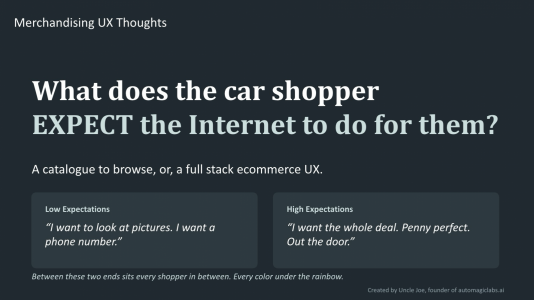
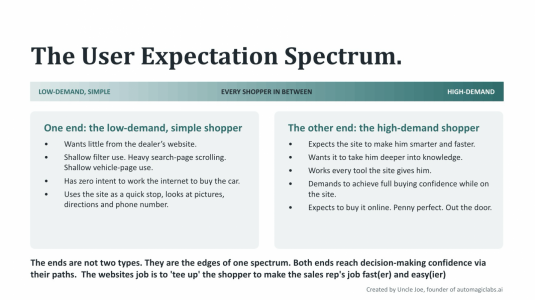
I agree, there isn't one “car shopper.” Everyone is different with different expectations of what they should get on a dealership website.

At one end you have someone who basically says:
“I just want to look at the cars, see some pictures, get the phone number and maybe get directions.”

At the other end:
“I expect this website to help me understand everything, make a decision, calculate everything, complete the transaction, and get me out the door.”

And everybody else falls somewhere between those two extremes.
I think the only thing we disagree with is I don't think the shopper's “job” is necessarily to shop the inventory.

The job might be:
“I need a reliable car for my daughter.”
“I need something for three kids.”
“I need to tow 5,000 lbs but don't want to daily a truck.”
“I need to stay around $500/month.”


I agree the inventory is the answer, but not necessarily the starting point.

And I think that's where dealership websites have it backwards. They start with inventory and then bolt tools on to it...payment calculator, trade tool, credit application, chat, lead form, etc.

However the salesperson does the opposite. They start with the customer's problem, figure out what would solve it, and then go find the right vehicle.

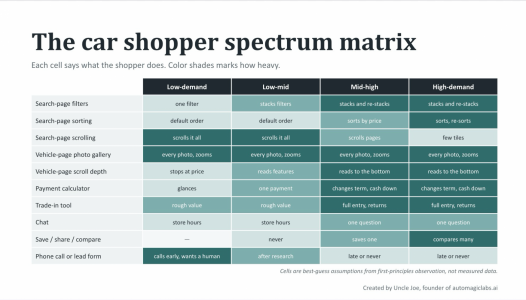
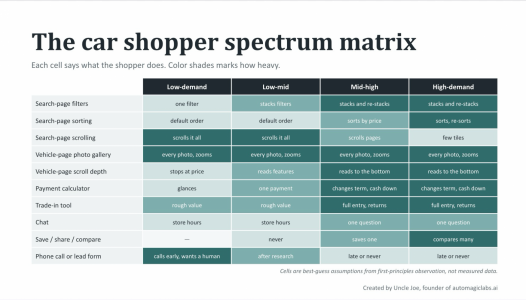
The “demand” appears to mean shopping intent...not how much they want a car?

For example:

BehaviorLow-demand shopperHigh-demand shopper
FiltersUses oneStacks/re-stacks
SortingLeaves defaultSorts/re-sorts
InventoryScrolls through everythingLooks at only a few vehicles
PhotosLooks closelyLooks closely
Vehicle pageStops around priceReads all the way down
Payment calculatorJust looksChanges term/down payment
Trade toolRough valueCompletes full process
ChatAsks basic/store questionAsks one specific question
Save/compareDoesn'tCompares many
Lead/callCalls earlyCalls late or never

My argument was:
Being late in the funnel doesn't necessarily mean the customer knows exactly which vehicle they should buy.

They may know:
  • "I need something for three kids."
  • "I need something reliable."
  • "I need to tow."
  • "I need to stay around $500/month."
But they may not yet know the exact make/model/trim.

You
recognize exactly that kind of person.

Your saying a low demand customer is still trying to figure things out but is more likely to make a reach out!

Notice the last row:

Phone call or lead form
  • Low-demand: "calls early, wants a human"
  • Low-mid: "after research"
  • Mid-high: "late or never"
  • High-demand: "late or never"
It suggests that the person who needs the most help may actually contact the dealership sooner, while the highly informed shopper may never submit a traditional lead at all.

This is the customer Alex described:
"I know what I want. Show me whether you have it, what it costs, and how quickly I can get it."
They're filtering aggressively, comparing vehicles, adjusting financing assumptions, entering trade information, etc.

1.) Alex is saying build for the high demand
2.) I'm saying build for the low demand
3.) Your saying Don't build a dealership website around one imaginary "average shopper."

Your saying we need to build for multiple types of customers!


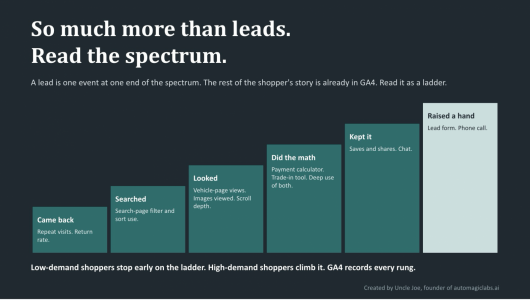
Exactly. We can observe the shopper's behavior at every rung so it is even more important to understand what they're actually trying to accomplish instead of whether they eventually submit a lead!

all focused on the shoppers JTBD.​

JTBD (Jobs To Be Done)​


Examples:

“I need a reliable car for my daughter to get to work.”
“I've got three kids and need more room.”
“I tow a camper a few times a year, but I don't want to drive a truck every day.”
 

Attachments

  • 1788956944877.png
    1788956944877.png
    1.2 MB · Views: 0

✨ AI Highlights

Dealers are questioning whether their websites create the same frustrating, repetitive experiences they'd never tolerate in a physical showroom — popup interruptions, redundant lead forms, and siloed vendor tools that force customers to start over. The key insight is that dealership website visitors are already deep in the buying funnel and have essentially two questions: price and availability, making friction-heavy tools counterproductive. Contributors argue dealers should design for high-intent shoppers rather than layering on attention-grabbing tactics borrowed from top-of-funnel marketing.

Replies Views 10 667 Started Last Reply