• This thread is just the tip of the iceberg.The people ahead of the curve aren't Googling for answers — they're already in here, having the conversations you haven't found yet. DealerRefresh is free.Get the full picture →

VIDEO: Does Your Website Attack Visitors?

Did you know that e-commerce sites spend on average only $1 of their advertising budget on converting website traffic for every $92 spent driving website traffic [Source]? This could very well be one reason that more than 38% of website visitors leave a website due to poor design and layout? If you're looking to maximize your ad spend, these might be two specific areas to consider.

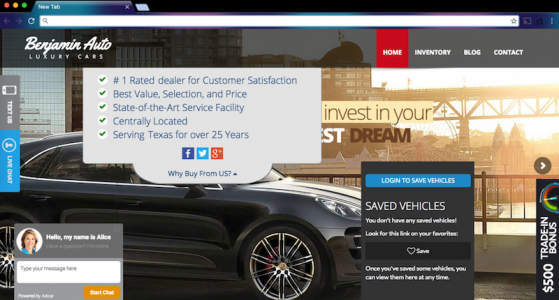
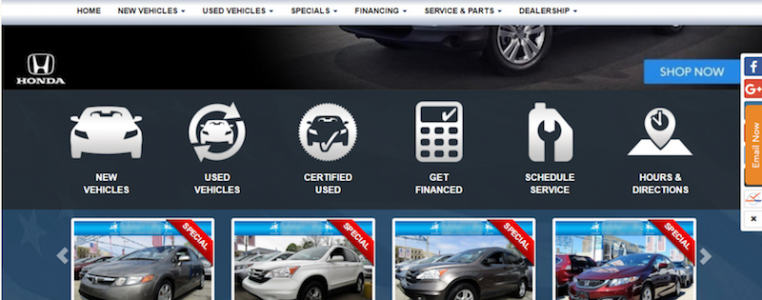
Converting website traffic is arguably one of the more over-looked and under-utilized practices on dealership websites. Most dealer sites "attack" users with numerous calls to action the moment they arrive, and the barrage is ceaseless.

For example...

als-dr-webinar-declutter-website-g1.png

Example of Dealership Homepage "Attacking" Visitors


als-dr-webinar-declutter-website-g2.png

Example of Dealer Website with Multiple CTAs

Considering that this is not an uncommon look for your typical dealership website, what can dealers do today to enhance the shopper experience on their sites and maximize their ROI?

[highlight color="#d65a3e" font="#ffffff"]
>> Free White Paper - Creating a Personalized Dealership Website <<

[/highlight]

In a recent live web chat with AutoLeadStar's Head of Business Development, Ilana Zur, Jeff and I took the opportunity to explore what dealers are doing wrong on their sites regarding calls to action, and what they can do to improve, and how.

During the webinar on how to "Declutter Your Website and Tighten Up Your VDP's," Ilana touched on three key points that dealers can and should be considering when it comes to their websites. She also gave examples of common mistakes dealers make on their sites, such as forcing too much information in one place for visitors to notice, not taking into account user friendliness.

Three Takeaways

  • Clarify your goals
  • Think UX
  • Tighten up your VDPs

Check out the edited 'mini version' of the webinar below where we introduce these three talking points and offer up a few suggestions. You can view the full recording on YouTube.

Login to view embedded media View: https://www.youtube.com/watch?v=mJ6po2fAiU4


[highlight color="#f4b945" font="white"]Join Discussion in the Forums with Other Members[/highlight]

[highlight color="#309ad3" font="white"]Listen to Corresponding Podcast Episode 2: Does Your Website Attack Visitors?[/highlight]

[highlight color="#d51d29" font="white"]Watch Full Version on YouTube - Trimmed for Quicker Viewing[/highlight]

How to "Pump Up" Market Share Using Social Incentives

Sponsored-Blue.png
In a down market, one Ford dealer needed a way to increase their overall market share and reduce the amount of pump-in sales lost to competitors. By leveraging the technique of matching sales data with consumer databases, the dealer was able to determine that they were losing more than 50% of sales to competitors in their market. This is what is referred to as "pump-in" sales.

Using the data that was available to them through strategic partnerships such as that with AutoHook, the alliance was able to identify specific areas of opportunity to grow their market share by targeting people with specific vehicles. They targeted the top three models they were losing to competitors - the Focus, Fusion, and Edge.

Using zip-code level targeting, in-market customers were incentivized to visit the dealerships for a $50 test drive incentive, as opposed to the normal $25 incentive. The incentive triggered at precise moments on the dealership's website where targeted shoppers were viewing the three targeted models.

The Results?

Despite a declining market, the dealership was able to significantly reduce pump-in sales lost to their top two competitors and successfully gain market share using AutoHook's private incentive offers and sales match attribution reporting. By how much? Download the free PDF here to see the complete numbers.

[highlight color="#417fab" font="#e67a00"]
>> AutoHook Pumps-Up Market Share for Ford Dealership <<

[/highlight]

Using targeted offers on these identified vehicles of opportunity, the total number of lost sales across the three models was reduced by 50% or more, and was maintained month-over-month for the following three months.

For more information about this case study, the dealership and the strategic partnerships, follow this link to immediately obtain a copy of the AutoHook Case Study.

Integrated Partnership

Great solutions are a result of knowing what you're best at and sticking to it. AutoHook's core competency is in securing their private offer and redemption rail system within dealerships and directly proving the source that led to a sale or a new-to-brand buyer. AutoHook knows their specialty is in delivering the industry's best sales attribution reporting. Social Dealer specializes in running successful Facebook campaigns, which is why AutoHook chose to partner with them to carry out this initiative.

For more information about the AutoHook partner integration with SOCIALDEALER, read, Is Vendor Integration the New Innovation?

Interview with AutoHook and SOCIALDEALER

From Hire to Profit: Analyzing How Long It Takes a New Salesperson to Become Profitable

When you hire a new salesperson at your dealership, you are investing in the future.

Just like with any investment, you can predict when this investment will break even and, eventually, when it will become profitable. In fact, the cost of a new salesperson starts to negatively impact your bottom line the minute you hire them. Employees often take quite a bit of time to get themselves out of the red. The truth is that while your sales department is a major source of revenue for your dealership, the individuals in that department are a drain on your resources before they ever start becoming profitable.

To better understand where your money is going and if a new hire is on track to break even... it's critical to analyze a new salesperson's time-to-profitability.

Calculating Employee Profitability

In order to accurately calculate when a particular employee will become profitable, you need to begin figuring out the cost of your salesperson and compare it against their future profits. Be sure you are factoring the total monthly cost of an employee not just their base salary. Don’t forget to add in incentives like:

  • Benefits
  • Commission
  • Training

After you finish calculating the total monthly cost of your salesperson, subtract that amount from the employee’s expected future profits. Armed with this information, you can begin figuring out how many months it will take for the employee to break even in terms of salary and total monthly costs to your dealership.

By analyzing these key metrics, you will have a pretty good idea of what kind of standard to hold your employees up against. Outside of new hires, this calculation method can also help managers identify top sales people and understand the total profit potential of those that are underperforming.

Keeping Track Of Employee Progress

Dealerships that have a fully integrated Applicant Tracking System (ATS) in their Human Resources (HR) software can track and monitor an employee’s results and profitability fairly easily. Just like you were able to use your ATS to find and recruit salespeople, you can also use that same system once they’ve been hired to track and evaluate their progress and benchmarks.

If you’re working with an HR stack that includes an ATS with integrated payroll, your ATS will work hand-in-hand with your payroll software to monitor your salesperson's time to profitability. You can use the data collected to compare your employee’s performance and see what methods of training, onboarding and incentives have been effective and which could use some re-tooling. This approach can be useful for dealerships looking to help their employees reach profitability faster.

Onboarding Process

The quickest way to have your employees reach profitability is to move them from new job applicant to “on the showroom floor selling cars” in as short a time frame as possible. The more efficient your hiring process, the quicker you can have salespeople out there generating revenue.

An efficient hiring process is not complete without a clearly defined new hire onboarding process. If your dealership is all over the place with its onboarding process, your new employees will be less likely to make an impact right away – extending their time-to-profitability. Without proper onboarding, new hires won’t get the training and tools to excel quickly in their new role. They will struggle initially and continue to feel like they are always playing catchup. If your dealership doesn’t invest the time and effort to get new hires fully integrated into your operations, it will be reflected in their ability, or lack thereof, to produce.

A formal onboarding program gives your dealership a way to track progress and jump in earlier if a salesperson is having trouble meeting goals and benchmarks. Onboarding ensures that there is communication with the employees until they feel comfortable in their sales role. Regular check-ins from your management and training team can fix any issues that arise early in the process and get employees comfortable and profitable and a faster rate.

By calculating your employees profitably, integrating your ATS into your HR software and creating a well-defined onboarding process, you can optimize your dealerships resources and decrease the time it takes to make your employees profitable. Constant measuring and retooling of training and incentives based on employee performance can ensure a favorable time-to-profitability.

What’s stopping your employees from achieving the results you wish to see for your dealership?

Free Dealer Guide: Leveraging Online Reviews for a Competitive Edge

Sponsored-Blue.png
Online reviews are the new word of mouth. A positive online review of your dealership causes a ripple effect that creates sales faster than a one-on-one conversation ever could.

The good news is that you can put reviews to work for you as
a competitive asset to grow sales, improve customer retention and empower your sales staff.

The key is to take ownership of reviews by creating a process for systematically managing them.

Read the full report below, to understand the importance of reviews in today’s car buying journey, as well as critical next steps you need to take to win with online reviews. After reading this report, you will learn:

  • How to take ownership of your reviews by actively managing them
  • How to highlight your reviews to drive customer retention and sales
  • How to use reviews to engage and retain your sales staff

The voice of the customer has a powerful impact on business today. You have a good opportunity to use reviews, both positive and negative –to acquire customers and create lifetime value.

Read on to start turning online reviews into one of your strongest competitive assets.

[highlight color="#e45825" font="#ffffff"]
>> Go Here to Now to Get this Free Guide from DealerRater <<

[/highlight]


The power of reviews

A huge 73% of consumers, looking to purchase a car, place a high value on consumer reviews and expert reviews. Today, online consumer reviews are also more readily available – something the Millennial generation has grown up expecting.  Online reviews also play a pivotal role in making your dealership more visible through search engine optimization (SEO), especially at the local level given the prominence of reviews online.

If you don’t currently have a reviews strategy, and you have less than three reviews – and they’re negative – you are likely deterring customers from your dealership. Your minimum goal is to have at least five for car shoppers to read and consider.

Go here now to get this free dealer guide and start implementing an online review strategy for your dealership to make reviews the most valuable asset of your marketing. This will give you the competitive edge to boost your sales to a higher level.


Meeting People Where Their Needs Are: Interview with George Grubbs, CEO, Grubbs Automotive Group

Sponsored-Blue.png

George Grubbs' approach to car sales is simple and personal. He sums it up as "Meeting people where their needs are." Since he and his family have been selling cars since the 1940s, they know a few things about developing relationships that turn into sales now and for years to come.

Over the past 70 years, Grubbs Infiniti has learned to adapt to new generations when it comes to car sales and building relationships. In the mid-90s they developed and launched the first Nissan website in the country and since then they have worked to stay at the cutting edge of technology while watching the ROI on everything they do.

When it comes to research on where to invest their time, energy and money George sticks to the basics. He says he reads everything he can and keeps a close eye on how soon results can be seen as well as how those results are measured.

Business decisions based on reliable results

"When I try something new, I need to see results," he reported in a recent CBT Automotive Network interview.

"What I look for when I talk to a new vendor is what do their reports look like? [...] How often are they gathering the data and how often are they giving it to me?"

But Grubbs doesn't settle for just being given data and reports on a regular basis. He says he prefers a vendor who can offer a back end tool so he can log in and check trends and results on the fly. Reliable results give a dealer that competitive edge.

[highlight color="#DE2424" font="#ffffff"]
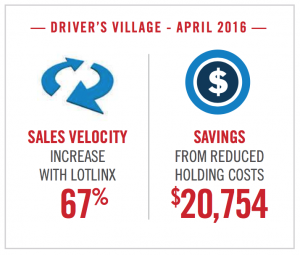
>> Free Case Study - Increase Sales Velocity by 67% <<

[/highlight]


Technology and Customer Relationships

His hands on approach to technological advancement and developing relationships with customers, based on how they want to interact, has certainly paid off. Customer reviews from across various platforms including Yelp, Facebook, and Cars.com have customers praising everything; from their well-appointed waiting room to their pricing and service.

Clearly, being willing to adapt to the latest trends in technology and digital marketing for dealers, and to meet customers on their level, translates into a healthy bottom line and a bright future.

Follow the link below to watch the full interview with Geroge Grubbs on CBT News:

george-grubbs-automotive-cbt-interview-650x400.png

How Weather Impacts Your Dealer's Sales Traffic

As an auto dealer, you are always looking for any information that may have a direct impact on the success of your store. In the first Driven Data Science blog, we looked at the impact of weather and day of the week has on the service department. Now we are going to take those same inputs and apply them to how it affects new dealership leads. The weather data is provided byWunder Ground and the lead records are extracted from the CRM of two Driven Data clients. We limited the time range of this research to the years of 2015 and 2016. We used more than 400,000 leads records from the Chicago, IL and Charlotte, NC areas to build our analysis. Since dealer stores of different scales have different amounts of new leads per day, we have normalized the lead data by following two steps:

  1. Remove the outliers of raw data and exclude data of Sunday when dealerships are usually closed. List out the number of total leads, the number of Internet leads and the number of showroom leads of each day in 2015 and 2016.
  2. Calculate z-scores for those stores that have normally distributed lead data (almost all of them)

After normalization, the value of lead data actually becomes a statistic which describes the level of new leads on a given day. 0 = an average level, >0 = a high level and <0 = a low level.

Now the normalization process is complete, we have some interesting findings that we elicited from this research:

The weekday has huge impact on the number of showroom leads, significant impact on total leads and a little impact on Internet leads

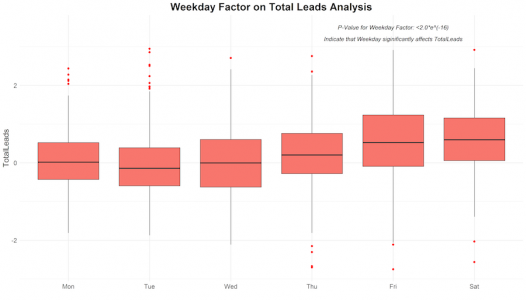
Figure 1 below shows how the weekday has a significant impact on the number of total leads. As you can see, Friday and Saturday have the top two highest volume of total leads compared with all other days of the week while Tuesday has the lowest. Logical thinking suggests this makes the perfect sense as Friday and Saturday tend to have the most flexibility when it comes to the customer’s potential free time.


Figure 1
https://wp-files.dealerrefresh.com/wp-content/uploads/2017/05/10141108/Leads_Tables456.png Leads_Fig-1.png


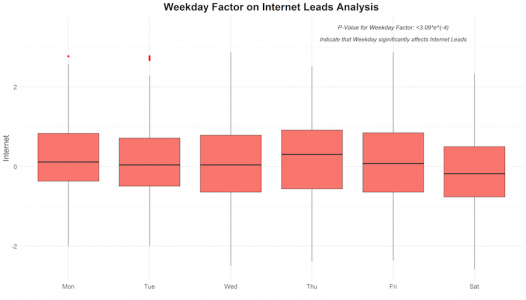
Drilling down into the different types of leads, we will begin to see a different story. Figure 2 shows the impact that the weekday has on internet leads. I should say the lack of impact the weekday has. The analysis shows it does not matter which day of the week it is, you are still generating internet traffic and producing leads. This is mainly due to the access people have at all times to your site.

Figure 2
Leads_Fig-2.png


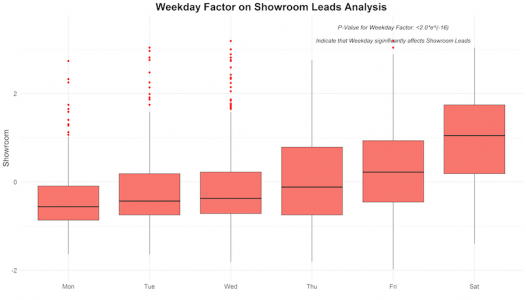
For showroom leads, figure 3 indicates the volume of leads is greater on Fridays and Saturdays. This takes us back to our prior theory of potential customers have more flexibility on those two days to visit the dealership.

Figure 3

Leads_Fig-3.png

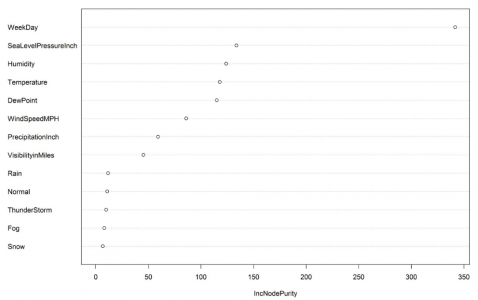
We compared the weekday to all other factors for showroom leads and it has two times the affect as the second most important factor. See figure 4 below.

Figure 4
Leads_Fig-4.png


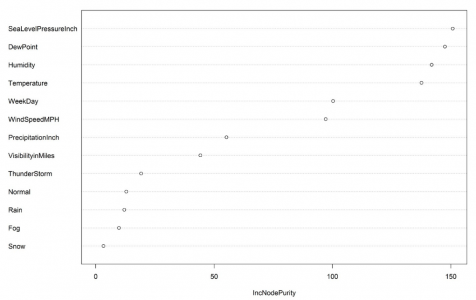
Let’s take a look at the same analysis for internet leads. Figure 5 shows that weekday doesn’t have nearly the impact on internet leads as showroom leads. In fact, the weather is the main driving factor for generating internet leads. This does make sense if you think about how bad weather can impact a person to be online more due to limited outdoor activity.

Figure 5
Leads_Fig-5.png


We have discussed the impact of weekdays on leads, now let’s look more in depth at how weather plays a part in the Chicago and Charlotte areas.

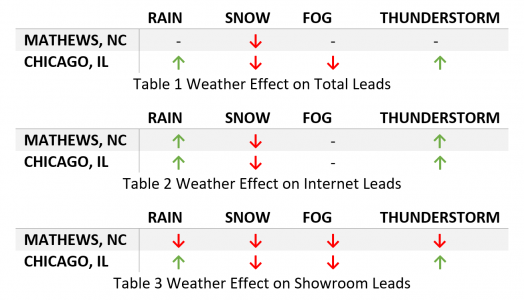
In the tables below, you will see how different types of weather events has a different effect on leads for our regional areas of choice. indicates that the weather event will significantly increase the number of leads. indicates that the weather event will significantly decrease the number of leads. ‘-’ indicates that the weather event will not have significant impact on the number of leads.

Table 1 – Weather Effect on Total Leads

Leads_Tables123.png

For the Charlotte area, rain does not have a significant impact on the total leads, but if you dive into the different lead categories, you will see a different story. When it comes to internet leads, the volume will increase while the showroom will decrease. Again, indoor vs outdoor activity is impacted by this type of weather event. You will notice that the thunderstorm event results in an identical pattern. A snow event will negatively impact this area. Mainly because this is not a normal event for this area.

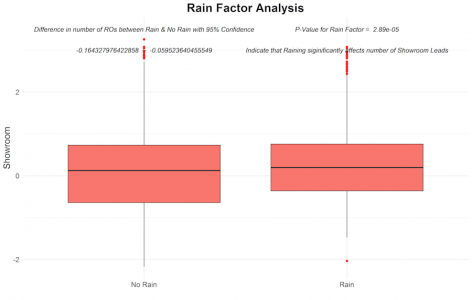
When it comes to the Chicago area, we find it interesting that the number for all types of leads increases when it has a rain or thunderstorm event. Figure 6 below shows the rain factor analysis for the Chicago area dealership.

Figure 6
Leads_Fig-6.png


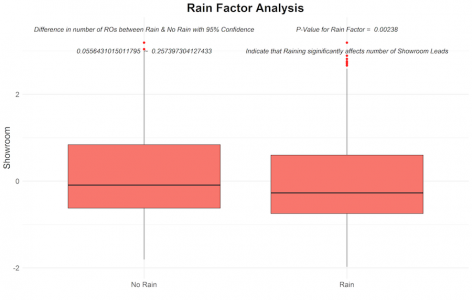
If you compare this to figure 7, the rain factor analysis for the Charlotte area, you will see that the rain event has a much smaller impact on the Chicago area.

Figure 7
Leads_Fig-7.png


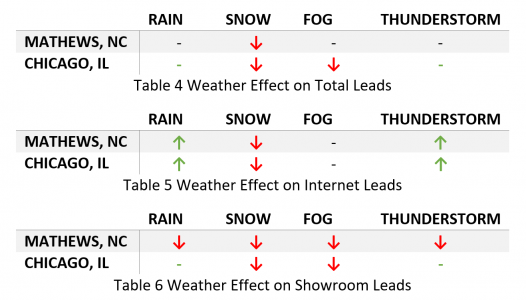
We remove the outliers after splitting the data by different weather factors and redo the statistic test.

Table 4 – Weather Effect on Total Leads

Leads_Tables456.png

These results indicate that a rain or thunderstorm event will not have a significant impact on the Chicago area dealerships. This could be due to the higher tolerance of a weather event as the Chicago area typically deals with more types of weather events. The Charlotte area does not receive as many of the cold weather events like snow and typically has a warmer climate and more opportunity to potentially get outdoors. The Charlotte area can attribute up to 15% of their rainfall from tropical cyclone events so rain and thunderstorms will have a more significant impact on their showroom leads.


5 Keywords to Include in your Job Description

Millennials­ now make up the majority of the U.S. workforce, and they bring different expectations to the job than the generations before them. In order for companies to attract top talent today, they must highlight the ways in which they can meet these new employee needs.

For many companies, the job descriptions they have used for decades must be revamped with appropriate wording and highlights to appeal to a new target audience. Job descriptions featuring keywords will yield organizations more qualified candidates for consideration, by positioning them as an employer of choice to top talent.

The most successful job descriptions should be a combination of marketing, a description of the role and career path, and the company culture and vision.

Read on for the top five keywords every job description should include to help attract the best candidates for your dealership.

1. Culture

Perhaps one of the most important components of the recruitment process is correctly outlining your dealership’s culture, and seeking out individuals who not only possess the skills required to do the job, but will fit in well within that culture. Ultimately, hiring someone who is not a good fit will limit the employee’s engagement and increase your dealership’s turnover rate. This results in wasted time, money and limited productivity.

The individual job seekers will be evaluating your dealership on how it fits into their lifestyle as much as you’ll be evaluating them. If your company offers special perks, such as a happy hour, relaxed attire, free food or flexible schedules, showcase them on your career site to appeal to potential employees.

2. Career Path

Millennials are also interested in knowing that their time with a company will lead to promotions and professional growth opportunities. Rather than simply detailing daily tasks for the position at hand, clearly identify the ways in which a candidate can advance within the company, and how their position will help them do that.

Instead of presenting a list of responsibilities, consider filling a job description with information on how the job will contribute to the overall success of the dealership, as well as the potential for advancement and how the candidate’s accomplishments will help aid your organization.

The goal is to amp up a potential employee’s excitement about the company and where it’s going, to make them want to become a part of that.

3. Vision

Not only do millennials want to identify with a company’s culture and know they will have the opportunity for career advancement, but they want to be part of something bigger than themselves. They want to work for a company with similar values and vision, and seek out employers that align with their views. Many millennials want to make the world a better place, and look for jobs where they can feel a sense of purpose and fulfillment outside of the traditional salary and benefits.

One way they look to do this is to become part of a company that seeks solutions for social and environmental challenges. In job descriptions, companies should clearly articulate any causes or initiatives aimed at giving back, such as paid time off for employees to volunteer, to make clear to candidates not just what is important to the company, but the steps the organization is taking to back it up.

4. Winning

As mentioned, millennials today are looking past the paycheck and want a job with a sense of purpose that contributes to an overall picture and a greater good. To do this, they are looking to join a winning team. They want to know their company is on the forefront of internal development, striving to become bigger and better for their customers and their employees.

Dealerships should tout company success and vision for upcoming innovation or expansion to demonstrate to candidates how the company is keeping its finger on the pulse. Conveying a winning strategy will get candidates excited to join, and grow with, the team.

5. Engaging

Tell prospective candidates your company’s story – quickly. Rather than repurposing an old narrative of your founding, grab a candidate’s attention with the most tempting part of the organization. A company should get creative in convincing their target audience why they should want to work for them.

Companies often wrongly assume that candidates automatically want to work for the company if they are applying for the position. With millennials especially, however, that is not the case. They are vetting you as much as you are them.

If your company has the ability, incorporate a multi-media aspect to the job description to help bring your dealership to life. Consider short employee videos where they describe in their own words why they love working for you, or add an infographic to illustrate your company stats rather than filling up the space with a dry paragraph.

A proper, well-written job description will not only help attract the best candidates for the position, but it will allow unqualified individuals to self-select themselves out of the running early on, saving you time.

Lastly, it is also important to revisit job descriptions on a regular basis to update any information accordingly, such as organizational development or the evolution of new technologies in the space, ensuring you continue attracting the best candidates to your organization.

Digital Dealer 22 Review with Kevin Frye #DD22

Can Peyton Hoffman Keep Me from this 5-Hour Energy Drink & another Digital Dealer review?

Woo hoo! It’s spring break!

I mean – “Hey boss, is it OK if I go to Digital Dealer 22 in Tampa to learn about the latest and greatest in automotive digital?”

Use your noggin knucklehead!

The last approach might be more successful if you want to join fellow dealers in sunny Florida to work, train, and network 24/7 to become a better digital dealer when you return. And who doesn't want to go to Tampa, Florida for Digital Dealer 22 after a long, cold winter? Are you ready to begin this recap?

VTDV0356-1024x398.jpg


 Sunny Tampa, Florida hosts Digital Dealer 22

(humming to the tune...) Blinded by the light!

Or more appropriately, blinded by the white, which would be the skin tone of many northern dealers like myself as I flew in Monday and tried to catch a few rays at the pool before Digital Dealer 22 began. With multiple hotels to choose from within walking distance of the convention center, dealers had some great choices for accommodations. And of course I walked over to pick up my badge for early registration which was plenty convenient  - BUT…

IMG_1875-1024x768.jpg


 Smooth check-in for Digital Dealer 22

I speak for drink, at least that's what I think...

While checking in, I was told, “since you are a speaker, you don’t get a give-away bag or drink tickets”. Holy tight-ass, is this a new low in cost control care of Digital Dealer that they won’t even give a “speaking” dealer like myself a few drink tickets? Am I not even worth a couple Pabst Blue Ribbons after I complete another great Digital Dealer session? Don’t they know how many hours I put into creating a first class presentation? Or perhaps they are figuring out how many drinks I have while putting together my presentation and they are concerned for Kevin’s liver. Oh well, more on that later...

IMG_1889-1024x768.jpg


 Candice Crain, Brent Wees, Josh Mitchell and Arnold Tijerina at #DD22

The Jeff Wyler Automotive Family sent a team of seven to Digital Dealer 22. I bring this up as I recall when I was the only person from our large auto family that attended these conferences for many years, and I know that many of YOU have also been that lone person. Has your dealership(s) also expanded who is attending as our market becomes more competitive?

A Jack in the Box, or a Charley in the Box? That makes steak???

The Wyler team had a wonderful steak dinner at Charley’s Steak House on Monday night – and it appears that 98% of Digital Dealer entertaining was also taking place there. Joining our team was Kate Frost who is now working with the Jeff Wyler Automotive Family as our social media consultant. She has taken our Instagram efforts from zero to 120 mph in less than 6 months and is doing much more. Thank you Kate, and welcome to the Wyler family! And time to get ready for day one of #DD22...

DINNERkp11-768x1024.jpg


The Jeff Wyler Automotive Family enjoys dinner in Tampa

(to the tune of Twisted Sister...) I wanna walk! WALK!

I love starting each day with a short walk to the convention center, crossing the bridge and enjoying that Florida sunshine. Folks were picking up their badges at the registration counters with minimal lines and waits, which was a huge improvement from last fall at Digital Dealer 21. As I came up the steps, I was greeted by Jim Ziegler, who was speaking that morning. One problem – we were both speaking at the same time, so I was unable to join Jim’s session. Jim has always been passionate about being the dealers’ advocate. I am still trying to figure out where he is getting all of his energy as I am years behind him and he brings an energy level I envy. Thanks for all you do Jim!

IMG_1880kp-1024x768.jpg


 Welcome back to Digital Dealer Jim Ziegler!

Practice practice practice!

While the Wyler team went to the peer strategy round-tables, I spent some time setting up my room for my upcoming presentation. My session involved some advanced Google Analytics techniques that included several screenshots and video clips, but I was discouraged to find one small screen in the corner for one large room. The size of the room was great but I was concerned that folks would not be able to see my content, what do you think? This was the case in several sessions. Hey Digital Dealer – could we at least have 2 screens, or one large screen in the middle for these larger rooms?

IMG_1883-1024x768.jpg


 Big room, one small screen in corner

Talk about Stranger Things

I had spent a LOT of time preparing some great clips from the Stranger Things series from NetFlix which aired last year to complement my training. This is a tactic I call “entertraining”, where you both entertain and train but I ran into major issues. I ran through every slide, and every video, and everything worked flawlessly. Great video, great slides, great sound. As soon as my presentation started, every video failed but one very short clip – what happened?

Digital Dealer records the sessions so that folks can purchase them later to view. After learning that at least 5-10 speakers had the same problem as myself with their powerpoint videos failing, I figured out the problem. Once they start recording your presentation digitally, it takes up all of the RAM in your laptop and your videos cannot play. ARGH! I was one pissed pirate when I figured this out and am still upset. I have the highest respect for the attendees that come to my session and that means lots of preparation and practice to deliver a flawless presentation. Digital Dealer – let’s please get this figured out or not record sessions in the future.

IMG_1894KP-809x1024.jpg


 Great to see Kim DePalma who has always supported dealer presenters

You can chew, but DON’T blow!

Of course, my session had to live up to its name of “Stranger Things” as I am always giving out some, let’s say “different” give-aways, and in this case it was some Bazooka chewing gum which was featured in the Stranger Things series. I was getting some “strange” looks from folks in the room as they opened their gum and of course opened up the comic strip that was inside. Turns out that all of the comics were printed in Arabic. Wait, ummmm, wasn’t I just calling Digital Dealer out on cost control? Holy hypocritical tight ass, that gum I ordered online must have been sourced out of some third world nation. Sorry folks...

IMG_1989-1024x768.jpg


 Jessica Ruth, Blake Arbogast, and Peyton Hoffman at the Dominion Booth

VDP, yeah you know me...

My session focused on some of the flaws in Google Analytics that can mislead you in your reporting results. I shared how to fix this with the setup of events and event-based goals, and then followed up with some actual examples that dealers could see for some hands-on training. Much of my session focused on VDP-based solutions and I shared how I feel these will be a bigger part of our future digital marketing solutions in the future. Why? That warrants a full article in itself – stay tuned to see in an upcoming DealerRefresh blog.

IMG_1892-1024x768.jpg


 Three Wise Men - Nick Cybela, Dan Moore, and Glenn Pasch

Line’em up kids!

Exhibit hall opened after my morning session and there were a lot of vendor booths on the floor, with only 2-3 empty stalls in the corner. I liked Cox’s new setup at the entrance. Rather than having multiple large booths for each of their entities, they had one large rectangular booth where you could walk around to the different “stations” for VinSolutions, vAuto, etc. that were part of the Cox family. I imagine that setup is likely a more efficient spend for their money as well. Is that important to me? YES – as ALL of us need to become more efficient as our market becomes more competitive, including our partners.

IMG_2772-1024x768.jpg


 All-in-one Cox Exhibit. One stop shopping in exhibit hall

I spent a lot of time in exhibit hall this conference, looking at the different solutions available. It was great to see Nick Cybela and his team with FlowFound where they are providing virtual reality solutions. Virtual reality – and augmented reality – are 2 advanced digital solutions that are in the market, but are still trying to find their place in the dealership mix. I am certain that many of you have ideas of how to use virtual reality, but it has really caught my attention for the following reasons.

IMG_1901-1024x768.jpg


 Nick Cybela and the FlowFound team

Mushrooming or showrooming, which is worse?

Well, your HR department might have some ideas on that, but all of us would agree that “showrooming” is an issue we all face. When the sales rep leaves the customer alone to approach the desk, out comes the customer’s cell phone and the showrooming begins as they begin to “cheat” on you and look at other dealers. I believe virtual reality can help fix this.

What if you had a virtual reality kiosk in your showroom with a library of some great video content. When the sales rep is ready to approach the desk, they first take the customer to the virtual reality kiosk and have them view a short VR video that not only creates a “wow” factor for your dealership, but also builds value in the car you are trying to sell. The sales rep can now return from the desk and find that their customer has remained engaged with the product, and is hopefully receptive to the “bump” you are ready to approach them with. What do you know, virtual reality is not only a defensive tool to prevent showrooming but also an offensive tool to help build gross…

IMG_1896-1024x768.jpg


 Lance Alm, GM with Jeff Wyler Auto Family, getting virtual reality demo with FlowFound

Small plates anyone?

I did hear some grumbling about the small plates being handed out for lunch. While not as small as the dinner plates in a Barbie RV, but not as big as the plates provided with an EZ Bake Oven, they were certainly not large enough for some of these dealers’ appetites. Well, it wasn't porridge for crying out loud. Lunch was fair, and for me, it was a quick affair as I was doing my favorite thing at Digital Dealer - picking other dealers' brains.

IMG_1903-1024x768.jpg


 Was great to see Jenn Pederna. I don't know how she handles working with Brent Wees

You have 2 ears and one mouth - use them in that proportion

What is your #1 concern today in our market? That was my question for fellow dealers on the floor, and almost unanimously, the answer was “compressing margins”. When our costs to acquire cars to sell are rising, while the gross we can earn when selling them is declining, we have compressing margins, and that means less profitability. Dealers are struggling in today’s highly competitive market, and they are looking for more efficient digital solutions to help them to optimize profitability. I talked about this at length in my presentation.

IMG_1966-1024x768.jpg


  Jennifer Sanford, Sean Stapleton, Jeff Loos with Lotlinx and Tom Lapointe

Ladies and gentlemen – our business is changing. That’s right. The “gravy train” for profits is ending, and if it is ending for dealers, it is also ending for our vendor partners. We must ALL work together to become more efficient in an ever-more transparent market that is driving down our margins. Understanding that this is a top priority for dealers, I felt that activity in exhibit hall was stronger than normal. If there was a solution which could give a dealer an edge, it was being looked at. Let’s look at a few.

Am I dreaming or streaming?

The folks at Dropin Auto were very busy providing demos on their new streaming product. Was it the free drinks at their bar? Or their unique new product that enables you to put a “Live Stream” video button on your VDPs? As I best understand, when the shopper clicks on the “Live Stream” button, it alerts one of the sales reps at your dealership to respond with a live stream video of the vehicle. I have to admit, it was a pretty impressive demo. Think of it like live chat times 10, as you could not only get instantaneous chat with the shopper, but show them the car while they are hot.

Louis Ziskin provided some additional details for us about their solution which you can read about here.

IMG_1957-1024x768.jpg


 Lots of activity, and free drinks, at the DropInAuto booth

We must divide and conquer!

That is how we work with the Wyler team we send to these conferences. We meet before the conference and decide who will attend which sessions. Since we are a big Dealer Teamwork customer, we had some of our team going to see Sean Stapleton, others to see Greg Gifford with his Local SEO presentation, our video producer going to see Tom Gallaher, and being the analytical geek I am, I went to see Brian Pasch and Tom Moore who were presenting “Eliminate Digital Marketing Blunders, BOTS, and Waste!”.

IMG_1945-1024x768.jpg


 Jason Wiley, AJ Maida, and Jeff Gonzales. Jason and Jeff are with DyGen. Apparently AJ is Mat Koenig in another form (nametag?)

Brian and I are on the same path towards efficiency in the industry. Our vision for the future is very similar. It was great to see Brian in the back of my session tweeting and I wanted to sit in his to see what he and Tom Moore had to share. One key concept that we both agree on is to STOP focusing on the quantity of digital traffic and start focusing on the quality. We have a mutual vision in teaching fellow dealers how to set-up their Google Analytics and other tools to best measure the quality of their incoming traffic, and then teaching them what to look for. Brian is pushing for the standardization of goals and events in GA for the industry so that we can hold vendors accountable for performance with the same metrics. Brian, you have my support!

IMG_1983-1024x768.jpg


 Great to see Michael Groves back at Apple Autos (with John Yoder)

I was unable to attend the next speaking session as we had practice for the upcoming “Tech Tank” panel. Once again my team split up to see great speakers like Joe Webb, Andrew Meyers, Kathi Kruse, and more. And speaking of the “Tech Tank” panel, wow! We had some great solutions to choose from.

Is Twitter going down the $hitter?

Are we seeing the slow demise of Twitter at Digital Dealer? It seems like there was little Twitter action by dealer attendees outside of a few, but lots of posts from the vendors. Hats off to Joey Little who also brought this up as much of the content was canned and pre-programmed, with little real-time insight in the sessions as compared to previous years. I have seen a similar pattern at other shows this past year. Good news for you though - I have tagged names through this recap with their Twitter handles so you can follow each one and keep on top of our industry.

IMG_1939-1024x768.jpg


Chris Hill is always passionate about automotive, joined with Ross Stirewalt of Dealer.com

Want an appointment? You better have some Voodoo…

Vendor Voodoo caught a lot of dealers’ attention with its unique approach on how to help vendors connect with busy dealers. Basically, the vendor makes a donation to your charity of choice in return for an appointment to see you. Vendor Voodoo helps you manage a busy schedule, while allowing both the dealer and vendor to support a local charity. There was a fair amount of feedback on this concept of “pay to play”, but I have to give a kudos for the creativity of the idea..

IMG_1929-1024x768.jpg


 With long time friends April Rain and Kate Frost - strong leaders in our industry

The winning solution was 1Micro Secure Asset Control and their new key management system. It allows dealers to closely and conveniently manage their car keys as well as their cars. Why do I think it won? Simple – it is helping dealers to be more EFFICIENT and to save money in their daily operations by saving time with not chasing down cars and missing keys.

IMG_1977KP-768x1024.jpg


 Jamie Grum wins the Tech Tank competition with 1Micro Key Solution

Hey Batman, do you see the signal in the air?

Well for me, that was a cell phone text and a crisis back on the work-front, so I had to miss the keynote. I am certain that I am the only dealer this has ever happened to (insert heavy sarcasm here). The feedback I received was that keynote speaker Michael King did very well. In fact all of the keynotes were strongly attended – just look at the large crowd in the picture below.

IMG_2724-1024x768.jpg


 Packed keynotes at Digital Dealer 22

And speaking of attendance, everything I saw and heard was that the turnout for DD22 was stronger than average for a spring conference. While some other shows are starting to stagnate, Digital Dealer seems to be getting a second wind and growing stronger.

Do the DT’s stand for Dealer Teamwork?

NO! Cocktail hour started and I had no free drink tickets. I pulled out my banjo, opened the case on the ground, and started playing the theme to Deliverance to hopefully get some tip money to buy some drinks. Before I finished the first 9 notes, Melissa Green was there to deLIVER (did you catch that..) some free drink tickets to me and save the day. Thank you Melissa for restoring my faith in humanity, and Digital Dealer. More great times followed connecting with fellow dealers and vendors, and then off to dinner at the Columbia.

IMG_1915KP-1024x768.jpg


 Cecil Bolling, Kelli Pierani, Lance Alm, Ron Overstreet, Ross Stirewalt at Columbia restaurant

Let’s just say that when you mix type-A, outgoing car folks with a little libation, good times always follow. I cannot share the contents of much of the evening but let’s say I have some videos that can earn me some nice retirement money. And while I got in around 3 am – this big dog was there at 7:30 eating breakfast the following morning for day 2!

IMG_1936KP-1024x768.jpg


 Lots of fun with awesome #AutoFam in Tampa

At heart, I am an exhibitionist...

Hold on a sec, maybe the night before after some liquid courage, but I did spend the first session in exhibition hall completing a demo with one of the major providers at the show. Sorry folks, name withheld on this important meeting.

IMG_1923-1024x768.jpg


 Ran into Heather Allred, Mat Koenig, Tom Lapointe, Ted Dupuy, Kevin Campbell and many more fun folks

How sick am I?

Well, I guess sick enough to see Brent Wees and Mark Stringfellow at 10 to see “How Sick is Your Sales Floor?”  Of course it was a great session if Brent was involved, though I cringe every time he calls me up front with another opportunity to humiliate me.  Wait, he was very nice this time, Brent must be really sick. Brent and Mark shared many great tactics to deal with the psychology of the sales floor. Visit missingopportunity.com to see one of their great tricks to help you become more efficient.

IMG_1950-1024x768.jpg


 Brent Wees and Mark Stringfellow "entertrain" the audience at #DD22

More demos followed at 11 am – and I did not attend the charity auction but I heard a lot of noise and excitement over there. Another quick lunch, and off I went to see my counterpart at AutoNation – Famous Rhodes.

Just send the bills to Jennifer…

As in Jennifer Bills and Famous Rhodes who shared some of their strategy with SEM, SEO, Display and Social Media. Take a guess – do you think they are trying to become more efficient? If the largest in the industry is heading that direction, is that a signal that you should do the same? Did you know that your used cars get 8x more traffic on the major aggregators that your new cars? And understanding that, are you using your heavy traffic VDPs to drive traffic to vehicles that need help (eg. Similar vehicles). Lots of great ideas in this session. Thanks Famous and Jennifer.

IMG_1961-768x1024.jpg


 The Infamous Famous Rhodes and myself, with the boring name "Kevin"

More time in exhibit hall, texting to find fellow friends. Wait, did I mention that it seemed like there were lots of texting solutions this year? While each has some great ideas, I am uncertain where they fit in our mix as most of the major chat providers we use are already providing text solutions, and it is hard for me to see where these add-on text solutions work for us. Even our service scheduling provider (xTime) has a text solution. What do you think?

And the lion will lay next to the lamb...

That’s it baby, now I am bringing scripture into these Digital Dealer reviews. A big shout-out to Phil Sura for orchestrating the next keynote panel that put Twitter, Google, and Facebook on the same stage. Fortunately, speakers Peter Leto with Google, Trace Przybylowicz with Facebook and Chad Rumminger with Twitter were ran through some metal detectors followed by a strip search to ensure that no knife fights would follow on stage. A great keynote presentation followed which shared how dealers can leverage each of these HUGE social platforms to help them to sell more cars and service.

IMG_1982-1024x768.jpg


 Josh Mitchell, Peter Leto with Google, and Jason Wiley in exhibit hall

And then it started catching up with me…

Two nights with less than 4 hours of sleep. I enjoyed another great evening with friends but this time I wrapped up by midnight. I am sorry that I missed the Joe and Shaun Karaoke event, but I chose to go back to my hotel room and dunk some Oreos in a warm glass of milk and get a good night’s sleep.

IMG_1971-1024x768.jpg


 Great job by Phil Sura with his keynote panel (joined by Tim Kost)

Arise!

A full 6 hours of sleep brought me back to life (just like the college days) and I returned for breakfast and another quick meeting. However, I had to fly out the morning of Day 3 as I had a very important meeting with Homenet upon my return. I was incredibly disappointed to miss presentations with Kate Frost, Steve White with Clarivoy, Matt Raymond, and Elise Kephart. I am certain that you all did well - and all of the feedback I have received was positive for each of you.

What is this? Disabled Dealer?

Speaking of Matt Raymond, was he reaching for an all-time low by arriving in a wheelchair and looking for some type of registration discount? Or perhaps this was a brilliant move on his part to get free publicity for his presentation with countless selfies in exhibit hall? Or was Matt just looking to get fellow dealers to push him around? Well played Matt, well played...

IMG_1885-768x1024.jpg


 Bobbie Herron wheeling Matt Raymond to his next session #AutoFam

Before I forget – what was the second concern of most dealers I spoke to? It was the recent purchase of Digital Dealer by Emerald Expositions.

Love’em or hate’em, you gotta RESPECT him

I am talking about Mike Roscoe. Over the years I have learned more about conferences than I care to know. What goes on behind the scenes with conference organizers and our vendors is an amazing amount of work to make these shows as smooth and wonderful as possible for dealers like you and myself. It is a high pressure business that involves a lot of money, preparation and aggravation.

Digital-Dealer-22-decks.jpg


Here is where you will find #DD22 decks in about a week

I think all of us can agree that Mike has created a first class product with Digital Dealer. He was one of our pioneers and innovators that brought fellow dealers together in the most challenging transition of our industry as automotive entered the digital arena. Along the way, he worked with a lot of great people to build these shows, including Cliff Banks, Kim DePalma, Ceren Isildak, Melissa Green, Arnold Tijerina, and I know I am missing so many more names. Mike and his team were very supportive of encouraging dealers like myself to speak on the podium, but there is more to that.

IMG_1987-1024x768.jpg


 Too long since seeing my long time friend Katie Richter!

Many of you know if you have attended my sessions that I often present content that is controversial and can aggravate many of our vendors. These are many of the same vendors that pay a lot of money to participate in Digital Dealer. The reality is that my sessions are not as welcome at many other shows as the show organizers are hesitant to offend anyone. Mike Roscoe has NEVER attempted to censor me or moderate me – or my fellow dealers. He has always encouraged me to share the truth and supported my efforts - that is true transparency in the industry.

Mike and the entire team at DD have been great friends to my wife Julie and I as well. I value their friendship and Mike - you have my highest respect. And Emerald Expositions, as the new Digital Dealer owners, you have a high standard to maintain and dealers are looking at you closely to deliver the same high quality content combined with a first class experience.

ENJR5048KP-768x1024.jpg


 Why Sean Stapleton should not challenge Tom Lapointe to a wrestling match. BTW - socks?

Can you handle the truth?

I talked about "true transparency" in my session, as part of my vision of digital automotive in the upcoming years. As one of the initial folks to openly present on attribution in the industry, and as the first dealer to build a model for others to share, I have seen a lot of folks pursue the study of how to best identify what digital providers are giving them as an "assist" as they sell cars. In our efforts to become more efficient, I shared what I felt was a better model:

  1. When less than half of a dealer's inventory is even seen on the major aggregators, and that half is the cars that don't need help getting VDP's, wouldn't it be better, and cheaper to just syndicate the cars to them that need help with views?
  2. If the battleground for the modern shopper is at the VDP, wouldn't it make best sense to send them directly to our website VDP where we have our best tools and processes to win that battle? (think credit pre-approval, video of the car, trade in value tools, etc - and no competing ads)
  3. If we work in a performance based industry, isn't it fair for our vendor partners to only get paid for proven performance as well? As in we only pay for VDP views?
  4. Why should we have to argue with our vendors on whether their solution is performing? If they delivered shoppers directly to our VDP, we can directly see the quality of the traffic (this is what I was teaching how to setup correctly in Google Analytics).
  5. Why are we pointing our fingers at our vendors when WE as dealers bear responsibility as well? If the provider delivers quality traffic to my website, it is my responsibility on whether I have optimally merchandised the vehicle and provided the best tools on the VDP to win the battle at that point.

Think about this - why should we have to trust that "shoppers are going to these sites and they don't submit a form or make a call, they just arrive at our dealership" when true transparency is available. If I see these shoppers going directly to my VDPs on my website, I can SEE if they are engaged whether they call or submit a form, and then I know the provider is doing a great (or not so great) job for us. Do I have the perfect solution? I don't imagine, but I am seeking it. Can we unite as dealers and vendors in one common team to become more efficient in a market with leaner margins? We need to, and I am pushing each of you that direction.

IMG_1992-1024x768.jpg


With Kelli Pierani and Cecil Bolling from our Wyler eCommerce team

And speaking of Digital Dealer 23 - it will be at the Paris Hotel and Casino in Las Vegas from September 18-20. Until then, I will be learning how to count cards with Jerry Thibeau so that we can dominate the Blackjack tables this fall. Cheers to each of you and I look forward to seeing you at Digital Dealer 23 in Vegas! And make sure to check out our Jeff Wyler video recap of Digital Dealer 22 below.

This review is also post over in the DealerRefresh forums for commenting - click here

How Weather Impacts Your Dealer's Service Repair Orders

Every fixed operations department across north America thinks that weather has an impact on the number of completed repair orders (ROs) each day. Every fixed operations department across North America thinks that certain days of the week are slower (i.e., fewer completed ROs) than other days. We've uncovered some unexpected results.

More than 100,000 service records from 2015 and 2016 were used to construct 12,000 data points for analysis in this study. Various locations from the U.S. were used to account for differences in regional reactions of the same weather pattern.

For example:
People in Chicago, Illinois may react differently to 3 inches of snow than people in Atlanta, Georgia react to 3 inches of snow.

Since one repair order (RO) at a small shop accounts for a larger percentage of the total than one RO in a very large service department, the data were normalized to account for this variation in service drive size. After standardization, the RO counts per day were expressed as a number between 0 and 100.

Here is the breakdown: 50 = Average, >50 = High Level

The daily RO count was analyzed using the day of the week as our independent variable. This article will refer to this as weekday factor.

Figure 1 is the boxplot for analyzing weekday factor. It shows that weekday factor has a significant effect on the number of ROs. Monday has the highest number of ROs compared with all other days of the week while Saturday has the lowest.

Figure 1


WHY?

  1. More research is needed to fully understand this significant difference, but we have a few theories:
  2. Fixed operations departments are usually open for a shorter period of time on Saturdays (i.e. 8 hours instead of 10).
  3. Monday RO count is higher perhaps due to procrastination of service customers during the weekend.
  4. People often desire to spend days off (Saturday and Sunday) with family and friends. Folks often need their car for personal events, errands, or travel.

For some, it may be more desirable to take time away from work on Monday rather than one’s own personal time on Saturday.

“Actually, the effect of weekday is so overwhelming that in the result of regression tree-based machine learning method for predicting number of ROs, weekday has twice importance than the second most important factor, as shown in Figure 2.”

Figure 2
Fig2-Seam-RandomforestVarImp_Result.png


What does this mean?

Predictability is important in any statistical analysis. In fact, one might say determining predictability is the reason for analyzing any data set. If a variable is more predictable it typically means it has a larger and more consistent effect on another variable. In this case, we compared ROs to the following:

  1. Weekday
  2. Sea Level Pressure
  3. Humidity
  4. Dew Point
  5. Temperature (Fahrenheit)
  6. Wind Speed (MPH)
  7. Precipitation (inches)
  8. Visibility (Miles)
  9. Normal (No measurable events)
  10. Rain
  11. Thunderstorm
  12. Snow

Weekday factor has DOUBLE the influence as the second most influential factor (Sea Level Pressure) in predicting RO count.

This tree (Fig. 3) uses a significance test procedure to select variables. These significance tests are computed at the beginning of each algorithm. We calculated all possible values of the test statistic under rearrangements of the labels on the observed data points.


Figure 3
Fig3-CART_Result.png


What does this mean?

Each variable was compared to every other variable in every possible arrangement. After this, it was determined that Saturday is, by far, the most predictable and influential factor including all weather events and other days of the week.

Speaking of weather events, they were analyzed separately from weekday factor to isolate weather events from the powerful influence of weekday factor. Examining t-test results, it seems like rain and fog do not impact the number of ROs, but snow and thunderstorms do have a noticeable impact on RO count. This is a general observation using all data, but does this same pattern persist when we compare different regions in the U.S.?


Figure 4
Fig4a-RainFactorBoxplot.png


Fig4b-FogFactorBoxplot.png


Fig4c-SnowFactorBoxplot.png


Fig4d-ThunderStormBoxplot.png


Analysis of dealerships in North Carolina revealed that rain has a statistically significant impact on RO count. When it rains, dealerships should expect 0.35-0.45% decrease in number of completed ROs. It is worth mentioning that snow does not have a significant impact on RO count for dealerships in NC.


Figure 5
Fig5-ScottClark-_Rain_scatterplot.png


Figure 5 shows the scatter plot of number of ROs spread over temperature and humidity and grouped by whether it’s raining or not. We can observe that if there is no rain, there seems to be more percentage of data points with high level number of ROs.

Figure 6

Fig6a-ScottClark-RainFactorBoxplot.png


Fig6b-ScottClark-SnowFactorBoxplot.png


Analysis of dealerships in Chicago showed that snow, not rain, negatively impacted the number of ROs. In fact, when there is a snow event (snow accumulation), we expect to see a 4.5-8.8% decrease in RO count!

Moreover, Figure 6 shows that snow doesn’t have significant impact on number of ROs for them.

Figure 7

Fig7a-MotorWerks-SnowFactorBoxplot.png


Fig7b-MotorWerks-RainFactorBoxplot.png


This analysis was performed at 3 other locations and the results can be seen in Figure 8. Upon closer examination, IL and OK have more frequent days of snowfall than the other 3 states. Therefore, snow impacts daily activities more frequently in these states than in the other 3 states. Likewise, GA, AL, and NC have more frequent days of rain compared with the other states.

Since these rain events occur more frequently in these southwestern states, the effects of the rain occur more commonly, and therefore rain’s impact on RO count in these states is more far-reaching and impactful.

Figure 8

Fig8-Weather-Factor-Summary.png


In conclusion, there are two noteworthy findings:

  1. Weekday has a profound impact on the number of closed repair orders.
  2. Weather events have a different impact on service shops in different locations.

So how much does weather impact your dealership?

It depends on what day of the week it happens. If the forecast calls for bad weather weather on a normally busy weekday you can expect a relatively normal day. Also, different parts of the country respond differently to adverse weather.

VIDEO: Creating a Personalized Dealership Website

The automotive industry is built on strong relationships and trust. So the shift to digital presents a challenge: bringing that personalized experience to online shoppers without face-to-face interaction. With smart targeting personalization technology, dealerships can create a customized online shopping experience that builds trust, promotes satisfaction, and boosts leads and sales.

A personalized digital dealership provides the one-to-one customization of the brick and mortar showroom.

In this 20-minute webinar recording, DealerRefresh Founder Jeff Kershner along with host Ryan Gerardi sit down with AutoLeadStar Head of Business Development Ilana Zur to discuss "How Smart Targeting Can Customize Online Shopping to Boost Leads and Sales."

In the recording we address the following questions:

  • Why should dealers consider "Personalization?"
  • What is Personalization?
  • What are some examples of Smart Targeting?
  • What is a Feedback Loop?
  • How do you define Dealer Success with Smart Targeting?

Login to view embedded media View: https://youtu.be/pueFfzqnTqY


[highlight color="#d65a3e" font="#ffffff"]In the webinar we introduce AutoLeadStar's new White Paper, "Creating a Personalized Dealership Website" which you can download free here or by texting AUTOLEADSTAR to 555888.[/highlight]

Should You Be Cross Training New Employees?

Traditional roles in dealership culture are changing rapidly, and current employee structures need to adapt accordingly. In the past, it was not uncommon for a dealership to foster a culture where most employees operated within siloes. For example, sales associates and finance & insurance (F&I) personnel traditionally were relegated to two separate departments with little-to-no interaction between them (except for the initial customer hand-off). If someone from the sales side didn’t properly prepare the customer for the F&I side, the process could seem overwhelming or uncomfortable and cause customers to walk away.

Pigeon-holing employees into one specific role in your dealership hierarchy can also cause riffs between staff members and create internal dissonance. The notion of separate departments and roles does little to establish synergy or teamwork within a business. Instead, it often leads to employees not fully understanding the importance of the work being done by each party and results in them blaming each other when a promising deal falls through.

The Evolution of the Dealership Employee

Recently, the auto industry has experienced the rise of the product specialist. A product specialist is a position that replaces the “old-school car salesperson.” Instead of pushing to make the hard sell, like dealerships commonly do, the product specialist instead is a resource for car buyers, providing in-depth information and insight about each and every vehicle line.

The product specialist is a great addition for customers because they can take their time to explain all the features and finer points of a vehicle instead of trying to push them to immediately buy. They serve as the first point of contact for customers and help create a low-pressure atmosphere, while coming across as both helpful and knowledgeable.

The role is an example of an employee being trained on all things related to the product and the dealership to help better prime customers to be sales ready. Since the product specialist is not only knowledgeable about the vehicle features but has also been trained on the entire buying process, they understand exactly how to present information to a customer.

The product specialist can introduce situations early on in the sales process that relate to the purchase of F&I products. For example, thoroughly reviewing the technology components of a vehicle plants the seed for a service contract. When it comes time for customers to weigh their dealership insurance options, they will already have vehicle technology fresh in their minds and not need to be overly convinced of its importance.

That can only happen in a cohesive and open work environment where employees are communicating with each other and employees have a thorough understanding of their roles in a certain process. Giving dealership employees a more in-depth understanding of what each role entails creates a smoother customer experience – not to mention more synergy among their co-workers.

The Next Step

As far as this new generation of dealership employees is concerned, cross training should be the new normal. Training staff to be well-versed in all aspects of the car buying process allows for the creation of a cohesive unit. Instead of just sticking to one aspect, such as sales or finance, training employees to take on responsibilities beyond their role is a way to encourage teamwork and make the most of your current resources.

The “traditional” structure has been proven to exhibit inefficiencies, and this has resulted in a growing number of dealerships around the country to implement a single-point-of-contact model. This new system effectively merges the sales and F&I roles together to create a consistent and more efficient process for car buyers. This new consolidated role allows one point of contact to show the car, run credit reports, review bank deal structures, and get customers in their new cars and on the road more quickly.

Finding the Right Talent

Dealership roles are constantly evolving; don’t let “tradition” stunt your business’s growth. The right model begins with the right employees and then educating and engaging those employees so they can grow beyond the defined roles of the past.


VIDEO: Don't Get Owned Marketing Your Pre-Owned Vehicles

Dealerships love to compete on the amount of new inventory they sell. However, the best margins in auto sales come from used cars. The problem is that digital marketing techniques for new cars just don’t translate well to promoting used cars.

Used cars are completely unique, there is limited OEM marketing support, and sometimes they’re completely off-brand to your dealership.

So how can you market these high-margin vehicles effectively and increase your bottom line?

In this recorded webinar, DealerRefresh Contributor Ian Cruickshank explains how to increase your bottom line by connecting in-market car buyers to your pre-owned inventory.

The following points are discussed:

  • Why your new car marketing doesn’t work well on pre-owned vehicles
  • What new marketing techniques to use and to avoid when promoting your pre-owned inventory
  • How these techniques can easily translate for used in new car marketing

Login to view embedded media View: https://www.youtube.com/watch?v=symGtvVzngI


[highlight color="#314e51" font="#ff8403"]
>> Attract In-Market Buyers, Sell More Cars <<
[/highlight]

How Smart Targeting Can Customize Online Shopping to Boost Leads and Sales

Sponsored-Blue.png
Today’s shoppers expect a personalized experience. They respond to websites that address their individual interests, and are repelled by those that do not. In fact, 74% of customers express frustration at being shown website content not specifically relevant to their needs, demonstrating the new standard of personalization that has taken hold across industries.

With 88% of customers starting their car shopping journey online, and 40% visiting only one dealership before purchasing, creating a personalized shopping experience is essential for dealership websites to reach customers and grow their sales.

What is personalization?

In the showroom, personalization is intuitive and natural. When a customer walks in, you ask them what they are looking for and guide them accordingly. When a return customer calls, you greet them by name and follow up on the previous conversation. When a customer is frustrated, you can address it on the spot.

Without face-to-face interaction, personalization is dramatically more dif cult. How can a dealership understand customers’ interests and answer their questions before speaking to them?

And yet, personalization is possible on dealership websites. Content, messages, and offers can be targeted to specifc website visitors based on factors such as location, device, and behavior onsite. Optimal times to reach out can be predicted. It is possible to give customers valuable, customized service even without ever meeting them.

[highlight color="#d65a3e" font="#ffffff"]
>> Download this free white paper from AutoLeadStar today to learn more <<

[/highlight]
Personalization is already happening, but not on dealership websites

Most dealerships already employ personalization in their digital marketing strategy by targeting and retargeting online ads and PPC. Ads are carefully placed online to reach the best possible audience, just as they are scheduled with precision on television, in print, and anywhere else they appear.

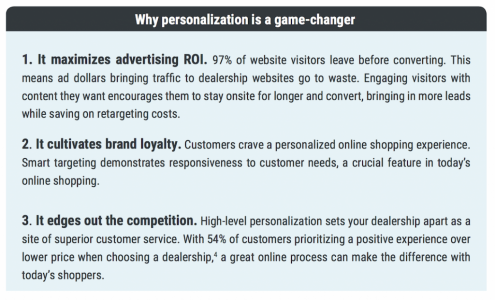
And yet, when it comes to dealership websites, content and lead forms frequently populate the screen at random, without being targeted to customers who will actually want to see them. This frustrates customers who see irrelevant content, and it wastes the dealership’s valuable ad dollars already spent bringing traffic to the site.

autoleadstar-why-personalization-gamechanger-1024x621.png

Personalization for the Dealership Website

Like a salesperson who asks the right questions, or hangs back and observes visitors’ behavior to understand their interests before approaching, a website with personalization technology can respond to individual customers in real time. It takes overlays, onsite messages, and offers, and shows them to the right people at the right time.

Real-time data about each site visitor, as well as predictive analytics, enable this high level of personalization for dealership websites.

Smart Targeting: The Key to Personalized Dealership Websites

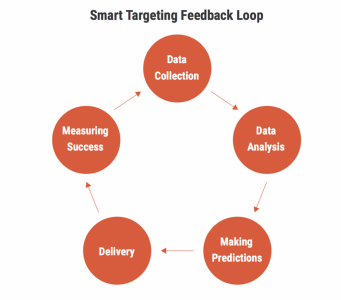
Smart targeting refers to advanced machine learning systems that can “observe” people in real time– and then respond in helpful ways. These systems collect data, analyze it, use it to make predictions, deliver relevant content to site visitors, and measure their own success. They create what we refer to as the Smart Targeting Feedback Loop, a technology that creates a truly personalized dealership website.

autoleadstar-smart-targeting-feedback-loop-1024x903.png

Smart Targeting Provides Personalization that Typical Analytics Cannot

A dealership using a service like Google Analytics receives aggregated data, which is information combined from all site users. This data is crucial for gaining insight into how individual pages and campaigns are performing. However, because it does not track the behavior of individual users, this type of analytics does not allow dealerships to enable smart targeting for a personalized shopping experience. For personalization to be successful, a much more comprehensive data-tracking and analysis system is required in parallel to a system like Google Analytics.

Free White Paper - Creating a Personalized Dealership Website

A positive, customized experience drives an increase in leads – and ultimately brings in more sales. The process of data collection, analysis, and continual improvement is no small feat, but with the right people and technology, this level of smart targeting is achievable.
800-1.jpg

What is the “HR tech stack,” and how does it affect your dealership?

Dealerships run the gamut with respect to the technology they use for hiring and onboarding.

The trouble that many businesses run into is knowing where to invest their limited budget for HR software. In its 2015 research report, Key Interval Research highlighted 13 unique HR areas where dealerships can potentially focus their efforts – your HR technology stack. It includes:

  1. Onboarding
  2. Recruiting
  3. Learning
  4. Performance management
  5. Payroll
  6. Benefits administration
  7. Time and attendance
  8. Analytics
  9. Compensation management
  10. Wellness management
  11. Total rewards
  12. Success management
  13. HR information systems (HRIS)

Your HR technology stack may include just a few or all of these types of software platforms. Furthermore, these tools range from individual purpose resources, like an onboarding platform, to an HRIS, which frequently includes all of the above. So, it’s critical to fully understand where your pain points reside and how these tools can reduce or eliminate them entirely.

What Are the Fundamental Pieces of Your HR tech stack?

At the very least, you must have some sort of payroll technology across the board. Legally and functionally, you need to ensure you’re paying your staff on time and compensating them accurately. Along with a payroll solution, a platform to manage benefits is critical to run your dealership. Again, you have a legal obligation to provide employees with certain benefits, such as health care insurance, disability insurance and paid maternity – depending on the size of your organization.

According to the Key Interval Research report, the majority of dealerships rely on Excel spreadsheets and similar types of databases to keep track of data related to applicants and employees. It should go without saying that most of the more reputable HR software vendors provide technology that improves on spreadsheets by offering a way to aggregate, organize and analyze data in a user-friendly format.

So, your HR tech stack should also include a platform that helps automate and streamline recruiting and onboarding. A common misconception that many dealerships have, with respect to their hiring strategies, is that job boards are the answer to all of their recruitment problems. In reality, simply posting a job opportunity to a site like Indeed or LinkedIn will only increase the flow of applications you receive online. The critical component is your response to – or management of – an increasing number of job seekers coming through these channels. What’s next?

With an automated solution for recruiting and hiring, you’re able to let technology do a lot of the manual labor that has traditionally fallen on the shoulders of hiring managers and other dealership staff. At Hireology, we’ve found that our processes enable dealerships to automatically filter out more than 90 percent of unqualified applicants before they’re even considered a candidate. So, the dealer principal or HR manager is able to focus their time and efforts on the right candidates instead of those who are qualified for a specific role.

At the same time, pre-screening surveys help separate those who are serious about applying for a position within your organization from those who are simply “kicking the tires.” In fact, we’ve found that roughly 6 in 10 applicants actually take or complete a survey. On top of helping eliminate time spent on unqualified candidates, dealerships can also use surveys to gauge the job seeker’s cultural fit.

In another way, your approach to your hiring process isn’t much different from your approach to sales, ranging from lead generation to customer relationship management. It’s all about how you organize your applicants in the first place, keep track of their information, score them based on specific criteria and maintain the relationship through in-person and digital touch points. If you have a bunch of electronic applicants coming in you need something comprehensive to bring them together.

What Do Best-in-Class Organizations Focus On?

Beyond applicant tracking software and payroll and benefits management systems, dealerships have to focus on productivity. In fact, recent research from Aberdeen Group found that best-in-class HR organizations are 21 percent more likely than other businesses to place a high priority on boosting productivity when they consider business objectives.

To achieve this goal, it’s important for dealerships to ensure they have developed the right processes – that are supported by effective technology systems. Having a way to attract, qualify and organize candidates is a good starting point. However, the true test of the value of your HR tech stack is whether your software enables new hires to become high-performing employees. Onboarding is fundamental to this effort. Effective onboarding software allows dealerships to structure:

  • Collecting personal details
  • Filling out the required tax forms
  • Distributing training materials

Effective onboarding aligns with ongoing training that dealerships provide new staff. The best platforms make onboarding resources accessible from anywhere at any time. So, new hires can fill out documentation at work, commuting or at home, which frees up their time at the office to focus on adjusting to the new setting and learning the processes. Meanwhile, onboarding software gives the dealership a clear view into the how a new employee is progressing throughout the process.

Where Should Dealerships Begin?

Your applicant tracking system should be the foundation of your HR tech stack to help you organize all prospects within a single, user-friendly platform. Included in this must be your payroll and benefits management system to ensure you fall in line with any state or federal regulations.

To keep pushing your dealership to outperform your competitors, it’s increasingly important that you invest in tools that help you keep track of new hires as they transition from candidate to employee. By doing so, you’re in a better position to track performance and productivity – helping you build a stronger business.

Simplifying Attribution to Propel Efficiencies and Profits

Despite changing consumer behavior patterns, many if not most dealers continue to evaluate third parties only on “hard lead” measures and discount others forms of influenced purchase behavior. Consumers want to be in control of their experience and they are reluctant to provide their contact information because they fear the repercussions of unwanted marketing and solicitation.

These influential experiences appear anonymous to the dealer looking through the lens of a traditional hard lead, and even when a flow of hard leads is provided, many dealers struggle to ascertain their value when they can’t attribute them to immediate sales, even when the leads are proven to have made a purchase elsewhere.

As competition in the automotive space increases and sales plateau, dealers will need a continually better way to understand the complexities of consumer shopping behavior and refined data to help cut through the clutter and focus on their marketing spend,

A Strategy, Goal, and Framework

After months of research and analysis, Cars.com has launched an attribution strategy that begins to resolve the conflict between how consumers shop and how advertisers measure and differentiate valuable data. While slow to adopt, the general consensus across the industry does acknowledge that the traditional way of measuring performance does need to change.

The goal is to provide automotive advertisers - OEMs and Dealers - with a better understanding and appreciation of the next generation of value measures that better reflects the connections with Cars.com Consumers, using a framework to demonstrate value and influence called Influence Drivers. The frame will continue to evolve and grow with the consumer and consists of Digital Drivers, Physical Traffic, and Revenue Signals.

Digital Drivers

Digital Drivers refers to a strategy and use of the full spectrum of digital media opportunities that boost broad influence of a message rather than trigger a behavior. Examples of this might include OEM campaigns, reviews, editorial content, and desktop/mobile integration or even insights.

Physical Traffic

Physical Traffic refers to tracking consumer behavior in the physical world in order to make more informed marketing investments elsewhere. One might think of it like night-vision google for shopper behavior. Cars.com was first to market with such tracking with its lot insights tool.

Revenue Signals

Revenue Signals refers to patterns of results from marketing investments calculated from a wider rate of financial metrics beyond weekly unit sales. You can think of this like judging GPA rather than an SAT score. As an example, over a six-month span, Cars.com influenced an average of 274 sales per dealership, 32% of sales at a dealership, and an average of 135 first-time vehicle sales, according to the Transparency Case Study January 2015 - September 2016.

CarsCom-Influencer-summit-Roundtable-1024x768.png

Influencer Summit

Cars.com recognizes that it cannot do this alone. This is an industry move that requires collaboration with other industry players, and because of this has launched its first ever Influencer Summit, an event that is expected to continue occurring annually and grow, also with an ongoing online community effort.

On February 9th, 2017, thirteen industry players from outside the Cars.com family descended upon the Sheraton Grand in Downtown Chicago for a one-day roundtable discussion to explore  these ideas and how the industry can lock arms to bring solutions to dealers. These players included:

Cliff Banks, The Banks Report
Steve Finlay, Ward’s Auto
Ryan Gerardi, AutoConversion
Darren Haygood, Transparency
Jeff Kershner, DealerRefresh
Eric Miltsch, DealerTeamwork
Gary May, Interactive Marketing and Consulting Services
Cory Mosley, Mosley Strategy Group
Joe Oltman, Pin Business Network
Brian Pasch, PCG Digital Marketing
Matt Reid, Clarivoy
Joe Webb, DealerKnows Consulting
Steve White, Clarivoy

State of the Industry

During this roundtable discussion, Cars.com CEO Alex Vetter kicked things off with a State of the Industry address that reflected on the industry in 2016 as well as share how Cars.com is continuing to build a decision engine for consumers and a growth engine for its advertisers. During this time attendees had the opportunity to ask questions and share insights, which as you might imagine from the name listed, we did.

Industry Metrics and Influence Drivers

So much in fact that we rolled seamlessly into the second segment without the planned break. This second segment, led by EVP of Business Operations Elaine Richards explored the issues caused by the modern consumer being mobile and multi-touch whereas most dealer attribution models are not.

Product and Research Strategies

After a brief lunch , Chief Product Officer Tony Zolla gave attendees a glimpse into Cars.com's product strategy and upcoming enhancements. He also shared new consumer insights based on Cars.com's research.

Industry Innovation Roadmap

Finally, we spent the last part of the day with Chief Strategy Officer Greg McGivney leading a discussion on the advances in digital, giving attendees an opportunity to chime in with their own views on where the auto industry and market is headed in the immediate years to come.

CarsCom-Influencer-summit-Roundtable-B-1024x768.png

Reflection and Insight - A Summary

Being part of this inaugural Summit was an honor, and I believe all attendees were more humbled by the experience than anything. Each of us in the room has put forth tremendous effort over the last 15-20 or more years, not just riding the wave of digital evolution and innovation in automotive retail, but putting our necks out to be pioneers in our own way. To be recognized for this and asked to participate in this Summit was a welcome nod, especially coming from the folks at Cars.com.

Not So Warm and Fuzzy

As stated in the opening sentences of this article, dealers have a way of viewing a third-party provider that is not always pleasant. The people at Cars.com not only recognize this but also embrace it, seek to understand it, and are attempting to change that sentiment.

As an example of this, let me assure that not all input from attendees at this roundtable was music to the ears for the team at Cars.com. There was no brown nosing going on in the room. In fact, I observed more challenging situations for the folks at Cars.com than sugar coating, and it was evident that the Cars.com team not only wanted this, they expected it from us.

Having dealt with, collaborated with, and observed other third-parties in this space, I am enthused to see such authenticity from an established company such as Cars.com who by the looks of things is about to make its last few years in the business appear like its adolescence.

[highlight color="#f4b945" font="#ffffff"]

Discuss in the Forum

Care to chime in about the Summit and the need for simplifying dealer attribution?

>> Go Here to Discuss in the Forums <<

[/highlight]

External Benchmarks Don’t Really Matter. Here’s What Does.

Digital marketing in the automotive dealership industry is incredibly competitive. Dealers are constantly vying for the top position in all channels - SEO, SEM, listings, display. If it exists, they want to be at the top. And as a result, we get many requests for benchmarks and whether they are “better than the guy down the street.”

However, putting too much emphasis on external benchmarks may lead you down the wrong path as it focuses purely on how others are doing rather than how well (or poorly) you’re doing.

What dealers should be focusing on are internal benchmarks and comparisons such as how well you are doing compared to yesterday and what you need to do today to improve your results tomorrow.

External Benchmarks Don't Provide Any Actionable Insight

Forget about digital marketing for a minute and let’s compare benchmarks to something else. Suppose you own an NASCAR team. The lap times at Daytona range from 44.53 to 47.97 seconds, the average lap time is 45.51 and your car’s lap time is 45.30.

I’m not sure about you, but I wouldn’t be happy if my car had a lap time of 45.30. Even though I’m above average, I would want to improve on that. I would want to get my lap time to 45.00, then 44.53, and if possible 44.00. What’s more, it wouldn't matter if my car was the one bringing up the rear at 48.00 or in the pole position at 44.50, I still want to better my lap time.

As this example illustrates, external benchmarks don’t have any bearing on what you should do next.

This analogy can be applied when comparing results for your digital marketing efforts. Whether it’s Time on VDP, VDPs per Session, Bounce Rate or anything, it’s more important that you keep improving regardless of where you are on any external benchmark.

Internal Benchmarks Provide Much More Insight

Internal benchmarks provide much more value because they are a direct reflection of the actions you have taken. As a result, you can see where your decisions or activities have become better or worse.

Below are a few internal benchmarks that will help with your comparisons.

Benchmark 1: Before vs After

This is typically what people think about when they do internal benchmarking and it works well to measure the difference between a major strategy shift. Given the same time period determine if we are better now than we were before.

Example 1 - VDP / Session - Before vs After

Months 1-6
Months 7-12
% Change

0.84
1.12
33%


In Example 1, the benchmark from Months 7-12 was 33% better than from Months 1-6. As a result, we know that the activities we are executing are producing positive results.

Benchmark 2: All vs One

“All vs One” benchmark comparisons are good for determining if a particular tactic is contributing to an increase or decrease in your average. This helps assess if a tactic is helping or hurting your metrics.

To do this, measure the metrics from a particular tactic and compare them to an aggregated benchmark of all tactics. The benchmark in this case is the “All” measurement and the comparison is against the “One” measurement.

Example 2 - VDP / Session - All vs One

2016-10-26-External-Benchmarks-are-BS-Ex2.jpg


In Example 2,  the internal average of all sources for VDP / Session is 0.84 and we can see that Technology1’s average is higher than the average for all sources.

What this means is that Technology1 is helping bring up overall metrics and is contributing to the success of that metric and should be viewed positively.

Benchmark 3: Month vs Month

“Month over Month” comparisons provide insights into two things:

  1. What direction items are trending, and
  2. If the results are an anomaly

Example 3 - VDP / Session - Month vs Month

2016-10-26-External-Benchmarks-are-BS-Ex3-1.jpg


In Example 3, we see a general increase in metrics for Months 1-3 and a dip in Month 4 for “Technology1.” However, results recover in Month 5 and Month 6. As a result, Month 4 looks to be an anomaly.

Additionally, when we compare it to the “All” line, we see that both sources dipped in that month. This indicates that the dips were universal and may be caused by an external market factor.

Focus on What’s Important: Continuously Improving

It’s easy to get caught up in external benchmarks. It’s nice to hear that you are doing better than the average or, alternatively, it’s frightening to hear how much further you need to go. But the one thing that both of these scenarios have in common is a shared goal for constant improvement.

So the next time you are given benchmark metrics, take them with a grain of salt and try turning your focus inward.

Case Study: How Dealer-Centric Digital Marketing Brings Buyers for One Dealer Where He Wants Them

Over the course of nearly two decades where Firas Makhlouf has spent leading technology and digital marketing initiatives at Driver’s Village, he’s pretty much done it all. From helping the dealership initiate client server architecture to move the group from “dumb” green screen terminals to PC’s in 1999, to introducing new forms digital marketing such as third-party leads, banner advertising, and now growing brand awareness through social media. But what Firas says works best for the dealership right now is when they’re able to drive low-funnel, VIN-specific traffic directly to their website.

So when Firas was introduced to LotLinx at a Chrysler conference in Las Vegas in October 2014, he was immediately intrigued.

“A different kind of digital marketing solution.”

A couple months after he became aware of LotLinx, Firas tried it out, and he’s been an enthusiastic customer from that day.

lotlinx-drivers-village-cs-customer-testimonial-Firas-Makhlouf-1-300x133.png
“We feel the value of that LotLinx customer is a lot higher than what we were once accustomed to. When LotLinx sends a shopper to me, I know that person is in the lower part of that funnel. He’s seven to 10 days away from buying. When we see traffic that’s not VIN-specific, those people are either mid- or top-funnel. They’re between 60 to 120 days out.

“We serve up our new and used vehicles to LotLinx, and they take it and distribute it out to many different sites. When a customer is doing a search and sees that VIN-specific 2015 Nissan Altima with 18,000 miles — that’s a unique vehicle. It’s like a snowflake. No one else has that vehicle but me. Yes, there are other 2015 Nissan Altimas out there, but this one with the scratch on the front bumper is mine and only mine.

“The results are measurable. The traffic that comes to my site is traffic we own. I can do with it as I please. If I want to serve up an ad to them, or they want to see all my inventory, both new and used, or they want to get into the e-commerce side of things and get a trade valuation — the LotLinx model is really profitable for us because now we have the shopper right where we want him.”

Better analytics make for better marketing

In recent months, LotLinx has increased its capabilities to deliver actionable intelligence to dealers at the VIN-specifc level, and Firas is taking full advantage of it.

“When we first started looking at it,” he reports, “we saw that some vehicles that I don’t have enough of were getting too much exposure, so we started shaping our spend based on our bread-and-butter cars. We no longer serve up Jeep Wranglers because those are on my lot maybe 15, 30 days. The ones that are on my lot for 45 to 60 days and those that I have multiple models of are the ones we want to serve up, and LotLinx is helping us control that spend.”

Firas recently gave LotLinx access to the dealership’s Google Analytics. “They’ve set up goals and work flows, so I can see now how LotLinx traffic is engaged, how deeply they’ve penetrated our site. It’s become a lot easier to analyze our traffic and spend.” 20 years on the job, and Firas is still getting better at it — with a little assistance from LotLinx.

Fore more information about how Driver’s Village is benefitting from LotLinx, get the free case study. Included in the case study is a scorecard that shows:

  • Percentage of new shoppers delivered to the Driver’s Village website
  • VDP Views on the Driver’s Village website
  • Cost for each VDP View
  • Number of Vehicles sold attributed to LotLinx
  • Cost Per Vehicle Sold Through LotLinx

Go Here Now to Get the Free Case Study

lotlinx-drivers-village-case-study-velocity-savings-e1487877164528.png

NADA 100 New Orleans Refresh from Ryan Gerardi

NADA and its dealer members have experienced many major milestones over the past 100 years, and had the fortune of celebrating this in New Orleans last month at NADA 100. Being adaptable to changing circumstances has allowed NADA and its members to thrive. The traits of hard work, diligence and perseverance continue to propel dealers toward the future.

Whether or not you were able to attend NADA 100, DealerRefresh has you covered. As Assistant Editor I was on the beat broadcasting via Facebook Live all three days, snagging interviews with DealerRefresh Sponsors and other exhibitors from their booths, attending special events, and more. For a glimpse of what we were able to capture, which is literally but a mere fraction of everything that occurred at this year's convention, here is a breakdown of the video material we produced:

DealerRefresh Facebook Live Videos (Facebook)

  NADA 100 New Orleans 2017 Video Compilation (BlogPro Automotive)

Here is my official music video compilation from the convention. This is the third time I've done this at NADA. The video consists of clips from the above Facebook Live broadcasts on DealerRefresh as well as those on AutoConversion's Facebook page. It also consists of photos I took at a few different events such as the LotLinx VIP Reception at Harrah's and the Cars.com Party featuring Fitz and the Tantrums. Be sure to watch the entire video so you don't miss the "Viewer Bonus."

Login to view embedded media View: https://www.youtube.com/watch?v=8EwrCjoCDvE


10 Best Facebook Live Recordings from NADA 100 (BlogPro Automotive)

For a deeper look into the Facebook Live broadcasts I captured, here is my post on BlogPro Automotive that consists of the 10 Best recordings. Included in this post are the six above-mentioned, plus four others that were published to the AutoConversion Facebook page. These are the 10 most-viewed broadcasts from the event, reaching more than a combined total of more than 10,000 people.

LotLinx Turning Point 2017

You may have noticed in each of these segments the inclusion of LotLinx's Turning Point 2017 event. LotLinx, which is a DealerRefresh Sponsor, held a private event Saturday at Loews New Orleans where Guest Speaker Brian Pasch and LotLinx Founder Len Short shared the stage to announce the latest innovations being introduced and how that benefits dealerships.

I was able to broadcast both Brian's and Len's speaking slots via Facebook Live. Below is Brian's time behind the podium explaining why there is chaos among dealers with measuring ROI and what he and LotLinx are doing about it. His presentation lasted approximately 30 minutes which you will likely find dynamic, engaging, and compelling.


Looking Ahead: DealerRefresh and Automotive Events DealerRefresh is committed to capturing the spirit of events such as NADA. Our goal is to give dealers a taste of the experience and also to help give our Sponsors coverage during and after the event. If you're interested in coordinating with us for future events, contact us and let us know what you have in mind. Additionally you may also text DEALERREFRESH to 555888 to opt in to receive text alerts while we cover such events.

NADA-100-Collage.png

From Top Left: Steve McFarland and Melissa Maxey; Jennifer Briggs, Eliana Raggio and Veronica Dunford; Jared Hamilton and Stu Berkely: Eric Brown and Ryan Gerardi

Case Study: How one Toyota Dealer Generated 268 Reviews in 161 Days

Sponsored-Blue.png
Greg Holway, General Manager of DCH Toyota of Milford, was assigned to the store shortly after it was acquired by the Lithia Automotive Group. According to Holway, many aspects of the store were in need of improvement, including its online reputation. “The ratings were as poor in Service as they were in Sales,” stated Holway. “The store had every opportunity to improve.”

In the 365 days prior, the store added a mere 6.8 reviews per month at a 3.1 average star rating with little to no presence on third party sites. Based on satisfaction Holway had enjoyed with Dominion’s solution for fixed operations marketing, he turned to Dominion’s award-winning reputation and social media platform, Prime Response.

About Prime Response

Prime Response enables dealers to track, manage, and engage with online car shoppers.
After bringing in Prime Response, not only did the store master monitoring online conversation, responding to negative reviews, and winning with social media campaigns, but it has set records in third party site review generation.

In the first 161 days of using Prime Response, DCH Toyota of Milford skyrocketed to an impressive 51 reviews per month at an average 4.6 star rating. “I would have had a tough time believing that it could happen that quickly and with that much improvement,” commented Holway, “but if you listen to the experts, it makes life a lot easier” – referring to the partnership Holway now enjoys with his dedicated specialist at Dominion.

Both review quality and quantity have improved dramatically. What used to be 3.2 and 3.0 star ratings on Google+ and Facebook, now stand at 3.9 and 3.5, respectively. Likewise, with seven DealerRater reviews posted in the year prior to partnering with Dominion and zero presence on Cars.com, 80 reviews hit DealerRater and 100 reviews posted to Cars.com, all of this within the first five months on the solution.

But this isn’t all. Now that Holway has unleashed the full potential of Prime Response, DCH Toyota is also experiencing significant improvement in its social media traffic to highly specific destinations on its website. How much traffic and where and how this is impacting business at Holway’s store, you will have to see for yourself by downloading this free case study today.
Download the Case Study Now and Get the Full Story

640x280.jpg

New Car Marketing Techniques Aren't Effective at Marketing Pre-Owned Vehicles

Everyone loves new cars. They’re shiny, they smell great and the sales staff love making a big sale. It’s a huge part of how OEMs rate their dealers as well. I mean, who doesn’t want to be the “#1 Chevy dealer in the county”?

But once we scratch the surface, the bright sheen of selling these new cars starts to wear off. According to the NADA DATA Midyear 2016 Annual Financial Profile, dealers actually LOSE $227 on every new car they sell and PROFIT $228 from every used car they sell.

Now, I’m not suggesting that you don’t shoot for being the “#1 Chevy dealer in the county”, but if you’re looking to make a real profit, you might want to shift your emphasis towards more pre-owned inventory.

However, if you plan on focusing more on pre-owned sales, you need to realize that the methods you’re using to market today aren’t actually optimized for pre-owned sales. Here’s why:

[highlight color="#314e51" font="#ff8403"]
>> How to Attract Buyers At Every Stage of the Journey <<
[/highlight]


Pre-Owned Buyers Need to Confirm Inventory, New-Car Buyers Don't

According to an article by Automotive Ventures, “On average, car buyers only visit 2.2 dealerships” and “two-thirds (68%) visited two dealerships or fewer before buying, while 40% of consumers visited only one dealer before buying.”

What this means is that the buyer knows what he/she wants before going into your dealership.

Here’s the difference:
New car shoppers assume you DO have the cars they want on your lot - or that it’s easy for you to get them. After all, if you’re a Ford store, you MUST have the new Ford Mustang, right? And if for whatever reason you don’t happen to have the exact package or color your shopper wants, the shopper expects you to be able to order it for them. As a result, they don’t need to confirm you have to the vehicle they want before they visit.

However, used car shoppers assume you DON’T have the car they want because they know that a used car’s availability is inconsistent. They know that if you don’t have what they want, it’s not as simple as ordering one from the factory. As a result, they need to confirm you have the vehicle before they visit.

In order to optimize marketing for pre-owned vehicles, dealers must move past only marketing the make and model, and go all the way down to the inventory level.

Which brings me to my next point:

Most Dealership Marketing Tactics Don't Focus on Used Inventory or Any Inventory at All

Let’s look at the most prevalent tactics a typical dealership employs and how they relate to inventory level marketing:

Digital Channel
Sub Type
Inventory level marketing
Sufficient for New Car Marketing

SEM
Branded Keywords
No
Yes

SEM
Non Branded Keywords
No
Yes

SEO
Blog Articles
No
Yes

SEO
Videos
No
Yes

Display
Brand, Offers, Specials
No
Yes

Facebook
Sponsored Updates
No
Yes

Facebook
Sponsored Carousel
Yes
Yes

Listings
AutoTrader & CarGurus
Yes
Yes


As you can see, a good six out of eight do not market at the inventory level. But, because most dealership marketing is geared toward new cars and new car shoppers assume you have the inventory they want, many dealers stop at this point.

However, only your campaigns on listings sites are actually aligned with how used car shoppers buy, since that channel allows shoppers to confirm available inventory.

Pre-Owned Optimized Marketing = Inventory Level Marketing

The interesting thing about inventory level marketing is not that it’s new, but rather, that it’s just a slight variation of some of the existing channels that you are currently using.

In fact, there are webinars available that talk about existing and available technology as well as tactics for optimizing pre-owned vehicle marketing.

So, if you’re more interested in results, try focusing a bit more on marketing your pre-owned cars at the inventory level. According to the data from NADA, your bottom line, and hence your wallet, will thank you.

5 Automotive Marketing Predictions For 2017

Back again for my annual car dealership predictions post for the retail automotive industry.

This year will be defined by a new level of awareness surrounding relevant marketing, the state of accountability and performance, and understanding mobile consumer behavior. I believe we'll reach a higher consciousness of execution, operational excellence, and results that every level of the dealership can understand. No more shell games.

Are we beginning to understanding the seemingly endless flow of data flow as it relates to quantifying marketing results? Or, quite possibly, have solution providers finally been identified as not providing the results other industries demand as a standard? Whatever the reasons, there are significant events the professionals in our industry must be aware of to collectively raise the quality of the solutions our industry uses.

2017 Car Dealership Marketing Predictions 

I've placed the key marketing items into five categories.

  1. Mobile
  2. Metrics
  3. Media
  4. Messaging
  5. MPOP

Mobile - Search engine results will be disrupted 

//giphy.com/embed/WJZBopTQp4ydy
The mobile mindset is agreed upon. We're well past the point of just saying "mobile is important" or, "we need to pay attention to mobile." We all get it - people use their phones to do stuff. A lot of stuff. I believe what we're all missing is how search engines are changing the ways marketers deliver mobile content and the way users consume and interact with mobile content.

Last year I predicted the death of SEO as a stand-alone tactic. (Rather, a single product that agencies and consultant sell) The largest portion of traffic a dealership website receives is from their branded organic traffic. Anyone still paying excessive amounts of money to optimize pages for long-tail search traffic and compete with more authoritative content is misinformed. Also, be extremely cautious of any solution which doesn't provide proactive management and is 100% transparent with their strategy.

This year we'll see local SEO become even more important for marketers. Why?

Simple. Local and mobile searches will rule the land. 50% of mobile searches have local intent. I expect to see this number approach 65% in 2017. Google released the following statistics as it relates to this behavior from last year:

  • 4 in 5 consumers use search engines to find local information.
  • Local searches lead to more purchases than non-local searches. 18% of local searches on smartphone lead to a purchase within a day vs. 7% of non-local searches.
  • 30% of consumers would buy in-store instead of online knowing they are close to a store.
  • 57% of smartphone users look for local info at least once a week

I predict we'll see signals of a transformation in the search engine landscape. Google may make the first bold move and begin to reduce the number of organic listings displayed in the mobile search results. (When was the last time you clicked an organic result from your phone?) They've already increased the size of their Adwords units by 58% in their new Expanded Text Ads. This takes up more screen real estate (especially on your phone) in the hopes of creating better-contained choices for the user.

However, a major flaw exists in the early phase of the ad unit utilization: Only 30% of the companies in all industries have converted to ETAs. In fact, some early adopters are experiencing lower click through rates because their ads are simply longer, but haven't improved their contextual relevancy.

Why do I believe this change will happen? The first clue was the elimination of the right side-bar ads earlier last year. Everyone was batching and blasting the same plain-vanilla ads that didn't appeal to anyone's search intent. Plus, we've experienced a massive change in how Google shows local listings due to the increase in mobile usage.

Also, we observed a faster evolution of Facebook's paid search advertising ecosystem than standard search engine platforms. Facebook quickly moved to a pay-for-play platform for advertisers and has quickly demonstrated how they can generate massive levels of revenue. About 80% of Facebook's $7 billion revenue comes from mobile advertising. Facebook's local data is an incredibly impressive and effective platform where shoppers can easily find what's important to them - rather, the information finds them.

Going even further, hands-free devices such as the Amazon Echo and Google Home will also change how we interact with search engines. These devices will also create more transactional based activities. As these activities continue, search engines will seek more alternatives to monetize their results.

What Should I do? Hold Your Providers Accountable.

  • Are your paid search campaigns fully converted to Expanded Text Ads?
  • Make sure your ads aren't just longer versions of your older ads. Increase your relevancy, not just your character counts.
  • Is your website optimized for local prominenceGreg Gifford knows what's up.
  • Smart SEO is still a requirement. Consider companies who actually do the work needed, such as Search Engines MD.

Metrics - Massive changes with measurement

//giphy.com/embed/d1dzsb2Ib1Zkc

More dealerships will realize they've been measuring wrong metrics. The primary measurement theme for 2017 will be measuring the quality of traffic vs. quantity of traffic. At the end of the day dealers only care about the marketing activities which demonstrate real results. Does It Sell Cars?

Sure, historical analytics metrics such as bounce rate, page views and time on site are indicators of page and site quality. And yes, they contribute to the overall quality rating Google assigns to pages. These items on their own don't indicate sales success. Bots became the new school SEO cheat because people realized how easy it was to correlate engagement with improved rankings. Unfortunately, this traffic is pure garbage and contributes nothing of value.

Quality engagement drives conversion. We all understand video drives engagement rates that are up 10 times higher than standard content. It's time this engagement is tracked properly to show ROI and give dealers the results they're looking for from their marketing partners.

Dark social will become a larger point of confusion. Apps, messenger apps, texting, and secure browsing (and others) make it impossible to track referral traffic. It's happening at a such a massive scale. In North America alone, dark social referrals account for up to 59% of referral traffic.

I believe Brian Pasch and his team at PCG will drive the concept of understanding hard conversions to a new level with their engagement project. A new group of metrics will help demonstrate the quality of the traffic and its true contribution.

Four metrics to focus your attention on for 2017:

  • Cost per Engagement (CPE)
  • Engagements per Session (EPS)
  • Zero Engagements per Page (ZEP)
  • Form Completion Rate (FCR)

As traffic quality increases, natural engagement increases, and so do traditional "hard" conversion events: lead forms, phone calls, chats, and text messages. - Brian Pasch

Media - Streaming experiences will become an important branding element

//giphy.com/embed/NjbFdHe4NDrdm
  

The marketing ecosystem will be dominated by paid ad spend for content and eventually paying for video advertising solutions. Approximately 14% of marketers experimented with live video past year. I believe this may explode to over 40% of marketers using streaming media in 2017. Standard post reach has been pegged at approximately 1-2% while paid search spend has increased 234% in the past seven years.

2017 will see considerable less effort and resources spent towards irrelevant content creation. This is due to the fact the largest brands have cornered the content market and competing against them will prove to be worthless. This also ties into the understanding of the shopper's journey and where they're consuming different content. Visitors come to dealership sites to buy. Filling a website with irrelevant pages that don't act as a catalyst to move the buyer to the buying stage is a waste of efforts. Dealers will realize their irrelevant marketing efforts are driving up costs and it can be prevented.

Videos will create more empathetic and emotional experiences. I would also expect to see a better method of video channel organization within Facebook. (Think YouTube channels) I watched over 50 videos before I purchased my last vehicle. My youngest son began the search for his first vehicle on Youtube.

Another indicator of this trend is the fact that Facebook changed their own experience to include a new section for their video feed within the app. The line between the standard newsfeed and the video feed will be blurred as the two experiences merge into one. Customers are four times more likely to take action on a product demonstration video. 75% of ALL Internet traffic in 2016 was streaming video. Facebook has also stated they will invest up to $4 billion dollars in more AR/VR experiences within the platform.

Look for a new level of mobile video appreciation as Apple releases the iPhone 8 later this year, which is rumored to include mixed reality technology. This will usher in a new age of immersive experiences that raise the bar for incredible brand experiences. I believe (mixed) augmented reality will be more widely accepted than virtual reality due to the ease of use of out of the box and lower costs compared to VR solutions. Plus, AR is seen as less creepy and a lot less dorky. All of these improvements will keep users on their phones and contribute to changing how we find and interact with the products we purchase.

Bonus prediction - Twitter gets bought out by either Google, Facebook or Salesforce.

Messaging - 4 billion messaging app users isn't a fluke

//giphy.com/embed/8pOsoH25Pt4hG
  

I expect to see more dealerships using Facebook messenger with some moving towards 24/7 coverage. I also expect to see larger brands leveraging message bots to handle initial conversations and customer interactions. Customer service will be defined by when it happens, not where it physically happens. More smart dealerships will leverage one-to-one communication platforms such as Slack, Conversations, or Pando for more personalized experiences.

Our communication behaviors are changing as a result of the functionality available and the real-time experience it provides. Social and Messaging commerce will become more acceptable as users rely on this channel for customer service, FAQs, and appointment setting. Watch for more direct purchases via platforms such as Instagram and Pinterest. 31% of consumers are using social media platforms to actively search for products to buy. Their personalized and smart experiences make it easy and enjoyable.

Younger users prefer Snapchat and I have a different theory why. Remember when many of us (I'm talking to the parents of Millenials or younger Internet users) could enjoy a social gathering without the fear of someone sharing content in real-time beyond your current location? Sure, photos and video cameras captured moments, but it didn't have real-time broadcast capabilities and the ensuing consequences.

Snapchat user behavior isn't much different. They have the same experiences. They're taking pictures and videos of each other without the risk of content going beyond the current situation. Sure, users can grab screenshots, but that's not acceptable and tolerated. Just as it wasn't acceptable for us to share content beyond its original intenders.

As platforms, such a Snapchat and Instagram, continue to drive real-time disposable interactions, marketers will attempt to connect with these users. Unfortunately, about 74% of Snapchat users and 63% of Instagram users don't even remember seeing advertisements on these platforms.

As younger consumers maintain this type of activity, it will be become increasingly difficult to connect with these shoppers. Think of how many personal chat groups you currently have on your phone. Safe to say you have at least one text group, one in Facebook messenger and yet another in WhatsApp.

I believe the real value for dealerships is real-time customer service via social messaging from multiple departments. Dealers shouldn't be surprised to see more of their dealers adopting their own follow-up processes that include more direct video responses rather than standard email follow-up responses. Elise Kephart continues to do an excellent job of guiding dealerships and salespeople down the path of video personalization.

MPOP - A Merchandising, personalization, and optimization platform

//giphy.com/embed/DYCqww80XOydO
  

Martech solutions will prove their value. Last year's post also introduced the concept of dealers operating as Martech companies to improve their customer relationships. I believe those efforts will extend further creating more effective, relevant marketing solutions. Dealers will recognize easier, faster and more effective methods of creating and managing their website marketing processes.

New vehicle sales may be flat in 2017 and used vehicles may be value plays for shoppers based on the inventory available. Mobile consumer behavior and many of the factors mentioned above will convolute the marketing processes.

Third party platforms will find it increasingly difficult to provide dealers with concrete attribution and performance data.

The dealership website must be the cornerstone of the marketing strategy, especially as dealers are offered more website provider alternatives. Watch for more creative designs, better mobile experiences and improved performance from website providers such as Carbase, DealerOn, and Dealer Inspire.

Less than 5% percent of marketers receive the full benefit of the tools they're using. 39% desire an improved technology strategy, 36% want to improve analytics reporting, and 33% want better support and training to help improve their current Martech tool performance.

Nearly 88% of marketers use more than one Martech tool regularly, of which include single-vendor platforms. Only 16% of vendor suite users say it’s the only tool they use because of the ease of use, simplicity, and overall effectiveness. Incredibly, 42% of marketers described their marketing technology as “fragmented” or “piecemeal.” Sound familiar? Dealers want to change however, that change must be easy to understand and use.

I'm also a used car dealer and we need to be as efficient and relevant as possible with our merchandising and marketing efforts. This will be an increasingly important philosophy for new and used car dealers in 2017.

Our focus is simple: Make it as easy as possible for search engines to find our relevant organic and paid content - and deliver our content to in-market car shoppers faster. I'm putting my money where my mouth is and using Launch Control to manage our vehicle marketing efforts.

(Full disclosure: I am a Co-founder of DealerTeamwork's Launch Control) 

Predictions from the community

//giphy.com/embed/4jQCh6JTVxcNa
  

Dara Moore: Customer retention is going to be the key to dealer’s success this year.

Tony Ly: Paid Traffic is and will continue to dramatically increase as Dealers, OEMs, Lead Generators, 3rd Party Buying services compete for clicks. We may see a point of saturation on some top keywords.

Jeff Green: Speed, efficiency, creativity are all going to become exponentially more important in 2017. More specifically, aligning your marketing message to show customers that there’s more to your dealership than just the transaction. Standing out from the crowd gets harder every day as we all step up our collective games so creativity will make a huge difference. Customers will continue to demand a more streamlined road to the sale. End to end transactional websites will start to become even more common. F&I processes will get more streamlined allowing faster purchase experiences.

Andrew DiFeo: I believe the shift from third party advertising to first party will continue, especially as more dealers harness the power of Facebook. Dealers must continue to make it easier for consumers to shop and transact online, as well as ensure their offline processes match their digital presence and brand promises. As Dara mentioned above, customer retention will yield the highest ROI versus trying to conquest customers from other brands and dealerships.

More dealers will also realize not all web traffic is good web traffic. The amount of fraudulent web traffic, intentional or unintentional, to websites. is significantly higher than most people want to admit. Savvy google analytics users can spot this, and now companies like Orbee can assist dealers in identifying this fraudulent traffic.

Scott Monty: My wish: that a fraction of the budget allocated toward sales gets shifted to service, in an attempt to show existing customers that they’re more important, thus reducing the cost of new leads. The reality: the same budget will be put toward sales and no additional attention will be paid to service and retention, because of the increased efficiency of digital advertising.

Eric Giroux: Page/site speed will become increasingly important. OEMs will continue to tighten mandates for their stores to ensure a consistent online and in-store UX for their consumers. More vendors and OEMs will push toward an online purchase/desking process. More manufacturers will explore a direct-to-consumer purchase process. Pricing will become more transparent as the market will demand it and more states will regulate it. And, of course, the race to catch up with Tesla will continue… more self-driving technology and (affordable) fully electric vehicles.

Ed Brooks: My prediction, dealers will (finally) begin to move away from last click attribution and towards more advanced analytics. The age of influence measurement is upon us.

Gary May: We can all hope. 80%+ won’t unless prompted by outside forces. Vendors themselves don’t get it. Most have never been into MCF in GA or even assisted conversions.

Michael Donovan: I am not giving up my secrets but here are some hints:
Transactional data uniformity, Search/Social Marketing, Sales processes, Digital inventory merchandising

Jarrett Kuljis: An increased awareness and concerns by Dealers about data ownership and access to that data. Obvious advancements in autonomy and traditional OEM’s embracing relationships with autonomous technology. Increased subscription to the on-demand transportation models, Uber, dynamic ownership… Maybe more automotive technology companies with dealerteam in the domain name?

Benjamin Freedman: Used cars will continue to become a commodity, the rise of digital merchandising (a best practice within digital marketing), innovations to help retain gross profit due to the commoditization of used vehicles, and digital marketing innovations across all stages of the customer journey.

Robert Scoble: I’ll let you know. A major car company is taking me out in a prototype self-driving car on Wednesday at CES. My biggest prediction? Tesla won’t ship its model 3 in 2017.

Kacie Faye: Say goodbye to 3rd party lead generator and even a lot of SEM budgets will decrease as OEMs take over making it less affordable or efficient for dealers. Shift to creating home and work deliveries not only in sales but service too. Bring me what I want, when I want it I how I want it. Less about $$$ more about saving the customer time and giving them VIP service.

Ryan Dunkle: 2017 for us will be about trimming the vendor fat. Taking the increased money over the past 1-2 years (that was supposed to get us increased sales) and reallocating it into new marketing and advertising areas. Deploying a new hybrid floor model to increase efficiency overall and create a better customer experience. Continuing our focus on retention both internally with employees, but also with our customer base. Lastly, continuing to learn and pioneer to be at the forefront of the automotive space for others to follow.

Brian Pasch: My hope for 2017 is that dealers will embrace the four new PCG metrics that will focus their advertising dollars to increase high-quality consumer engagement on their websites. The focus for 2017 should be toward QUALITY metrics and away from QUANTITY metrics.

Owen Moon: With 85% of all marketing currently being spent in the Consideration stage, Mobile GPS targeting will continue to become more of a factor as dealerships are now starting to understand the importance of reaching car buyers later in the shopping cycle.

Lee Drake: Direct to consumer sales by companies like Tesla will significantly eat into dealer market share, just like it did in the IT world 20 years ago. Increasing political pressure on states that forbid direct sales like NYS from free market proponents backed by Trump will see more and more direct sales availability. When the mid price model 3 hits the street it’s runaway success will result in a huge impact on all non-Tesla brands, and major manufacturers will scramble (and fail) to create their own Giga factories.

Will McGinnis: Just a hunch but overall vehicle sales across the nation will take a noticeable dip. Used and New… except for Tesla

Tom Hawkins: “Direct to consumer sales by companies like Tesla will significantly eat into dealer market share”…this is NOT true…first of all, Tesla has no money except investor money. Secondly, this has been predicted for years…and we are still almost as far away as years ago.

Troy Spring: I predict that the business will get harder for some and easier for others. Those that don’t already know the difference of why…. will be on the wrong end of 2017.

Carl Bauer: Massive auction disruption by roaddealer.com.

Patrick OBrien: In 2017 the car business will continue to allow indie dealers to dominate the used car sector.

Chris Kelly: These are all very interesting! DISC! Here my prediction for 2017! Dealers will finally take charge of their marketing messages online and offline. Remembering cars are still an emotional purchase! The 2% of the grinding shopping public and 98% that can be brought into the cycle! This will be a year of waking up!

Michael Warwick: As we approach a 70% turnover rate, dealers may finally realize that their managers actually need to know how to train their salespeople to be successful.

Brad Hensley: “Traditional” dealerships that continue to try to crank “home runs” every deal will continue to shut the doors and wonder what happened. They tend to be ones who are force feeding warranties and not embracing a transparent process.

Matt Watson: I’m hoping we see more and more electric cars! After owning one, I don’t understand why anyone would want anything else! I’m hoping the Chevy Bolt sells like hotcakes in 2017.

George Nenni: Sales below 17 million, even worse in 2018
Expense cutting challenges vendors. Showdown on DMS data. Used car supply is up, price pressure will be strong. Who knows, hoping the train keeps steaming along, just not sure it will.

John Gentner: I predict a new up and coming dealership out of New York expanding even more. Adding 4 more stores blowing their sales and customer service through the roof….This prediction we have control of.

Cliff Banks: AI becomes more prevalent; two big sales on the vendor front; at least two large dealer groups will be sold in 1st or 2nd quarter; 1st quarter pricing pressure on used vehicles; and a legal showdown on DMS data will happen.

Larry Schlagheck: 1) Tesla wins a big lawsuit over franchise laws. 2) AI grows but infrastructure holds its growth back 3) Oil prices up. Truck sales down.

Bill Playford: The battle of 2017 will be fought with inventory. Due to the market’s seemingly insatiable urge to purchase trucks, SUVs, and crossover type vehicles, dealerships who are in urban areas or are limited on real estate, will be hamstrung by what they are able to stock. Manufacturers will be quick to use allocation as a means to control dealerships who do not care to fall in line with OEM mandates. Consumers will increasingly turn to virtual test drives (such as those on YouTube) and targeted social campaigns (follow the eyeballs) to hone down their selections. Dealerships that actively manage the proper selection, mix, and display of vehicles will be at a distinct advantage.

In regards to tech, the onboard diagnostics port (OBD) will be the hottest piece of real estate inside the vehicle. Vehicle to vehicle (V2V) communication will gain steam along with the autonomous push so that older vehicles will function in the autonomous world. The same technology that will allow pull-alerts to be broadcasted will also be used to push alerts to vehicles and passengers. Services will be developed to proactively and automatically schedule service for vehicles, further bolstering the service department as a revenue generator.

On the vendor front, a critical mass of dealers will leverage the NADA to finally crack the duopoly that is CDK and Reynolds & Reynolds. With falling margins, crippling fees, and questionable data practices, dealers will slowly, but surely, band together politically to get their way. Before things get busy in DC (and to counter Cox’s portfolio of services), CDK and Reynolds & Reynolds will go on an acquisition spree as a means to offer best-in-class tools to retain dealerships and protect their position in the market. Everyone will be happy…for a few months. Bold prediction: One OEM will have an autonomous shuttle offering service to and from the dealership by the end of 2017.

Glenn Pasch: Education and then implementation. Too many people preaching without helping to implement. Learning how to spot the pretenders.

Ryan Everson: Some of my 2017 automotive digital marketing predictions….

Google Paid Search Ads Will Capture 50+% of SERP Clicks – With paid search ads looking more like an organic result and more relevant than ever before, the percentage of people who click on paid search ads will start to overtake organic clicks. Not participating in paid search will no longer be a viable option, dealers have to pay to play.

Accelerated Mobile Pages (AMP) Will See Adoption in Automotive Industry – Automotive website providers will start implementing AMP versions of vehicle detail pages. Dealers need a great mobile website in 2017 not for Google but for our customers and faster pages will help drive conversions.

Display Ads Evolve into Native Advertising – Customers continue to largely ignore display advertising regardless of how well the targeting may be. Native advertising will grow in popularity as an effective way to get customers’ attention more naturally.

Dealers Will Start Targeting Niche Markets – Almost every dealer is active online nowadays which has resulted in crowded and more expensive online marketing while the number of consumers has remained more or less steady. Astute dealers will start targeting more specific niches and queries which will result in almost personal level content and ad campaigns.

Online Retailing Will Finally Gain Real Momentum – After failures like GM’s shop click drive, this is the year that online retailing will finally start to pick up steam. With tools like Joe Chura’s Online Shopper, dealers will finally be able to offer customers the online buying experience they have come to expect and are increasingly desiring.

2018 PWA Prediction - Innovative website companies will start developing a progressive web app version of their websites in 2017 that will be ready to launch in 2018. Customers love the experience of mobile apps but getting them to install one is near impossible for dealers whereas progressive web apps will provide the mobile app experience while sill being indexed by google and not requiring the user to download anything.

Bill Simmons: I believe 2017 will be the year that many smart dealers prepare for the expected industry slowdown in 2018. Many single point dealers may realize this could be the last year of record blue sky numbers and sell out to a mega group in their area. I’ll go against the idea that dealers will increase digital paid search spend. But will reallocate their dollars from some of the digital fluff like retargeted display ads that many studies prove are not effective at all. Look for those dollars to be shifted to tried and true paid search methods including Facebook.

James Klaus: Website companies will see their dealers shopping for a better customer experience on mobile. We have known the importance of mobile for years, hopefully, this will be the year that mobile is no longer ignored.

Chuck Parker: Media is generally ineffectual in not only advancing automotive business model strategies — but in gaining any respect for ideas or visionary thinking, however subliminal — so the current dealer business model is in for massive migrations and changes in next 3 to 5. Dealers should become Total Transportation Management Centers and the Beepi/Fair business model should move to a Personal Vehicle Management Strategy. Stand by for more.

Thank you for reading and thank you to everyone who contributed their vision for 2017. I look forward to seeing many of you at NADA in New Orleans. Keep learning. Keep helping others. And keep on improving the retail automotive industry.

For more of Eric's yearly predictions check out his previous posts:
2018 Automotive Marketing Predictions – DealerRefresh

5 Automotive Marketing Predictions For 2017 – DealerRefresh

4 Predictions in 2016 for Car Dealerships – DealerRefresh

4 Predictions That Will Affect Car Dealer Performance in 2015 – DealerRefresh

6 Predictions That Will Impact Automotive Retailing in 2014 – DealerRefresh

24 Free Online Training Resources for Car Dealers

Sponsored-Blue.png
Today’s consumers have a lot of the answers they need before they ever contact your dealership or set foot on your lot, but they don’t have ALL the answers. Your organization’s processes and talk tracks must adapt to this ever-changing reality, which means you should be training your team constantly with the most up-to-date lessons you can find.

Sure events such as NADA, Digital Dealer, the DrivingSales Executive Summit and the likes offer helpful resources for savvy dealers, but they aren’t cheap to attend and they aren’t on-demand for your team when they need specific training. DealerRefresh can be a great free online resource, but when individual team members need the best training on specific subjects, your options are limited.

Say “Hello” to 24 Free Online Training Resources

At SteveStauning.com you will find a diverse array of online dealer training content and videos, and on this page in particular you will find more than 24 free online training resources that you and your team can access absolutely free anytime you need.

To make assigning and watching these free videos even easier, they are organized by job title and dealership function as follows:

  1. Sales Managers; General Managers and Internet Managers
  2. Floor & Internet Salespeople and BDC Agents
  3. Receptionist Training

DR-Advertorial-CTA-for-pladoogle.png

Accountability Quizzes

After your team members have indicated they’ve completed the video training, you can have them complete the two tests that are also available on the site - Creating an Appointment Culture and Appointment-Driven Communications.

Steve’s Guarantee: By focusing your team on this curriculum and holding team members accountable for learning and applying what they’ve learned, you will have gone a long way toward improving your sales, market share, gross profits, employee turnover and customer satisfaction.

About Steve Stauning

Steve Stauning [LinkedIn] is a respected automotive ecommerce industry veteran, and is the founder of pladoogle, LLC., a leading mystery shop, ecommerce and automotive consulting firm providing cutting-edge products and in-store sales consultation to automotive dealers, industry vendors and media companies. Prior to his involvement with pladoogle, Steve served in various automotive ecommerce leadership roles, including as Asbury Automotive Group’s Director of Ecommerce, the Director of the Web Solutions division of the Reynolds & Reynolds Company, and as General Manager for Dealer Web Services at Dealer Specialties. Steve is also an extremely popular automotive industry speaker and writer.

Free Car Sales Video Training Series: Turning Auto Leads Into Engagements

When shoppers on your website inquire with your dealership, the expectation of hearing from you is at its highest, be it a phone call, email, or text. But when they inquire with you indirectly by way of third-party automotive sites, sometimes their association with your dealership can be fuzzy, or in some instances, completely unexpected or unwanted.

Why do some shoppers forget why you are contacting them, or outright deny they ever asked to hear from you?

To address this, we've laid out five free car sales training videos in a series titled, "Turning Leads Into Engagements." In these videos we address the following topics:

  1. Understanding the Mystery Car Lead
  2. Online Car Buying Behavior and the Value of Leads
  3. How Loyal Are Your Car Leads?
  4. Tips to Best Manage Your Car Leads
  5. Car Buyers Rely on Third Party Information

Understanding the Mystery Car Lead
We've all gotten it before. The Mystery Auto Lead. The consumer who says 'How did you get my information?' This dealer training video outlines the process by which auto shoppers submit their information on third-party automotive sites so that you can understand what they're really saying and how you can improve your sales tactics to overcome objections.

Login to view embedded media View: https://www.youtube.com/watch?v=7vKRDvukelI


Online Car Buying Behavior and the Value of Leads
Car buyers today spend an average of 17 hours online researching their next vehicle purchase. This dealer training video highlights the 24 touchpoints that influence car buying behaviors to give you a better understanding of the path to purchase, and the value that car leads continue to represent today.

Login to view embedded media View: https://www.youtube.com/watch?v=h4v0du4YTe4


How Loyal Are Your Car Leads?
Auto lead loyalty is a hot topic today, and one that needs to be addressed from a sales best practices perspective. In this dealer training video, find out whether or not consumers predominantly buy the vehicle for which they submit a lead. Knowing these important statistics can help you improve your sales process and sell more cars.

Login to view embedded media View: https://www.youtube.com/watch?v=5JaVqhmeI9o


Tips to Best Manage Your Car Leads
If you're not following the right car sales process, you could be leaving money on the table. In this important dealer training video, learn about the buying behaviors of today's consumers and the steps you can take to keep more consumers in your brand, in your vehicles, and at your dealership versus the competition.

Login to view embedded media View: https://www.youtube.com/watch?v=1zifQVWBE_c


Car Buyers Rely on Third Party Information
Did you know that 64% of car buyers today say they still want and rely on third party automotive information? In this dealer training video, critical statistics are addressed about the behaviors of today's online consumers, the importance consumers place on third party vehicle information, and why the right third party website can be your biggest and best sales and marketing tool.

Login to view embedded media View: https://www.youtube.com/watch?v=xgb5sSARqtI


About Scott Pechstein
Scott Pechstein serves as Vice President of Sales for Autobytel Inc. where he manages in-house and field sales and account management for the company’s broad range of industry leading products. Scott serves as an automotive industry spokesperson, a company news media spokesperson, and lead trainer of the Autobytel Dealer Insight Series. Scott also contributes sales insight for the development of the company’s client marketing communications programs. Scott is an NADA Convention, NADA 20-group, Digital Dealer, IS-20 Group, DrivingSales Insights, Autocon, and Internet Super Conference speaker

abtl-playbook-learn-more.jpg

De-mystifying the Third-Party “Mystery” Lead

When I think back to the days of running an Internet department, I have many fond memories. I loved the hustle and bustle of the dealership and the smiles on the faces of people driving away in their new car.

My BDC was set up so that I was in the same area as my team and one thing I often heard from my team was the dreaded, “This person said they never submitted a lead and wants to know how I got their information.”

These “mystery leads” frustrated me. I felt like I paid for an opportunity that was now deemed useless to my dealership. As I learned more, I realized this thought process doesn’t make sense and, dare I say in most cases, is a more often misleading statement from the consumer.

Let me share ways you and your team can work the third-party lead smarter to avoid frustration and ultimately help you win the sale.

[highlight color="#004b7d" font="#fa6102"]
>> Free Car Sales Training Videos: How to Turn Leads Into Engagements <<
[/highlight]


Acquire Leads from Reputable Sources

For starters, always make sure that the leads you are purchasing come from reputable sources that require shoppers to select your dealership when submitting their information. Most third-party lead providers practice this, but not all. If you’re buying leads from a source where people aren’t actually choosing your dealership, then confusion will reign.

Consider the Shopper’s Third-party Site Experience

Let’s say I’m in the market for a new Porsche 911 Coupe (hey, I can dream big – it’s my scenario). I decide to do research first on a random third-party automotive site and then choose to request a quote from a dealer.

The first thing the site asks me for is the Make and Model I’m interested in along with my zip code. Contrary to popular belief, my computer does not automatically know this information so I must physically enter the information myself. (Hint – your customers' computers aren’t telepathic either).

Once I hit the continue button, I’m shown the dealership(s) that currently receive leads on the model I’ve selected in the zip code I’ve entered and I have the opportunity to request more information. Notice that no one is twisting my arm to fill out the information and once again, my computer cannot automatically enter the information for me.

Shoppers on reputable third-party automotive sites will automatically receive an email from the site letting them know you'll be contacting them. There should be no surprises, yet when you contact them they act surprised or in some instances violated.

At this point, let’s consider a few of the things the shopper might be saying to you without words:
“I’ve had a bad car buying experience in the past and I’m not ready to talk to you yet.”
“I’m still researching and am not ready to talk to you yet.”
“I’m not ready for the pressure yet.”
“I asked for a price quote and you didn’t send one. Why should I talk to you if you can’t give me what I want?”
“I don’t trust you.”

Do’s and Dont’s for Your “Mystery” Lead

Here are a few tips to respect the shopper while still maintaining your follow up.

  • Set up an automated follow-up process specific to the lead source from which the lead was acquired. Also be sure to follow-up personally.
  • NEVER, EVER, under any circumstances call the shopper a lead. In fact, the word "lead" should never leave your mouth when talking to a shopper during any conversation.
  • Respect that they aren’t ready to talk to you.
  • Send them a price quote – it’s what they asked for to begin with.
  • Offer your assistance. Let them know that you’re here to help them and want to make the process as easy as possible for them.
  • Don’t pressure them about coming into the dealership. Just continue to feed them the information they’re looking for.
  • Continue your normal 90-120 day follow up procedure via email.
  • Follow up periodically with emails about incentives and specials, as well as used car inventory that is comparable to their initial request.

When you understand the steps a shopper goes through to submit an inquiry through a third-party automotive site, is it plausible that the shopper really has no idea how you got their information and are shocked that you are calling? Yes, it is, and attempting to convince them they are wrong or forgot will never win them over.

Take the time to optimize your follow-up process to be personalized and specific to each individual lead source, be swift with your follow-up, and be mindful that the shopper may truly not understand how you obtained their information or they simply aren’t comfortable in talking with you, which gives you an opportunity to earn their trust.

Until next time - Happy Car Selling!

Author's Note: This Editorial was contributed by Cassie Perkins, Sr. Manager, Account Management Team and Programs for Autobytel.

It’s my data – How do I get access to it?


[highlight color="#F0F0F0" font="black"]This is a follow up to my previous article “Who owns dealership data?”[/highlight]

Attending back-to-back conferences (DSES and JP Power marketing summit) was a real eye opener!

I saw tremendous energy and clear thinking about the new age of automotive retailing. And it is a new age…. our customers demand a better sales and service experience. More purchase options exist than ever before. Customers have choices and they know it. Add an increasingly complex marketing environment and today’s dealerships face business challenges that would test the very best executives.

Deeper, more textured and widespread data exists in automotive today than ever before. We know our customer’s purchase habits, their equity position, what cars they are interested in, how often they view inventory - where they travel digitally. Data is important, but not the end game. The end game is what we can do with the data.

Walking the exhibitor’s hall, I saw some fresh, innovative and sometimes disruptive solutions. I saw a few others that may not make it but out of the group, many will. More encouraging, solutions providers view data as a tool to solve problems plaguing our industry. This is a change in direction from an industry that saw the data itself as a product.

All of us should be cheering this renaissance of automotive investment and new thinking. Break out the fireworks and let’s celebrate, right? The golden age is upon us!

Yes, but wait just a minute here!

Between the dealer and the vendor are the DMS providers. Though it could be different, it’s quickly becoming common knowledge that several DMS providers are putting a stranglehold on the free flow of dealer-owned data. Their mission is to monetize an asset they don’t own.  With pressure from investors, DMS providers are searching for all possible methods to increase revenue and profitability. It’s an aggressive stance taken by the DMS providers who clearly, now more than ever are publicly showing they will stop at little to achieve desired margins -- including their apparent willingness to disrupt their customers’ businesses to achieve their goals.

Consider an example where a vendor who manages CSI for a major OEM also authorized by dealers, routinely pulled data from a dealer’s DMS to survey customers. Just as important, the data was needed to provide incentive payments calculations to these dealerships. The problem is the vendor had not become a “Certified Data Partner.” After discovering this data export, the DMS provider, interrupted (shut down) data access and subsequently, no surveys were being conducted. Incentive payments calculations were not made to dealers forcing the OEM to guess at and reserve for payments while they worked out the Certified Data Partner issue.

The Certified Data Partner program promises to protect vendors and dealer from liability for a breach. Based on what I’ve seen, that doesn’t seem to be the case.   What is also unclear is what other downstream uses of this data are and if that usage is also protected from a breach.

The DMS providers are aggressively pursuing their seemingly well-conceived plan to target this huge revenue potential.

Compel all vendors to become Certified Data Partners

In speaking with solutions partners (vendors), they tell a similar story. Solutions partners must become certified data partners to receive data. This is accomplished by the execution of broad, restrictive agreements that impose harsh penalties to those that either allow or assist others to access data from the DMS. This causes rejection of any technology that is not willing or able to pay the DMS toll.

Some of the other penalties prohibit a third-party provider from disclosing the fee they pay for becoming a certified partner. Some agreements impose six-digit penalties per instance where a third party has told his customer, the dealer, what they are paying simply to access data that the dealer owns. Unbelievable!

The Targeted approach to produce the greatest revenue.

According to those I spoke with, DMS providers first approached the largest vendors of dealership software. The more customers they had, the higher up the hit list they ended up. This was based primarily on potential revenue. As a secondary strategy, the DMS providers could create havoc if they interrupted data. This was not an idle threat, by the way, as the DMS providers have arbitrarily entered DMS systems and removed profiles that appeared suspiciously like a profile a vendor would use to get access. Again, it’s all about potential revenue and this was the low-hanging fruit.

Interestingly, smaller vendors without large customer bases that I spoke with were summarily denied partner status and told to re-apply when they had grown large enough to provide a good revenue stream from increased fees. This effectively short-circuits the smaller vendors and could kill a promising start up.

Submit to our NDA… OR ELSE!

The second part of this plan seems to be to gain broad, ongoing rights to data. Very one-sided aggressive Non-Disclosure Agreements are being sent to vendors. Those not in a position to be able to fight the apparent bullying simply sign as-is and return. Those who have the wherewithal to make a stand are apparently being subjected to intense negotiations during which time their business is impacted by the hide-and-seek user profile tactics.

Preventing Competitive Technologies

Subtler is the approach towards competing technologies. According to those I spoke with, DMS providers have a long history of spotting interesting tech solutions and buying them when it makes sense to fill a gap in their product offerings. The certified partner process is a valuable platform for the DMS providers to spot these technologies, either buying or making the data access so prohibitive that the vendor can’t compete with the captive solution. I am no attorney, but this seems a conflict of interest at the very least. This ultimately can affect our business by stifling the most promising concepts in favor of lesser products.

Where do we go from here?

This Machiavellian strategy to increase revenues at the DMS providers has proven effective…the shareholders are happy and want even more. Other recent ideas from what I’ve heard are to charge for each time a vendor hits a data base…either retrieving or posting data. Wow! Reminds me of when the DMS providers would charge by the number of sheets of paper printed by their system.

Fortunately, awareness around this issue is increasing. When talking to dealers now, most are aware of the increased charges, the increased restrictions and they are highly upset about it. A few years ago, the average dealer executive was not aware of it.

In my opinion, this will end poorly and no one will win unless the DMS providers take stock of what they are doing to their customers and act with good common sense. Too often activist shareholders drive management to make poor long-term decisions that look good on a short-term basis. That strategy often results in ruining a company. Perhaps their energies could be better directed at improving the products that dealers use every day and becoming partners of their customers instead of adversaries.


Filter

🔥 This Week 5 threads · 28 posts
Tech & Data
Used Car Acquisition Costs - 1st Party vs. Auction
Alex Snyder shares DMS data analysis showing customer-sourced used cars (trades, street buys, lea...
Rank the CRMs
A 12-store dealer group on Elead/CDK is exploring a switch and asks the community to rank automot...
General
Looking for honest feedback on an idea. Turns car snaps into professional car listing photos.
An early-stage founder named Dyllan is seeking honest feedback on a tool that transforms casual c...
Too many automotive news sites... anyone else?
A dealer community member introduced AutoIntel, a daily automotive news digest he built to consol...
Dealer feedback - finding hidden mechanical problems before they impact profitability
A vendor called Sorel is seeking dealer feedback on an AI-powered tool that analyzes engine acous...
Get this delivered every week