100% And thats exactly why you can't infer "why" with a single search or action. Trying to will only result in failure, thats why nobody does what you are suggesting here.
Your correct however the question is how do I get 500 vehicles down to the best 3 makes and models that fit my needs.
Instead of asking:
"What make do you want?"
You ask questions that eliminate vehicles.
Yes. Be like Amazon. Kinda amazed that dealer website providers have done nothing in this area.
I don't think the dealership's competition is just the other dealership down the street.
The dealership website is competing with the entire ecosystem the customer uses to make the decision.
- Cars.com
- CarGurus
- Autotrader
- Google
- OEM sites
- YouTube
- Reddit
- AI
- Amazon
All of them have taken a piece of the car-buying journey away from the dealership.
And I don't think the dealerships current response is a sustainable long-term strategy.
Car buyers already have defensive mechanisms in place because they do not want to be sold to. (see above) So, meet them where they are in the way they want and give them the shopping experience they want.
Where the customer is can be radically different.
Customer #1 walks onto the site and says:
"I want a 2024 Toyota 4Runner."
Great. Don't get in their way. Show them 4Runners.
Customer #2 says:
"I have three kids, a wife, and a boat. I need something I can drive every day, but it needs to tow the boat."
That customer has no idea whether the answer is a Tahoe, Expedition, Yukon, or something else.
If we simply "meet them where they are" by giving both customers an inventory search, we aren't solving the the second customers problem?
I'm saying that the physical inventory should be connected to enable the car buyer in their purchasing journey. Thats my mission.

When you say:
"The physical inventory should be connected to enable the car buyer in their purchasing journey."
I agree.
Dealerships normally connect inventory to things like: VDP, payment calculator, trade tool, credit application, chat, lead form
What I'm talking about is connecting the inventory to the
reason the customer is shopping in the first place.
For example:
"I need a reliable car for my daughter."
"I have three kids."
"I tow a camper twice a year."
I'm talking about turning the inventory into the answer.
On the lot, a salesperson connects the customer's situation to the vehicles sitting on that lot.
Online, the dealership website could do the same.
And if the customer already knows what they want, none of that happens.
No disagreement there. But this needs to be done in how the customer wants to be engaged.
That's the problem, how do we know how to engage someone before they land on the site?
If I arrive knowing exactly what I want, I don't want you asking me questions. I want to see the inventory.
If I arrive knowing I need a vehicle for three kids that can tow my boat, but I don't know what vehicle solves the problem, I don't want to be dumped into 300 SUVs and told to figure it out.
Maybe we could give them three doors:
- Show me inventory
- Help me find it
- Let me browse
It's not changing where, rather AI is changing the tools they're using early in the process. The road to purchase hasn't changed, it's just that AI is giving car buyers better early stage search/discovery tools.
Exactly.
Those tools sit between the consumer and the dealership.
That's a threat!
The dealer website is not just competing against other dealer websites, it's competing against every decision layer before they get to the website.
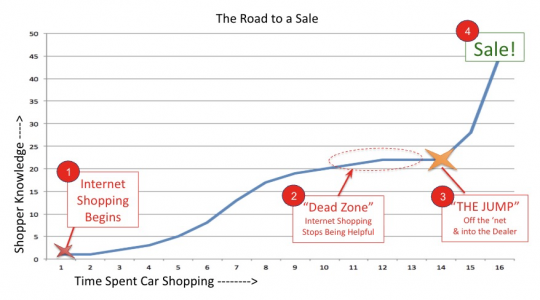
They come to the lot further down the purchase journey... or perhaps I should say, closer to the purchase point.
The question/need might or might not involve the dealership to solve - I think you might be too hung up that it's something the only the dealership can solve. (I could be reading you wrong here). ?
Regardless of what we think is best for the car buyer, if we don't meet them where they are, we lose. I think we both agree on that.
I agree that by the time someone is on the lot, they're closer to the purchase point. And I agree that the question/need doesn't necessarily have anything to do with the dealership.
However consider what happens when they get to the dealership's website.
If we truly believe in "meet them where they are," then the website shouldn't assume that where they are is simply, "I'm here to find a car you have in inventory."
As a mater of fact, I think there's an opportunity for a dealer to build more trust by being willing to say, "Honestly, I don't think the car you're looking at is the best choice for what you told us. Here's why and here's one we have that fits you better."
I'm not saying the dealership has to solve every problem. I'm saying the dealership website should be capable of recognizing where the shopper is in their journey and then connecting that journey to the dealership's actual inventory when it makes sense.