• This thread is just the tip of the iceberg.The people ahead of the curve aren't Googling for answers — they're already in here, having the conversations you haven't found yet. DealerRefresh is free.Get the full picture →

What do dealership websites make customers do that we’d never tolerate in the showroom?

Your saying we need to build for multiple types of customers!

UI architects are often mega-nerds and...
1. they build to solve their needs (i.e. they think all shoppers are power users).
2. are unaware of the spectrum of user's expectations.
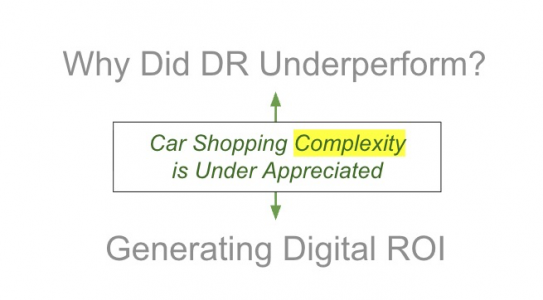
3. have NO idea how complex car shopping is.
4. UNiversally agree that car dealers suck
5. Are unaware that shoppers find MORE value in talking to the dealer becuase...
6. They have no idea that the websites they build... suck.

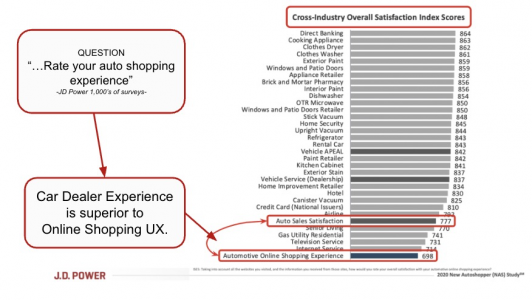
Fact:
1788965255627.png
The survey is 5 yrs old and our sites are basically unchanged since DealerRefresh was a babe (read: Decades).

1788965193814.png

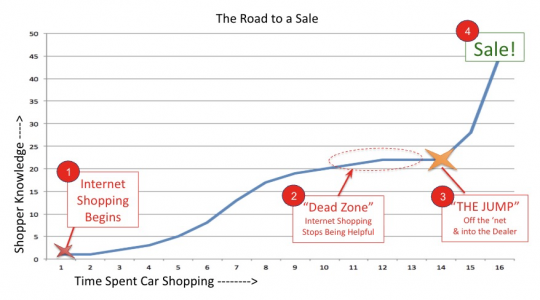
The "Dead Zone" and "The Jump", two of the most under explored areas in our space.
1788965220438.png


AutoMagic Labs is a merchandising research lab. We go deeeep into car shopping friction using 1st principles, then map it back to the UI.

DISC? :unclejoe:
 
  • Like
Reactions: Vochi
Customers don't give two sh*ts about what you think.

I'm the customer, I noticed it when trying to help my daughter find a car.(-;

Oh and there's Cox's independent-dealer research:
83% of independent-dealer shoppers began shopping without knowing exactly which vehicle they wanted.

Those buyers spent an average of 16.5 hours researching online and visited more than five websites.

The industry needs to let that go (thinking they know what is best for the customer)

We have evidence that most car shoppers do NOT arrive knowing exactly which vehicle they want!

Cox's 2025 Car Buyer Journey Study found that only 29% of buyers were certain about the vehicle they wanted when they started shopping.

That means 71% entered with an open mind.

And Cox's more recent independent-dealer research:

83% of independent-dealer shoppers began shopping without knowing exactly which vehicle they wanted.

Those buyers spent an average of 16.5 hours researching online and visited more than five websites.

and start observing what their behavior *IS* and shape the experience around that.

So the website should:
  1. Observe behavior
  2. infer/learn intent
  3. help accomplish the job
  4. recommend vehicles
  5. connect to inventory.
The mistake is assuming I already know what the customer wants.

Let's observe them.

The observed data says a very large majority aren't starting with a specific vehicle.

Cox's 2025 Car Buyer Journey Study found that only 29% of buyers were certain about the vehicle they wanted when they started shopping.

Consider this:

A customer searches: Toyota Highlander

That tells you what they searched.

It doesn't necessarily tell you why.

Maybe they:
  • have three kids
  • need a third row
  • tow a small camper
  • want something reliable
  • are replacing a minivan
  • heard Highlanders are reliable
  • their neighbor owns one
  • simply saw one they liked
The behavior is real.

The explanation for the behavior is a guess.

I'm not saying “I know what customers want.”
I'm saying “Let's figure out what they're trying to accomplish.”

However the website should be able to figure that out from what they tell you AND what they do.

Customers don't come into the showroom when they come on to the dealership... they drive around the lot. The lot IS the showroom. ;)

When someone drives onto a dealership lot, a salesperson can walk out and ask:
  1. What are you looking for?
  2. They can see what they are driving...
  3. They can ask, What don't you like about it?
  4. How many people do you need to carry?
  5. Do you tow anything?
  6. What's important to you?
And then the salesperson starts walking them toward inventory.

100%!! Thats what I call "The Connected Lot". ;)

We agree the disagreement is really about what should connect to the lot and in what order.

Your saying: Inventory, Connected tools, Customer

I'm saying: Customer's situation / goal, Needs & constraints, Best-fit vehicles, Dealer inventory, Connected tools, Transaction

And the lot can remain the showroom without being the starting point for the decision.​


Cox's 2026 research says AI is increasingly changing where vehicle discovery starts.

Cox specifically describes shoppers beginning with questions such as:

  1. Which SUV has the best safety ratings?
  2. What's the best 3-row SUV under $40,000?
  3. Which dealerships nearby have the best ratings?
71% didn't want to start with the vehicle listing.

And that's pretty much what I am trying to say, just like on the lot:
  1. The question comes first.
  2. The vehicle comes second.
  3. And then the inventory comes third.
 
  • Like
Reactions: The QR Code Guy
Consider this:

A customer searches: Toyota Highlander

That tells you what they searched.

It doesn't necessarily tell you why.
100% And thats exactly why you can't infer "why" with a single search or action. Trying to will only result in failure, thats why nobody does what you are suggesting here.

However the website should be able to figure that out from what they tell you AND what they do.
Yes. Be like Amazon. Kinda amazed that dealer website providers have done nothing in this area.

When someone drives onto a dealership lot, a salesperson can walk out and ask:

LOL, not on Sunday when the store is closed. ;)

Oh and if the store is open, 9 out of 10 customers will reply, "Just looking".

Car buyers already have defensive mechanisms in place because they do not want to be sold to. (see above) So, meet them where they are in the way they want and give them the shopping experience they want.

We agree the disagreement is really about what should connect to the lot and in what order.

Your saying: Inventory, Connected tools, Customer

I'm saying that the physical inventory should be connected to enable the car buyer in their purchasing journey. Thats my mission. :cool:
I'm saying: Customer's situation / goal, Needs & constraints, Best-fit vehicles, Dealer inventory, Connected tools, Transaction

No disagreement there. But this needs to be done in how the customer wants to be engaged.

And the lot can remain the showroom without being the starting point for the decision.​


Cox's 2026 research says AI is increasingly changing where vehicle discovery starts.

It's not changing where, rather AI is changing the tools they're using early in the process. The road to purchase hasn't changed, it's just that AI is giving car buyers better early stage search/discovery tools.

And that's pretty much what I am trying to say, just like on the lot:
  1. The question comes first.
  2. The vehicle comes second.
  3. And then the inventory comes third.
They come to the lot further down the purchase journey... or perhaps I should say, closer to the purchase point.

The question/need might or might not involve the dealership to solve - I think you might be too hung up that it's something the only the dealership can solve. (I could be reading you wrong here). ?

Regardless of what we think is best for the car buyer, if we don't meet them where they are, we lose. I think we both agree on that.
 
  • Like
Reactions: Vochi
Ask any car dealer how many customers have walked on the lot and said: "I have no idea what I want;

A study conducted by Black Horse found that 19% of buyers changed their mind about the car they wanted after visiting a dealership.

Auto Trader's Car Buyers Report found that two-thirds of buyers changed their mind about the make/model they initially considered during the shopping process.

Autotrader found that 30% switched between new and used vehicles.

Every customer either wants a brand, a model, something extremely specific, or is a get-me-done when they approach the dealership.

The 19% number supports my argument: The vehicle a customer walks into the dealership wanting isn't necessarily the vehicle that's actually right for them.

And the Auto Trader research shows the problem starts even earlier: consumers are still changing their minds about make/model while they're researching.

The Cox 2025 national study of 2,344 recent buyers, 71% said they entered the process unsure of which vehicle they would buy.

When they're hitting the dealership website, they have landed there from a different research experience telling them that dealership has that car. That could be Cars.com, Autotrader, Google search, or AI pointing at that dealership.

I agree with that, the dealership website is more likely not the beginning of the shopping journey.

Cox's data supports that. Third-party sites are heavily used, and dealership websites are important later in the journey. The 2025 study found buyers used an average of 4.6 sites, with 75% using third-party sites and 59% using dealership websites.

So when you say: When they get to the dealer website, they're probably further down the funnel.

I agree but you can't then say Therefore they already know exactly what vehicle they want. The data does not support that.

Customers come to dealers with a mission.

I agree.
The disagreement is your saying they only come because they want a F150 and I'm saying yes you could be correct but they could also be there because they've got a camper to pull, dislikes trucks but believe that's what they need.

Your saying that person doesn't exist anywhere on the entire planet and I'm saying the data doesn't support that so your response is I must be an AI?
Now, the studies you chose are gold to me. Cox Automotive Studies.

Your AI didn't realize that I used to work there. I spent nearly 8 years at Dealer.com building product. I was deep into how research is conducted.

News flash: we were always guessing at what motivated shoppers. We had no great intelligence. Cox liked to do surveys, but those had their flaws. Our bias was lead gen. It was the only thing dealers measured us on. We had zero insight into what happened after a lead was submitted. And no technology or study will ever tell you what psychology happens when a customer is sitting in front of a salesman. You have to be an asphalt-hitting commission-earner to get it.
Lol, talk about throwing your last employee under the bus.

Fair enough don't trust Cox!

However if 71–83% of shoppers don't know the specific vehicle they want when they begin shopping, I don't think the correct conclusion is that the data is useless because we can't observe everything that happens after that!

A good salesperson doesn't normally start with: Here's our inventory. Go find something.

They ask questions.
"What are you trying to accomplish?"
"Who's going to drive it?"
"How are you going to use it?"
"What's important to you?"
"What's your budget?"


Your first study was with NIADA about Independent shoppers. Well, that's a different animal entirely. Those people want a payment, and the actual car they want is secondary. They don't have the income or credit to qualify for a loan at a franchised store, so their options are limited, and they know it.

You sure do group people together a lot...lol

Cox says independent buyers are more driven by necessity, financial pressure, urgent transportation needs and constrained credit situations.

That's different from saying:

“They don't have the income or credit to qualify at a franchised store.”

Cox's broader 2,344-person study independently reaches the same general conclusion.

It's not just the independent-dealer study.

Only 29% knew the exact vehicle they wanted when they started shopping. 71% didn't.

"This ain't a bus stop" is what my first used car manager used to say in a gruff voice every time a customer was walking the lot without being upped. Those of us who have paid our bills on commissions from selling cars know that no customer comes to a dealership for the sheer joy of it (unless you're a Ferrari store). They come with a purpose, a mission, and the website is where they go to collect a little information to determine whether they're going to visit that dealership. It isn't a tool to decide whether they want an SUV or a Sedan.

I actually agree with you on the first part: this ain't a bus stop. People don't wake up and visit a dealership website for entertainment. They have a reason for being there.

If the argument is that the dealership website is generally later in the journey than Google, Autotrader, KBB, etc., I agree. Cox's own research supports that. In its 2025 study, 65% of buyers had established contact with a dealership before visiting in-store, and Cox's broader research shows buyers use multiple channels throughout the journey.

But "I have a mission" isn't the same thing as "I know exactly which vehicle I want."

I'm saying people walk into dealerships not knowing what car they want and I'm showing the data to support this and your saying that in the history of the world it has never happened and to even think it I must be an AI.
 
I'm saying people walk into dealerships not knowing what car they want and I'm showing the data to support this and your saying that in the history of the world it has never happened and to even think it I must be an AI.

Your DealerRefresh tone has always elicited a combative response. I don't know if you're a keyboard warrior or like this in real life. I hope it's the latter. Truth is, your tone is turning you into our main troll of the day.

Yes, I think you're using AI to write your posts.

If you keep failing to listen to people with experience, you will fail to provide the kind of products you seem to be striving to build.
 
100% And thats exactly why you can't infer "why" with a single search or action. Trying to will only result in failure, thats why nobody does what you are suggesting here.

Your correct however the question is how do I get 500 vehicles down to the best 3 makes and models that fit my needs.

Instead of asking:

"What make do you want?"

You ask questions that eliminate vehicles.

Yes. Be like Amazon. Kinda amazed that dealer website providers have done nothing in this area.

I don't think the dealership's competition is just the other dealership down the street.

The dealership website is competing with the entire ecosystem the customer uses to make the decision.
  1. Cars.com
  2. CarGurus
  3. Autotrader
  4. Google
  5. OEM sites
  6. YouTube
  7. Reddit
  8. AI
  9. Amazon
All of them have taken a piece of the car-buying journey away from the dealership.

And I don't think the dealerships current response is a sustainable long-term strategy.

Car buyers already have defensive mechanisms in place because they do not want to be sold to. (see above) So, meet them where they are in the way they want and give them the shopping experience they want.
Where the customer is can be radically different.

Customer #1 walks onto the site and says:

"I want a 2024 Toyota 4Runner."

Great. Don't get in their way. Show them 4Runners.

Customer #2 says:

"I have three kids, a wife, and a boat. I need something I can drive every day, but it needs to tow the boat."

That customer has no idea whether the answer is a Tahoe, Expedition, Yukon, or something else.

If we simply "meet them where they are" by giving both customers an inventory search, we aren't solving the the second customers problem?

I'm saying that the physical inventory should be connected to enable the car buyer in their purchasing journey. Thats my mission. :cool:

When you say:

"The physical inventory should be connected to enable the car buyer in their purchasing journey."
I agree.

Dealerships normally connect inventory to things like: VDP, payment calculator, trade tool, credit application, chat, lead form

What I'm talking about is connecting the inventory to the reason the customer is shopping in the first place.

For example:

"I need a reliable car for my daughter."

"I have three kids."

"I tow a camper twice a year."

I'm talking about turning the inventory into the answer.

On the lot, a salesperson connects the customer's situation to the vehicles sitting on that lot.

Online, the dealership website could do the same.

And if the customer already knows what they want, none of that happens.

No disagreement there. But this needs to be done in how the customer wants to be engaged.

That's the problem, how do we know how to engage someone before they land on the site?

If I arrive knowing exactly what I want, I don't want you asking me questions. I want to see the inventory.

If I arrive knowing I need a vehicle for three kids that can tow my boat, but I don't know what vehicle solves the problem, I don't want to be dumped into 300 SUVs and told to figure it out.

Maybe we could give them three doors:
  1. Show me inventory
  2. Help me find it
  3. Let me browse
It's not changing where, rather AI is changing the tools they're using early in the process. The road to purchase hasn't changed, it's just that AI is giving car buyers better early stage search/discovery tools.
Exactly.

Those tools sit between the consumer and the dealership.

That's a threat!

The dealer website is not just competing against other dealer websites, it's competing against every decision layer before they get to the website.

They come to the lot further down the purchase journey... or perhaps I should say, closer to the purchase point.

The question/need might or might not involve the dealership to solve - I think you might be too hung up that it's something the only the dealership can solve. (I could be reading you wrong here). ?

Regardless of what we think is best for the car buyer, if we don't meet them where they are, we lose. I think we both agree on that.

I agree that by the time someone is on the lot, they're closer to the purchase point. And I agree that the question/need doesn't necessarily have anything to do with the dealership.

However consider what happens when they get to the dealership's website.

If we truly believe in "meet them where they are," then the website shouldn't assume that where they are is simply, "I'm here to find a car you have in inventory."

As a mater of fact, I think there's an opportunity for a dealer to build more trust by being willing to say, "Honestly, I don't think the car you're looking at is the best choice for what you told us. Here's why and here's one we have that fits you better."

I'm not saying the dealership has to solve every problem. I'm saying the dealership website should be capable of recognizing where the shopper is in their journey and then connecting that journey to the dealership's actual inventory when it makes sense.

 
Your DealerRefresh tone has always elicited a combative response. I don't know if you're a keyboard warrior or like this in real life. I hope it's the latter. Truth is, your tone is turning you into our main troll of the day.

Yes, I think you're using AI to write your posts.

If you keep failing to listen to people with experience, you will fail to provide the kind of products you seem to be striving to build.

I started out years ago on an old SEO forum where we tested things and I was taught to keep it to the facts and never attack anyone.

Never let it get personal!

The idea is I post something I belive to be true and wait and see if the other side convinces me that what I am thinking is incorrect.

I've got no skin in the game, don't care one way or the other, just want to understand an idea and maybe test it.

To make sure I didn't miss anything I brake it down line by line, (for some reason I tend to skip lines and misunderstand things if I don't).

I take that line and try and understand it, look at the evidence, compare it with what the research I've done, and then decide whether I think the argument holds up.

I'm more than willing, I actually want to see evidence against my position because I don't want to waste time thinking about a stupid idea!

So when I go point by point, I'm not trying to be a troll or a keyboard warrior. That's just how I've learned to think through a problem.

I can see how it might feel combative from the other side.

But I'm genuinely interested in the subject, and I'm trying to figure out where the old assumptions about dealership websites hold up and where they don't.
 
The dealership website is competing with the entire ecosystem the customer uses to make the decision.
  1. Cars.com
  2. CarGurus
  3. Autotrader
  4. Google
  5. OEM sites
  6. YouTube
  7. Reddit
  8. AI
  9. Amazon
All of them have taken a piece of the car-buying journey away from the dealership.

"All of them have taken a piece of the car-buying journey away from the dealership."

huh? :oops:

Without KAYAK, shopping for a flight and a car rental would SUCK. Does UNited Airlines think KAYAK is taking away the travel shopping journey from the air traveler?

Dude, stick to code, that's your domain.
 
Last edited:
  • Like
Reactions: The QR Code Guy
"All of them have taken a piece of the car-buying journey away from the dealership."

huh? :oops:

hahhaha...

Without KAYAK, shopping for a flight and a car rental would SUCK. Does UNited Airlines think KAYAK is taking away the travel shopping journey from the air traveler?

Dude, stick to code, that's your domain.
To that effect, imagine shopping for a used car without the 3rd party sites? LOL no thank-you.
 
I started out years ago on an old SEO forum where we tested things and I was taught to keep it to the facts and never attack anyone.

Never let it get personal!

The idea is I post something I belive to be true and wait and see if the other side convinces me that what I am thinking is incorrect.

I've got no skin in the game, don't care one way or the other, just want to understand an idea and maybe test it.

To make sure I didn't miss anything I brake it down line by line, (for some reason I tend to skip lines and misunderstand things if I don't).

I take that line and try and understand it, look at the evidence, compare it with what the research I've done, and then decide whether I think the argument holds up.

I'm more than willing, I actually want to see evidence against my position because I don't want to waste time thinking about a stupid idea!

So when I go point by point, I'm not trying to be a troll or a keyboard warrior. That's just how I've learned to think through a problem.

I can see how it might feel combative from the other side.

But I'm genuinely interested in the subject, and I'm trying to figure out where the old assumptions about dealership websites hold up and where they don't.

I appreciate the response. In fact, it is my favorite thing I've ever read from you (y)

Maybe a different approach for the future is worth trying? Perhaps with fewer words.
 
  • Like
Reactions: The QR Code Guy

✨ AI Highlights

A dealership professional opened the thread by drawing a sharp analogy between intrusive in-store sales behavior and the friction-heavy experience dealers impose on their own websites — popups, redundant lead forms, and competing vendor widgets — asking where helpfulness ends and customer obstruction begins. The discussion quickly derailed into a prolonged personal dispute between a newer member named Vochi, who argued that dealer websites should better emulate AI-driven filtering tools like Amazon and compete more directly with third-party sites, and veteran members who pushed back on both his ideas and his argumentative style. The thread's key insight got buried under the conflict, though the original premise — that dealers would never tolerate in-store what they routinely subject online shoppers to — stands as a worthwhile provocation with little resolution reached.

Replies Views 24 938 Started Last Reply