• This thread is just the tip of the iceberg.The people ahead of the curve aren't Googling for answers — they're already in here, having the conversations you haven't found yet. DealerRefresh is free.Get the full picture →

POLL How far do you think agentic commerce (within auto) goes in the next 5 years?

I don’t think AI has to replace the dealership to change the business in a big way.

The bigger shift may happen before the customer ever talks to us.

If a shopper is using AI to compare vehicles, trims, pricing, payments, trade values, dealer reviews and financing before they submit a lead, they may already have 80% of the decision made before we even know they exist.

That changes what the dealership has to be good at.

We still have to earn the business, solve problems, explain the deal, handle the trade, get financing done and take care of the customer when something gets complicated. I don’t see that going away anytime soon.

But I do think customers are going to show up more informed, with better questions and less patience for bad information.

The stores that make their inventory, pricing and information easy to understand are going to have an advantage.

To me, that’s where this gets interesting. AI doesn’t have to buy the car for the customer. It just has to become part of how they decide where to buy it.

What do dealership websites make customers do that we’d never tolerate in the showroom?

Been thinking about this from the store side.

If a customer walked into the showroom and every few minutes a different person interrupted them, asked for their name and phone number before answering a basic question, made them repeat information they already gave us, and then made them start over when they moved to another part of the store, we’d call that a bad customer experience.

Online, we’ve somehow gotten used to a lot of it.

Popups. Chat boxes. Lead forms. Trade tools. Payment tools. Credit tools. Different vendors asking for the same information.

Some of those tools absolutely have a purpose. I’m not saying all of it is bad.

What I’m wondering is where we crossed the line between helping the customer and making the customer work around our systems.

What does your dealership website or digital process make a customer do today that you would never tolerate if the same thing happened in your showroom?

And if you could remove one piece of friction tomorrow, what would you remove?

I’m interested in both sides of it. Dealers living with it every day and vendors who think we’re looking at it wrong.
  • Like
Reactions: Vochi

Going paperless. How can you send a picture of the DL?

Looking at this from the store side, I wouldn’t solve it by having customers email or text pictures of their license and then relying on everyone to delete them afterward.

There are just too many places that image can end up. Inbox, text thread, employee phone, downloads folder, backups, forwarded messages, etc.

The cleanest process to me is a secure upload link. Customer gets the link, uploads the front and back of the DL, and it goes straight into a restricted customer record or document vault. The salesperson should be able to see that it was received without needing to download the actual image to their phone or computer.

I’d want the link to expire, access controlled by role, an audit trail showing who accessed it, and a clear retention/deletion policy.

I also wouldn’t really use HIPAA as the measuring stick here. If that customer’s information is tied into financing or leasing, I’d be looking at the FTC Safeguards Rule and making sure whatever process we’re using fits inside the dealership’s information security program.

Whether the upload piece comes from the CRM, DMS, Microsoft, Zoom or another vendor matters less to me than where the document actually ends up and who can touch it.

Dan’s secure-send option could absolutely work. My preference would just be to avoid creating another separate place for customer documents to live if we can send them directly into the system the store already controls.

Going paperless should mean fewer copies of sensitive information floating around the dealership, not taking something that used to sit in one locked file and spreading it across five different digital places.
  • Like
Reactions: Tallcool1

Have you had customer blowback when they found out you were using AI?

Makai and Joe are hitting the part that matters most to me. From the dealer side, the customer doesn’t care which vendor built the bot. If it lies, gives bad information, or pretends to be a person, my store owns that experience.

My line would be pretty simple. AI can help the customer, but it can’t fake being one of my people. If the customer asks what it is, answer clearly. No dodging it. No fake identity. No doubling down.

I also think the guardrails have to go beyond just telling someone it’s AI. Research, comparisons, features, basic questions, helping somebody narrow down what they need, those are all good uses for it.

But when it gets into a specific vehicle, price, availability, incentives, payments, trade value, financing, or anything else that can cost the customer or the dealership money, it either needs verified information or a person needs to step in.

I would much rather have a bot say, “I don’t know, let me get someone,” than confidently make something up. One bad answer can undo a lot of trust very quickly.

I don’t think dealers should run from AI. Customers are already using it every day. We just need to be smart about where we use it and what authority we give it.

That’s how I look at it. Use AI to make the customer’s experience easier, but keep the accountability with the store.

I Wonder if Dealership Websites Are Solving the Wrong Problem?

I think you’re onto something here.

Most dealership websites are built around one question: “Which vehicle are you looking for?”

But a lot of customers haven’t figured that out yet.

They know they have two kids, a dog, a long commute, need room for road trips, want something good in bad weather, and have a budget they’re trying to stay within.

They may have no idea if that means a Pilot, Telluride, Traverse, Grand Highlander, or something they haven’t even looked at yet.

That’s where I think we make the customer do too much work.

We send them somewhere else to research, compare vehicles, figure out trims, learn the differences, and then hope they come back when they’re finally ready to look at inventory.

Inventory still matters. Price matters. Availability matters. The exact VIN matters.

I just think there’s a step before all of that that dealership websites could be much better at.

Help me figure out what fits my life first.

Then show me the vehicles that make sense.

Then show me the inventory.

If somebody already knows they want a Wrangler Rubicon, great. Get them there fast.

But if they only know what they need the vehicle to do, we should be able to help with that too.

We’ve gotten really good at helping people find cars.

I think the bigger opportunity is getting better at helping people decide which car they should be looking for in the first place.
  • Like
Reactions: Vochi

Core Web Vitals Rankings - I spent way too much time on this to rank 1300 websites

Joe, this is the part I think dealers really need to see in plain English.

From the dealer side, I don’t care whether somebody calls it bot protection, a rendering decision or an accident. If I’m paying for a website that looks fine in a browser but the vehicle and dealership content isn’t actually readable by the systems people are increasingly using to research, that’s a problem — especially if the dealer has no idea it’s happening.

I’d actually like to see the report separate a few things: what comes back in a plain no-JS fetch, whether the major crawlers are specifically allowed or blocked, and whether the important content on the homepage and VDP is available without relying on JavaScript.

One thing I would be careful about is assuming a generic 403 automatically means every named crawler gets the exact same response. Vendors can treat user agents and traffic differently, so I’d rather test that directly and let the data say who can actually read what.

But I completely agree on breaking it out by website vendor. That’s where this becomes useful for a dealer. Don’t just tell me my score is bad; show me whether it’s my store, my website setup or something the vendor needs to fix.

If Jake can get enough rooftops behind it to make the comparison fair, that becomes a report I’d absolutely use in a vendor conversation. I’d be happy to help pressure-test it from the dealer side when you guys get closer.

AI = Awesome Intelligence

680+ builders who have created with us

Matt,
This looks interesting, plz consider opening a DR thread to display examples of your users outputs from your platform. I'd love to see before vs after. My brother in law sells 30 nissans a month and hes so proud of his SM posts, yet they're sooo geocities, so garish. Is this what your platform does?

AI = Awesome Intelligence

Today, we are officially releasing

Matt, dude, you got to tone down your AI slop generator. You're turning dealer refresh posts into lead gen. The "Hey, look at me, and look at my products" gets old. We need best practices, ideas, then toss on some humble brag.

Get more creative, please embrace the DR spirit.

P.S. This pissed me off, I signed your ptition and you used it for lead gen.
***URGENT*** Call to the industry builder community - It's time for interoperability Please sign the petition!

AI = Awesome Intelligence

The craft beer line is right about the build. I think it understates what happens after.
1788791238812.png

Ahhhh... you've uncovered the 'magic variable' in AI, the POV (Point of View) of the user.

Joe, you went into the intricacy of the building blocks and the technical connectors, the architecture of the system, the surfaces, etc. I was seeing an executive's view of disruption coming to a legacy enterprise, where employees create new products, new solutions, new ideas that the enterprise legacy system can't se -or- create on its own.

@Alex Snyder recruited me to come to Burlington Vermont, back in the day when craft beer was a baby. I saw firsthand how brewmasters would peel off and start their own company, creating craft beer that nobody else could make.

In 2026, the luckiest dealerships will have the resident nerd, the brainiac, finally having the resources, the tools through AI, to see problems and fix them on the fly, fast. The framework is the same: you have a master system, and then an employee inside the master system sees problems and can't get it fixed until AI shows up. Then, voila, a fix is made, a solution is created, and a new product is born.

For 2 decades, Dealer Refresh has a magnet for the smartest and brightest people in the dealership world. Look at our roster of amazing minds.

If you're new to DR and you want to know if this is the right place, Read this statement:

"Why isn't there a fucking API?"

If circa 2005 architecture makes your blood boil, then welcome aboard! A tidal wave of disruption is about to playout in real time, and DR will be the best seat to watch it play out in real time.

-Uncle Joe :unclejoe:

AI = Awesome Intelligence

DealerTrack (and possibiy other older apps that “require Lexmark printers”) forces a physical print job to get the right logos and forms on things like statements of account and tech cards.

Here it comes ppl.

From inside the stores, AI will power waves of disruption. Every software system you use, created by giant companies, will have new competition coming from little places, popping up everywhere.

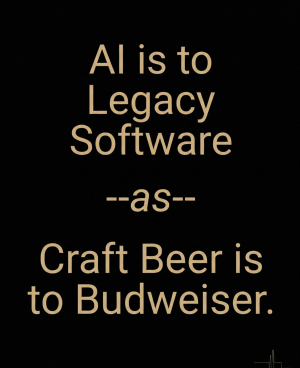
AI is to Legacy Software
as
Craft Beer is to Budwiser.

An unstoppable wave of innovation that Budwiser could not copy.
  • :light:
Reactions: MattCopley

Remember when AI was $$$ CHEAP?

I've been programming for a long time, and this is probably the biggest productivity change I've seen since the Internet became mainstream. I'm still bringing decades of programming and dealership experience to the table — AI just lets me turn those ideas into working software much faster.

@Jeff Kershner and @Alex Snyder
I said this a couple of months ago:

1. AI unlocks the brilliance of men and women inside stores who are deeply immersed in day-to-day life in the dealer world.

2. They will make products and experiences for themselves first, share it with their teams second, and sell it to others third.

3. That being said, based on this simple first-principle observation, DealerRefresh is a beacon for brilliant minds.


DealerRefresh's best days are coming.

p.s. For you young entrepreneurs that are building software systems intended for car dealerships' internal operations, posting open-ended questions like "Hey, do you think this idea will work?", posting here is going to end up as a dead-end question. If you genuinely have the desire to help car dealers build internal systems and help them be better, smarter, faster, then let go of the mouse, get out of the house, and go work for a store or become the general manager's best friend. Build him what he needs.
  • Like
Reactions: Alex Snyder

What Actually Moves the Needle in Dealership SEO

Me personally (and this is just me speaking here), if your website has a fat ass (I don't mean to offend anyone) and is slow to load and isn't somewhat structured well, it takes 10x the SEO effort to move the needle (If you can move it) with content and link building. Content is great and each site needs fresh good content on it but, really jumping in and cleaning up some of the bloated code to increase the site load times I think will move the organic needle faster than anything else. Why would Google recommend their user to your website if you're website is going to give their user a poor experience.
BTW - I think this is a really good point - A broken site or one that is just a poor user experience isn't going to really help you. That said, recognizable brands will outperform hyper fast websites, and that's because people choose brands they recognize and trust over the "unknown" - in spite of poor experiences. You see this play out everyday. Google prioritizes recognized brands because people click on and engage with their sites more. What's more is that will translate to every other platform as well.
  • Like
Reactions: Vochi

What Actually Moves the Needle in Dealership SEO

It's been a loooong time since I've posted here - but this is a good conversation and I'm jumping in...2 pennies worth

Agree with @MattCopley on this one, and I'd take it further. If you focus on optimizing a site and you’ll have an optimized site.

If you focus on building a brand with custom content you can build a moat…you get an optimized site + backlinks + AI citations + a dominant brand. That’s much harder to replicate.

In my experience, creating dealership driven content (using video as the source material) at scale, and delivering it across multiple platforms, wins because it’s a proactive strategy. On the other hand, a “well optimized” site is passive…It’s waiting for someone to find it. Are links, schema, mobile performance, GBP optimization important? Sure, but they aren’t differentiators.

IMO - Optimizing your website for local search shouldn’t be the goal. It should be a byproduct of better marketing. You don't win at “local SEO” by having the basics dialed in. You win it by building a dominant brand.

Remember when AI was $$$ CHEAP?

You won't get Fable or Opus level capabilities, but Sonnet-level stuff is really excellent

I hear the Frontier models are ahead of open-source local machines by about six months. And, with the demand for local machines and memory, hardware prices will probably go up. hmmm...

Remember when AI was $$$ CHEAP?

AI will price itself right out. It won't be long before I start to bring this AI in-house.

You won't get Fable or Opus level capabilities, but Sonnet-level stuff is really excellent for what we are all doing in the car business. We're working with broadly established retail datasets and not trying to fire a rocket around the sun. Totally doable (with a little patience) on your own machine with a downloaded AI.

REVIEW Review: backlist.io — Real-Time Private-Party Sourcing

backlist.io is a DealerRefresh sponsor. This review introduces the product and the sourcing approach its team shared with the forum — it does not synthesize long-run community discussion, because backlist.io is new to the community. We'll expand it as members weigh in.

Overview​

backlist.io is a used-vehicle acquisition tool built around one job: getting your buyer to private-party listings faster than the competition. It continuously scans the major private-seller marketplaces — Facebook Marketplace, Craigslist, Autotrader, Cars.com, and eBay — de-duplicates them, filters out other dealers' inventory, assigns a market value, and pushes real-time alerts the moment a qualifying car posts. The pitch, in the company's words, is "Be first to every deal. Every time." Pricing starts at $775/month, month-to-month, no setup fee.

The premise is the one driving the whole shift toward private-party and direct acquisition: the auction lanes are expensive and picked-over, and the cars with real margin are the ones you buy before they ever get there. backlist positions itself as the top of that funnel — the alerting and aggregation layer — not an appraisal tool or a CRM.

How it works​

Instead of a buyer keeping a dozen tabs open and refreshing Marketplace all day, backlist consolidates the sources into one dashboard and one alert stream. You set the parameters — make, model, year, price band, radius — and it watches the feeds and notifies you (the company says within minutes of a listing going live) when something matches. The quiet value is the filtering: stripping duplicate cross-posts and dealer listings so the alerts are actual private-party opportunities, not noise.

backlist's own numbers frame the ROI: a claimed $1,750+ saved per vehicle versus buying the same car at auction — roughly $650 in auction fees, $300 in transport, and $800 in reconditioning avoided — against the $775/month subscription. Those are the vendor's figures, not independently verified. The honest way to test them is a trial measured against your own recent auction buys.

The sourcing playbook​

What backlist brought to DealerRefresh beyond the product is a genuinely useful piece of content. In a promoted thread — "I Sourced 130 High-Line Cars Private Party — The Full Playbook" — Bennett E. (former owner of PurMotive, a high-line store in Hunt Valley, MD) walked through the method behind buying ~130 higher-line cars, many sight-unseen, over 18 months. The tactics are tool-agnostic and worth reading whether or not you buy the software: speed to first contact, sorting listings by seller motivation, building rapport on the phone before talking price, and negotiating on specific imperfections rather than the headline number. His framing — you're buying the seller as much as the car — is the part most acquisition tools can't sell you.

That thread is the clearest window into how backlist expects the tool to be used: the alerts get you there first; the playbook is what closes the car.

Where it fits​

backlist is aimed at any store trying to lean less on auctions — independents, franchise used-car departments, multi-rooftop groups, and wholesalers. It sits in the same acquisition conversation as tools members have discussed here before (Vettx and others), and it overlaps at the edges with appraisal and equity-mining tools, but its lane is specifically the real-time private-party alert. If your acquisition strategy is already service-drive- or trade-heavy, backlist is additive top-of-funnel. If you're auction-dependent and feeling the margin squeeze, it's aimed squarely at you.

Honest questions to ask on a demo​

Because backlist is new to the community, there isn't a deep well of member experience to lean on yet. A few things worth pressing on before you commit:
  • Source durability. The product depends on aggregating marketplaces that actively fight scraping — Facebook especially. Ask how they handle source changes and what happens to alert reliability when a platform tightens up.
  • Coverage in your market. Private-party volume varies a lot by region and price band. Ask for a live look at how many qualifying alerts your specific filters would have generated in the last 30 days in your radius.
  • ROI on your data. The $1,750/car savings figure is backlist's. Ask them to rerun the comparison against your actual recent acquisitions.
  • Workflow fit. Alerts only help if someone acts on them fast. Ask how it hands off to whoever's doing the buying, and whether it integrates with your existing tools or lives beside them.

Bottom line​

backlist.io is a focused, reasonably priced tool solving a real and growing problem: getting to private-party cars first, without living inside five marketplaces all day. It does one thing, and the accompanying playbook shows it's built by people who've actually done the buying. What it doesn't have yet is a track record here — so treat this as an introduction. Take the trial, measure it against your own numbers, and come back and tell the community how it performed. Those replies are what turn this into a real community review.

Visit backlist.io →

Disclosure: backlist.io is a DealerRefresh sponsor. This review was prepared by DealerRefresh.

Remember when AI was $$$ CHEAP?

You’ve used 79% of your Fable 5 limit · Resets Sep 3 at 2:00 AM

This kind of reminds me back in the day when PPC was brand new and we used to pay pennies per click.

Either I'm giving AI much more complex tasks, or they're really throttling back on the free tokens.
  • Like
Reactions: Jeff Kershner

Used Car Acquisition Costs - 1st Party vs. Auction

Alex, do you by any chance know, on average how many calls, emails, and SMS does it take for salesperson to convert 1 internet lead?
I'm no longer sitting on that direct data.

In this thread, it is a little irrelevant because our AI handles a lot of the communication. In one text thread, it can land an appointment for a trade/acquisition evaluation on the dealership's behalf. However, dealers who jump into the conversation and start talking different numbers do a better job of landing more trades/acquisitions.

Filter

🔥 This Week 5 threads · 23 posts
Marketing & SEO
Muse reads your Marketplace listings like a lender reads a credit app. It never asks a follow-up.
The thread introduces Meta's Muse AI agent and its potential impact on Facebook Marketplace auto ...
Core Web Vitals Rankings - I spent way too much time on this to rank 1300 websites
A developer shares a free tool built on two years of daily Google Lighthouse API data that monito...
I Wonder if Dealership Websites Are Solving the Wrong Problem?
A dealer professional argues that dealership websites are built around inventory search when many...
Tech & Data
People's Choice Awards for Best Vehicle Photos?
George Nenni asks the DealerRefresh community to share examples of dealers doing exceptional vehi...
What actually makes you switch on a new syndication destination?
A small used-car marketplace founder asks dealers whether they proactively browse syndication des...
Get this delivered every week